
Is 8K better than 4K Ultra HD & OLED?
If you’ve marveled at the deep blacks of OLEDs and the stunning colors of 4K UHD TVs, brace yourself for the next level with the mind-blowing 8K resolution!!
8K has become the latest trend, with marketers creating plenty of hype and confusion for the average buyer.
Although 8K TVs feature the highest pixel density on the market, are they truly worth the extra cost compared to today’s best-performing 4K and OLED TVs?
In this article, we’ll explore what 8K resolution is and find out whether or not it offers a better viewing experience than 4K Ultra HD and OLED technology.
Let’s get started.
The pixel count of 8K is immense.
Full HD resolution contains 1920×1080 pixels, whereas 4K Ultra HD increases that to 3840×2160 pixels, delivering four times as many pixels by doubling both the horizontal and vertical resolution.
Taking it a step further, 8K resolution again doubles the horizontal and vertical pixel count of 4K, resulting in 7680×4320 pixels, or roughly 33.2 million pixels in total.
In comparison, a 4K TV has around 8.3 million pixels, which means that 8K packs four times more pixels than 4K in the same TV.
While this jump in pixel count is undeniably massive, does it lead to an equally dramatic improvement in picture quality?
More importantly, are 8K TVs worth their premium price?
To find out, let’s compare them with today’s leading display technologies, 4K Ultra HD and OLED, and see whether 8K truly offers a significant advantage over existing options.
Is 8K better than 4K Ultra HD?
The transition from HD to 4K brought about a significant enhancement in picture quality, driven by the substantial increase in resolution.
This shift was further complemented by the introduction of high dynamic range and wide color gamut features, which added an extra layer of richness to the visuals.
Fast forward to the leap from 4K to 8K, and we’re met again with a staggering increase in pixel count.
However, to our surprise, the jump in pixel density doesn’t always equate to a proportional improvement in picture quality.
It is often observed that:
- Many 8K TVs deliver picture quality that is just similar to good 4K TVs.
- Some premium 4K models can even outperform many 8K TVs in overall image quality.
- Factors such as contrast, brightness and color accuracy often have a greater impact on perceived quality than resolution alone.
Why doesn’t 8K look dramatically better than 4K?
When moving from 4K to 8K, the pixel count again increases dramatically—from roughly 8 million pixels to over 33 million pixels.
However, a much higher pixel count does not automatically produce a proportionally better-looking image.
The key reason of this is that the human eye has a limited ability to resolve fine detail.
To understand this in a better manner, consider two TVs of the same size, say 43 inches—one with Full HD resolution and the other with 4K resolution.
A 4K TV packs four times as many pixels into the same screen area, resulting in a noticeably sharper and clearer image, though it might not be true for cheap 4K TVs (more onto that in the next topic).
With more than 8 million pixels, 4K resolution provides enough detail to render images with remarkable clarity across nearly all commercially available TV sizes, from 43 inches to 97 inches.
Studies suggest that, in a single glance, the human eye can perceive roughly 5–15 million pixels (megapixels), which falls within the range of 4K resolution.
As a result, most of the detail offered by 4K can be effectively appreciated by viewers.
In contrast, 8K resolution contains four times as many pixels as 4K on the same screen size, placing it well beyond the level of detail that the human eye can typically resolve.
Consequently, these additional pixels are difficult to perceive, and thus, the visual improvement from quadrupling the pixel count is often far less noticeable than the jump from HD to 4K.
Moreover, appreciating the extra detail offered by 8K typically requires sitting closer to the screen than the standard viewing distance for that TV size, something most people rarely do.
Impact of HDR and WCG is more than the resolution alone.
Another major revolution in display technology was the introduction of HDR (High Dynamic Range) and WCG (Wide Color Gamut).
These features have a far greater impact on picture quality than increased resolution alone.
When a true 4K HDR TV displays 4K HDR content, the visual experience becomes remarkably good.
HDR enhances the dynamic range of the picture by making dark areas appear deeper and bright highlights appear more luminous through the addition of more brightness levels.
At the same time, WCG expands the color palette by introducing a wider range of colors and improving color accuracy.
Together, HDR and WCG add a new dimension to picture quality by displaying accurate colors at precise brightness levels.
This combination makes images appear more lifelike and immersive.
In order to fully harness the benefits of these features, a TV must offer high peak brightness and excellent native contrast.
The resolution alone is not sufficient enough to deliver outstanding picture quality.
This is why the bright 4K OLED TVs, which combine exceptional contrast ratios with high peak brightness, are often regarded as some of the best displays available.
We will explore them in greater detail in the next topic: “OLED vs 8K.”
8K vs 4K: Content availability & bandwidth
4K content is widely available across leading streaming services such as Netflix, Amazon Prime Video, and YouTube, giving users access to a vast library of movies, TV shows, and other entertainment.
This allows 4K TV owners to fully benefit from their displays with plenty of high-resolution content to watch.
Contrary to that, 8K content remains scarce.
Most movies and shows are still not produced or distributed in native 8K resolution, making it unlikely that your favorite content will be available in 8K.
As a result, many 8K TV owners have to primarily watch 4K content.
Although modern 8K TVs feature advanced upscaling technology that enhances 4K content to appear closer to 8K quality, the full visual potential of an 8K display can only be experienced with native 8K content.
Moreover, bandwidth requirements for streaming 8K content also present a significant challenge.
Streaming 4K content typically requires an internet connection of around 50 Mbps for smooth playback.
Streaming 8K content demands substantially more bandwidth, often two to three times higher than 4K, making it impractical for many households.
Additionally, producing, storing, and transmitting 8K content involves considerable technical and infrastructure challenges.
Thus, even if 8K becomes more mainstream in the future, only a relatively small segment of users may have the necessary content access and internet speeds to take full advantage of the technology.
Compatibility issues arising with the evolution of display technology over time.
It is often seen that many early-generation 4K TVs struggle to support today’s advanced 4K content and features.
This is because, as the display technology has evolved over time, the gap between older hardware and modern content standards has led to various compatibility limitations.
A similar situation could arise with 8K TVs. Purchasing an 8K display today does not guarantee compatibility with the 8K content, formats, and technologies that would emerge over the next decade.
As display technology evolves, future HDR implementations and broader color gamut requirements, for instance, 100% Rec. 2020 support, may exceed what present-day 8K televisions can deliver.
In addition, 4K technology itself has not yet achieved universal adoption, and it will likely take several more years before 4K becomes fully mainstream across all markets and regions.
For 8K to establish itself as the dominant display standard, 4K technology would need to become largely obsolete.
However, given the widespread adoption, affordability, and continued relevance of 4K, such a transition is unlikely to occur anytime soon.
Is 8K better than OLED?
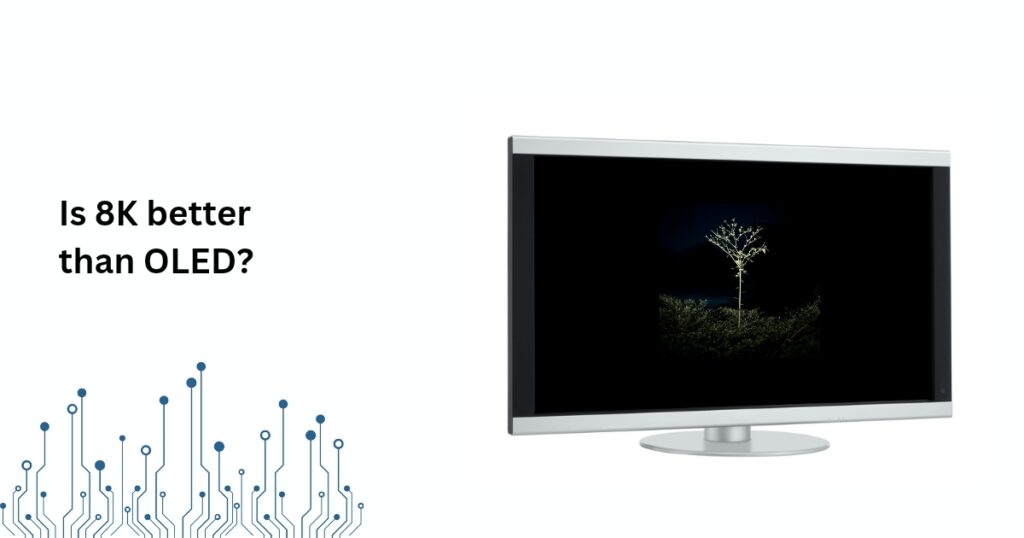
Many customers assume that 8K and OLED are competing technologies, but in reality, they are entirely different concepts that complement rather than compete with each other.
8K refers to a display’s resolution, while OLED is a display technology. Therefore, a more accurate comparison would be- “4K OLED vs 8K OLED” or “4K OLED vs 8K QLED“.
That said, we can still try to explore which one out of OLED and 8K generally offers a better viewing experience.
What is OLED?
OLED (Organic Light-Emitting Diode) is a display technology in which each pixel can turn on and off independently, allowing the display to achieve perfect blacks.
In dark scenes, pixels can completely switch off, resulting in absolutely no light emission from those areas.
This creates an almost infinite contrast ratio, making bright highlights appear vibrant and lifelike against dark backgrounds.
The exceptional contrast on OLED significantly enhances picture realism, depth, and overall image quality.
Even when watching HD content, an OLED TV can often deliver a superior viewing experience compared to an average 4K LCD TV with poor contrast.
This is because picture quality is influenced by much more than resolution alone.
If a display cannot clearly separate dark and black areas, the picture details will not appear as impactful, regardless of its resolution.
OLED’s ability to accurately distinguish bright highlights from dark regions plays a crucial role in displaying HDR content correctly.
Furthermore, OLED TVs offer exceptionally wide viewing angles thanks to their self-emissive technology, allowing you to enjoy consistent picture quality from virtually any position in the room.
Another major advantage of OLED displays is their significantly faster response times compared to any LCD, resulting in smoother and more fluid gaming.
4K OLED vs 8K LCD TVs
If you compare a 4K OLED TV such as the LG C2 with an 8K LCD TV, you may find the OLED produces a more realistic and immersive image despite having a lower resolution.
The primary reason is OLED’s near-infinite contrast ratio. OLED displays can reproduce images with greater accuracy and realism than conventional LCD panels, whether those LCDs are 4K or 8K.
While, many 8K TVs offer advantages such as higher peak brightness, advanced upscaling technologies, and come with mini-LED backlighting paired with VA LCD panels.
They achieve very good contrast through local dimming and help HDR highlights stand out, especially in bright rooms.
When watched with native 8K content, the viewing experience is ought to be exceptionally detailed, sharp and true to life on these TVs.
Even HD and 4K content often looks excellent on these 8K TVs, thanks to sophisticated upscaling.
However, in dark viewing environments, OLED still maintains a clear advantage.
Its perfect black levels reveal subtle shadow details more accurately and make high-contrast scenes appear significantly more realistic.
The state of 8K OLED TVs
Currently, there are virtually no 8K OLED TVs available on the market. The last notable model was the LG Z3, which has been discontinued as of now.
But, the Z3 represented what many considered the pinnacle of consumer television technology.
By combining OLED technology with 8K resolution, it featured over 33 million self-lit pixels capable of producing extraordinary picture quality.
It offered the widest viewing angles, the quickest pixel response times, exceptional brightness, and outstanding color volume.
However, the complexity of manufacturing and extremely high cost along with the scarcity of native 8K resolution content limited its commercial success.
Today, most 8K TVs are LCD-based models (many from Samsung) that use mini-LED backlighting and quantum dot technology, commonly marketed as 8K QLED TVs.
These TVs can outperform many standard 4K LCD TVs, but their premium pricing often makes them difficult to justify.
That said, many high-end 4K LCD TVs deliver picture quality that is remarkably close to that of 8K models.
Why premium 4K OLED TVs often make more sense
Modern premium 4K OLED TVs, especially advanced QD-OLED and MLA WOLED models, frequently outperform many 8K LCD TVs in overall picture quality.
These are highly bright OLED TVs and are much more difficult and costly to manufacture than LCD panels.
As a result, they come with a much higher price tag than most of the 4K TVs, which is often comparable to that of 8K TVs.
However, they largely justify their higher price with smoother motion handling, wider viewing angles, and superior picture quality compared to 8K LCD TVs.
The combination of high brightness and infinite contrast makes these OLEDs ideal for displaying HDR content accurately and vibrantly.
The bright highlights, deep blacks, and fine shadow details coexist naturally on them, creating an image that closely resembles real life.
Beware of marketing claims
Not all 8K TVs deliver outstanding picture quality.
Some manufacturers may market 8K resolution heavily while using IPS LCD panels that inherently struggle to produce deep blacks.
In dark scenes, these TVs tend to display blacks as grayish rather than truly black.
In such cases, a high-quality 4K OLED TV can provide a dramatically better viewing experience despite having a lower resolution than 8K.
The superior contrast, the widest viewing angles, and terrific HDR performance of OLED often outweigh the benefits of additional pixels.
What should you buy- 8K, 4K or OLED?
8K TVs, especially VA-panel LCD models equipped with quantum dots and mini-LED backlighting excel at producing bright, impactful highlights, making them particularly impressive in well-lit rooms.
When fed native 8K content, they truly showcase the potential of their resolution, by delivering stunning image quality with exceptional clarity and fine detail.
However, the substantial price premium of these TVs over high-quality 4K LCD models still remains difficult to justify.
In addition, top-tier 4K OLED TVs often rival or even outperform them in key aspects of picture quality.
So, for most buyers, a 4K TV, preferably an OLED, remains the more sensible choice, especially considering the abundance of readily available 4K content.
While purchasing an 8K TV may seem like a way to future-proof your setup, by the time 8K content becomes mainstream, advances in display technology could make today’s 8K models feel outdated.
That said, if owning the highest-resolution display currently available is a priority and the cost is not a concern for you, investing in a high-quality 8K TV is still a good choice.
FAQs
Here are some frequently asked questions (FAQs) about the 8K TVs.
1. How many pixels are there in an 8K TV?
An 8K TV has about 33 million pixels, which are about four times of the number of pixels present in a 4K TV and about 16 times of that in a Full HD TV.
2. How much internet speed is needed for 8K?
To stream 8K content smoothly, you’ll need an internet speed of around 50 Mbps, which is approximately double the speed required for streaming 4K content.
3. Which type of HDMI cable in used in the 8K TVs?
For 8K TVs, HDMI 2.1 cables are currently used to handle the approximately 50 Mbps bandwidth necessary for just smooth 8K content display.
However, as 8K technology progresses, it’s possible that new cables may be required as existing cables could become obsolete.
4. Which frame rate is supported by 8K TVs?
8K TVs generally support variable refresh rates and can display content at 8K@60fps or 4K@120fps.
This capability is important for both watching high-resolution movies and engaging in fast-paced gaming.
awesome
Thanks 👍