
What is WCG (wide color gamut) & color volume in a TV?
Why settle for ordinary colors? Unlock a world of richer, truer, more vibrant colors with wide color gamut.
As 4K TVs become more affordable, they’re not just offering higher resolution—they’re also delivering richer and more realistic colors.
Have you ever noticed two TVs displaying the same movie, yet one looks far more vibrant and lifelike?
Well, one of the main reasons of this is that one of them supports a wide color gamut, allowing it to reproduce a broader range of colors with greater accuracy and realism.
“Wide Color Gamut” or “WCG” is a term that’s often mentioned alongside HDR, but, is still quite different from it.
While HDR enhances brightness and contrast, WCG expands the range of colors a TV can display.
In this article, you’ll learn what wide color gamut is, how it works, and how does it matter for a TV.
Let’s get started.
What is wide color gamut (WCG) in TV?
Wide Color Gamut (WCG) is a capability of a display/a TV that allows it to reproduce a much wider range of colors than a standard TV.
This makes images appear more colorful, vibrant and natural, especially when watching HDR content like HDR movies or playing HDR games.
A display is considered to have a wide colour gamut when it can reproduce a broad range of colours and accurate shades.
This WCG capability is a property of the display itself and depends on the technologies and enhancements incorporated into the display panel.
Though, the term “WCG” is primarily used alongside HDR, it denotes a concept that is significantly distinct from, yet closely complementary to, HDR.
What does WCG do different from HDR?
HDR enhances an image’s dynamic range by adding more number of luminance levels to it.
This allows bright areas to appear brighter and dark areas to look deeper and richer.
This increased range of luminance levels ensures that objects and colors are displayed at perfect brightness.
WCG works towards making colors look more natural by producing more and deeper shades of colors. It makes the ‘reds’ redder, ‘blues’ bluer and ‘greens’ greener.
In essence, it improves the picture quality by displaying more and deeper colors.
What is the need of having WCG on TV?
You might be surprised to know that our eyes can see and distinguish millions of colors!!
Just look at the picture below of a parrot sitting on a tree branch. Can you guess how many different colors you can spot in it?

But, the real question is: How many colors can your TV show?
If your TV can’t reproduce as many colors as our eyes can naturally see, the picture won’t look as realistic as the world around us.
It’s that simple.
To create a more lifelike viewing experience, the display needs to reproduce a wider range of colors—and that’s exactly what a wide color gamut (WCG) is designed to do.
At this point, you might be thinking: why is it called a “color gamut”?
So, let’s first understand what this term actually means.
What is color gamut?
The word “gamut” means the entire range of something. Similarly, the color gamut of a device refers to the range of colors it can reproduce.
Each device, like a printer, scanner, camera or monitor, is designed to display a certain range of colors.
The color gamut of a TV can be defined as the range of colors it can display.
In other words, the total number of colors that can be displayed on a TV screen is called the color gamut of the TV.
Which TVs achieve a wide color gamut?
Not every TV marketed as “WCG” delivers the same level of colour performance.
Some models may support WCG only to a limited extent and may not cover a sufficiently large colour space.
Thus, it is always beneficial to check independent reviews rather than relying solely on marketing claims.
It is also equally important to note that viewing WCG content requires both a WCG-capable TV and a WCG-compatible source (such as a streaming service, Blu-ray player, or gaming console) that outputs WCG content.
That being said, some TVs which are generally capable of achieving WCG are:
- OLED TVs feature self-emissive pixels that produce highly accurate and vibrant colours. As a result, almost all OLED TVs are capable of reproducing a wide colour gamut (WCG).
- Quantum dot-enhanced TVs, such as Neo QLED, QNED, and other quantum dot-LCD TVs, also achieve a wide colour gamut. Quantum dots produce extremely pure monochromatic primary colours, enabling these TVs to reproduce a broader and more accurate range of colours.
- QD-OLED TVs, which combine OLED technology with quantum dots, deliver one of the widest colour gamuts presently available. They combine the perfect blacks and pixel-level control of OLED with the superior colour purity of quantum dots.
I’ll come back to wide color gamut again, but before that, let’s first understand what color volume is..
What is color volume in TV?
Color volume refers to the complete range of colors a display can reproduce across different brightness levels.
While color gamut describes the range of colors a display can produce, color volume goes a step further by showing how well those colors are maintained from the darkest shadows to the brightest highlights.
Let’s understand it in a simpler way.
The term “volume” refers to a three-dimensional space.
Similarly, color volume represents the total amount of color that exists within a 3D color space.
To understand this, let’s first recall the concept of color gamut.
Color gamut represents a 2D color space, showing the range of colors a display can reproduce.
However, it does not account for the brightness of those colors.
In real-world images, colors appear at different brightness levels.
For example, bright red, dark blue, and dull yellow are all colors with varying luminance.
Even the same shade of green looks very different at 500 nits than it does at 50 nits.
When brightness (or luminance) is added as a third dimension to the 2D color gamut, it forms a 3D color space, known as color volume.
So, you can think of it as simply adding a height dimension to the flat color gamut, transforming it into a three-dimensional representation of all colors at all brightness levels.
If two TVs have the same color gamut, the one with the higher peak brightness will generally have the larger color volume because it can reproduce those colors over a wider range of brightness levels.
What is the significance of color volume?
An image generally contains countless colors appearing at various brightness levels.
A display with a large color volume can reproduce each of those colors more faithfully at its intended brightness, preserving subtle details in both bright highlights and dark shadows.
This becomes especially important in HDR content, where images contain a much broader range of luminance levels.
A picture scene in HDR contains a wide range of colors appearing at different levels of brightness.
A TV with a large color volume can display each color of a scene at the specified brightness level to bring out even minute details.
Consequently, a high color volume allows the display to present HDR content as intended by the content creator, and thus, brings out the true essence of HDR.
The TVs having wide color gamut and high peak brightness have the highest color volume. Therefore, they display accurate and vibrant colors resulting in an extraordinary HDR performance.
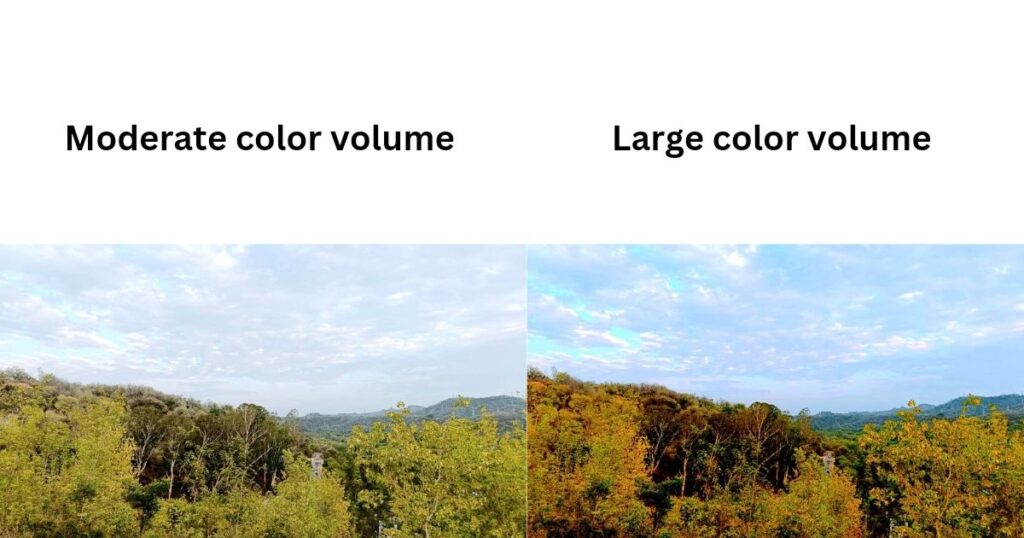
If you compare the above two images carefully, you’ll notice that the second image has richer, more saturated colors and brighter, better-defined highlights.
This is because every color is reproduced at its intended brightness level in it and with greater accuracy, whether it’s the sky, clouds, mountains, trees, or the road.
This is why choosing a TV with a wide color gamut and high peak brightness is so important, as these characteristics contribute to a larger color volume.
For the best viewing experience, it is recommended to invest in a true HDR TV that combines a wide color gamut with high brightness, which enables you to enjoy HDR content as it was intended to be seen.
Which displays feature higher color volume?
In essence, the color volume of a display is determined by three key factors:
- Color gamut: the range of colors the display can reproduce
- Contrast ratio: the difference between the darkest black and the brightest white
- Peak brightness: the maximum brightness the display can achieve
A display with high contrast and high peak brightness provides many more brightness levels between its darkest and brightest points.
When this is combined with a wide color gamut, the result is, obviously, a high color volume.
Displays such as QD-OLEDs, MLA OLEDs and tandem OLEDs which offer excellent contrast, high brightness, and a wide color gamut, are capable of delivering exceptionally large color volumes.
Bright highlights, such as the flame of a firecracker, the beak of a parrot, or the peak of a snow-covered mountain truly pop on these TVs.
Furthermore, LCD TVs that use VA panels, which offer high native contrast, together with mini-LED backlighting, which enhances contrast and enables higher peak brightness, are also capable of delivering amazing color volumes on the screen.
WCG vs sRGB vs DCI P3 vs Adobe RGB
The range of colors contained in a particular color gamut is represented as a specific percentage/area/region within the visible color spectrum, defined by the CIE 1931 color space.
The larger this region, or color gamut is, typically the more and better colors a TV can reproduce.
If you’d like to explore this topic in more detail, I’ve written a separate article about the major color gamuts available today, which you can check out here.
The article explains the major types of color gamuts based on the number of colors they contain along with the region of the CIE 1931 color space they occupy.
While sRGB and DCI-P3 are different types of color gamut standards, DCI-P3 offers a much wider range of colors.
That said,
There’s no single definition of a perfect wide color gamut — what qualifies as ‘wide’ depends entirely on the reference standard being used.
sRGB is restricted to an 8-bit color depth, which allows it to display approximately 16.7 million colors.
However, DCI-P3 supports 10-bit color, thus, is capable of reproducing up to 1.07 billion colors, about 64 times more than sRGB.
In addition to this significantly higher color count, DCI-P3 delivers richer and more vibrant shades in reds, blues, and greens, resulting in more realistic and visually appealing images.
Because of its broader and more saturated color reproduction, DCI-P3 can be considered a wide color gamut standard.
Similarly, Adobe RGB also provides a color range comparable to DCI-P3, though each of them performs better in different areas of color reproduction.
Both DCI-P3 and Adobe RGB can be classified as wide color gamuts due to their extensive color coverage.
In contrast, sRGB, with its narrower range and comparatively limited color depth, can be regarded as a more basic color gamut standard.
Which is the widest color gamut standard?
Rec. 2020 or BT.2020 is probably the widest color gamut till date, covering more than 75% of the CIE color space.
It includes almost all the colors that the human eye can perceive and distinguish. This makes it significantly wider than DCI-P3, which is currently the standard color gamut used in most high-end displays.
However, Rec. 2020 is not yet fully utilized by modern displays because it requires much higher color depth and content mastered specifically to take advantage of its full capabilities.
Most HDR content does not contain enough color information to benefit from such a wide gamut.
Therefore, Rec. 2020 can be considered a future-ready color standard. As advanced display technologies such as micro-LED and QDEL become more mainstream, they will be able to utilize much more of the potential offered by this expansive color gamut.
Is WCG in TV worth it?
Is WCG necessary to have better picture quality or is it just a marketing gimmick?
Sure, the improvement with WCG may not be as pronounced as it was when HDR was introduced.
But still, if you are a keen viewer, you will notice the difference when you compare two TVs, with and without WCG side by side.
In future, content creators may start using a very wide color space to craft content. Then, your TV will need to have a large color gamut like the Rec. 2020 to display the content to the fullest.
Otherwise, you may miss out on a significant color volume carried by the content if your TV has has a smaller color gamut like the sRGB or the Rec. 709.
So, why not make your TV future-proof with more and better colors?
FAQs
Here are some frequently asked questions about the wide color gamut.
1. Which is the best color gamut for gaming?
The best color gamut for gaming and watching movies, as per today’s scenario, is DCI-P3, which supports 10-bit color depth and displays deep, saturated and vibrant colors.
2. What is the difference between color gamut and color volume?
Color volume refers to a 3-D color space created by combining a dimension of luminance with a 2-D color gamut.
3. What is the difference between HDR and WCG?
HDR expands the dynamic range of the picture by introducing more contrast and color accuracy while wide color gamut introduces deeper, more vibrant and more number of colors in the picture.
Both HDR and WCG attempt to make the picture quality more realistic.
4. Is it possible to have a wide color gamut without HDR?
Yes, because HDR is related to contrast and the number of luminance levels while wide color gamut is related to the number and quality of colors.
However, WCG without HDR is not that worthwhile because, despite having a good number of colors, they may not be displayed at the required brightness levels, and thus, may not appear that realistic.