
How does HDR work on TV? HDR vs SDR vs Resolution Explained.
Once you know what HDR can do for your TV, you’ll stop worrying about the resolution.
You’re familiar with HD (high definition), but what does the new term with an added “R” mean?
Is it another kind of resolution, or something else entirely?
In this article, we’ll explore HDR—how it works and what it can do for your TV.
Let’s dive in quickly.
What is HDR?
HDR stands for ‘High Dynamic Range’ which means that it expands the dynamic range of the picture.
It enables the TV to display the content with greater contrast, with more highlights in the bright and dark areas and with better color accuracy.
It helps to display every single nuance of the scene and make the picture more vivid and realistic.
To understand HDR, we first need to understand what dynamic range is and how HDR enhances it.
What is Dynamic Range in context of HDR?
Dynamic range is related to the color, contrast and brightness of the image, which are the three most crucial factors for HDR.
These are the things that the salesman might not stress upon, and instead tell you about the other features like more pixels, theatrical sound, etc.
But, why I have mentioned the above factors, let me explain it in detail.
Factors on which HDR depends:
The factors I’m about to highlight are crucial not just for strong HDR performance, but for overall picture quality as well.
A TV that falls short in these areas will inevitably struggle to provide a satisfying viewing experience, regardless of any other features it may offer.
Let’s discuss them one by one.
1. Contrast Ratio
The contrast ratio is the ratio of the luminance of the brightest white to the darkest black a TV can produce.
The more this ratio, the more distinct the separation between the bright and dark areas.
You will feel it more if you compare two TVs, one with a poor contrast ratio and another with a high contrast ratio, side by side.
You would notice that the blacks in the former TV appear slightly washed out and not so dark. While, in the latter, they appear clear and distinct.
This clear distinction between light and dark areas makes it easier to see details in the dark shadows.
At the same time, bright highlights appear more vibrant and colorful.
For example, on OLEDs that can produce true blacks, details seem to be painted against a perfectly dark background.
2. Color Accuracy
We have three primary colors; red, blue and green. Using the combination of shades of these primary colors, a billion new colors can be generated.
A TV covers a certain area of the visible color spectrum, which can be ideally generated by using the combinations of different shades of RGB colors. This area is known as the color gamut of the TV.
WCG, or wide colour gamut is often linked with HDR in improving the overall picture quality of the TV. It introduces much more colors to the color palette.
The more accurate shades of color a TV displays, the more lively experience it delivers on the screen.
For instance, QD-OLED and premium Neo-QLED TVs achieve extremely accurate and high color volume by the use of quantum dots.
Moreover, QD-OLEDs have infinite contrast due to self emissive pixels, while Neo-QLEDs too achieve high contrast through advanced local dimming features.
This combination of high contrast and high color volume will enable it to deliver an excellent HDR performance on the screen.
3. Peak Brightness
Brightness is one of the most underrated capabilities of a TV that greatly affects its HDR performance.
A TV with high peak brightness can produce brighter highlights, resulting in a more vivid and impactful picture.
It can also have a wider range of luminance levels between the darkest and brightest parts of an image, allowing every color tone to appear at its intended brightness.
In contrast, a TV with lower brightness cannot reproduce highlights beyond a certain limit and may struggle to clearly distinguish between bright and muted colors.
Therefore, always try to choose a TV with high peak brightness for better detail separation and for presenting content close to the way the creator intended.
Having understood how contrast, color accuracy and peak brightness influence HDR, let’s see how HDR actually works on TV.
How does HDR work on TV?
High Dynamic Range, as the name implies, expands the dynamic range of the picture, i.e., widens the range of the color, contrast and brightness of a TV.
What HDR actually does is introduce a wider range of luminance, or brightness levels, between the darkest and brightest images a TV can display.
In other words, it expands the TV’s overall brightness range. TVs with higher brightness capabilities can obviously reproduce more luminance levels with greater precision.
But how does this improve contrast and color? Well, first, HDR separates image details more effectively by displaying each element at its appropriate brightness level.
Bright highlights are shown at full intensity, making complete use of the TV’s peak brightness.
This clear distinction between bright and dark areas, along with the preservation of subtle details, significantly enhances contrast and adds a greater sense of realism to the picture.
Next, HDR improves the color profile by displaying each color shade such as pale blue, muted yellow, and bright red at nearly accurate brightness levels.
As a result, colors too appear more distinct, natural, and lifelike, making the overall picture feel closer to reality.
What does 4K HDR TV mean? Is it different from a 4K UHD TV?
A 4K Ultra HD TV refers to the 4K resolution which means the TV has 3840×2160 pixels.
A 4K HDR-labelled TV means that the TV has 4K resolution and also, it can display 4K HDR content.
You will find many a range of TVs available in different budget options labelled ‘4K HDR’.
However, not all HDR-labelled TVs are true HDR TVs.
If you compare a cheap 4K TV with an expensive one with the same HDR label, you will notice a tremendous difference in their HDR performance.
For a good HDR performance, high peak brightness, high color accuracy, as well as high contrast ratio, is a must for a TV.
The high contrast ratio combined with high peak brightness helps in the clear distinction of different areas within the scene by making the bright areas even brighter and dark areas even darker.
The color accuracy, on the other hand, makes the reds, blues and greens deeper and brighter, thus bringing out great details on the screen.
Premium 4K TVs generally have high contrast and a high color volume. Therefore, they can perform very well in HDR.
For example, premium Neo-QLED and QD-OLED TVs with huge color volumes and fantastic peak brightnesses provide the best HDR experiences.
That said, these are all true only if the source is also delivering HDR content.
Only the TV can’t do it without HDR content
An HDR-compatible TV alone can’t deliver a true HDR performance until and unless it plays HDR content.
Thus, in addition to the TV supporting HDR, the source must also deliver HDR content.
And the good news is: nowadays, HDR content is widely available.
You can find HDR content on many streaming platforms like Netflix and Amazon along with the Ultra HD Blu-rays.
In addition, the Playstations and Xbox games also stream HDR content.
The metadata is a set of instructions sent by the source delivering the HDR content.
It tells the TV to display the required brightness levels and colors in various parts of the scene accurately.
Based on this information, HDR adjusts the brightness levels of various colors depending on which part of the image should appear bright and which one should be dimmer.
Without metadata, the TV cannot accurately determine which areas of a scene should appear brighter or darker.
In visually rich elements such as clouds, explosions, fire, and sunsets, HDR metadata guides the TV to fully utilize its brightness and contrast capabilities, making every scene look more vibrant and lifelike.
The colors are carefully chosen by content creators to match the intended mood, and the TV uses a process called HDR tone mapping to reproduce those colors faithfully on the screen.
Thus, watching HDR content on a true HDR-compatible TV, having high peak brightness and high contrast ratio will give you a true HDR experience.
SDR vs HDR
The main difference between SDR (Standard Dynamic Range) and HDR arises based on the number of brightness levels and colors.
While SDR can display a limited number of brightness levels in an image, HDR can display more number of brightness levels in the same image, thus providing more life and depth to the image.
For example, if you can see 5 brightness levels say, 3 nits, 30 nits, 40 nits, 75 nits and 95 nits in an SDR image, then you may see more than 10 brightness levels in the same image when it is mastered in HDR.
For example, 0.5 nits, 2 nits, 3 nits, 30 nits, ……, 95 nits, 150 nits,….., and 400 nits.
HDR, thus clearly distinguishes the colors and brightness levels as required in different areas of the scene. This causes the highlights to pop and makes the scene more realistic.
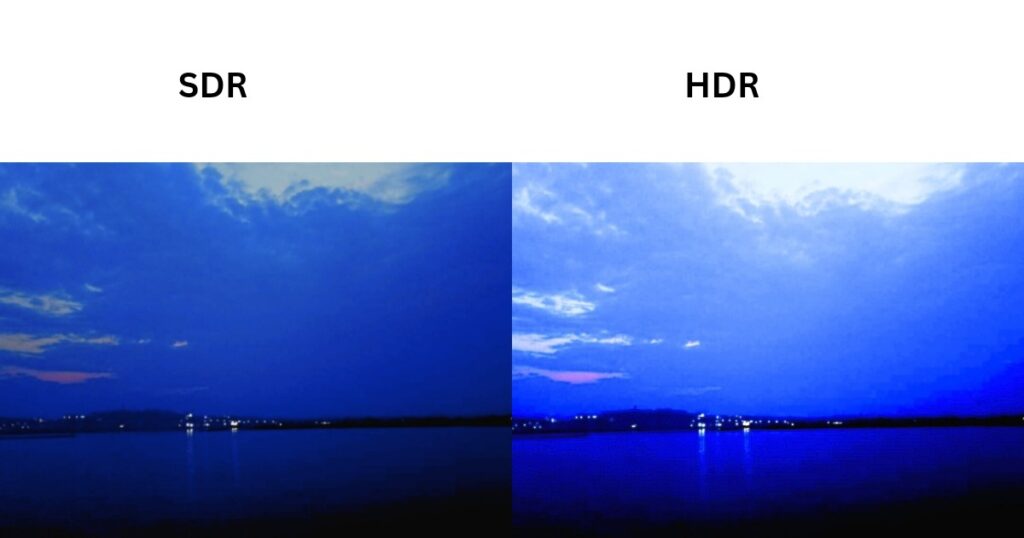
In the above SDR image, you may notice that there is not a large difference in brightness between the bright and the dark areas. Moreover, the blacks appear slightly washed out.
But, in the above HDR image, the skies are as bright as or very close to how much they should be in reality.
The blacks are amazing as well and the clouds appear distinctly highlighted in the sky.
There are many more brightness levels in HDR with a greater peak brightness in comparison to SDR.
The color tones are better saturated, and each color is shown at the correct brightness as it should be.
These features of HDR bring the image much closer to reality.
HDR vs Resolution
Resolution refers to the number of pixels an image contains.
A higher resolution means more pixels, which results in a sharper and clearer image.
E.g., a 4K TV produces a much sharper picture than a lower-resolution TV because it can display finer details.
On the other hand, HDR focuses on improving the contrast, brightness, and color accuracy of an image.
It enhances highlights, makes colors appear more vibrant and natural, and reveals more detail in dark shadow areas.
HDR allows a display to show colors and brightness levels closer to real life.
A TV with higher resolution can create a sharper image, while a TV with HDR can display more realistic lighting, contrast, and colors.
For instance, a true HDR 4K TV with high peak brightness, strong contrast levels, and a wide color gamut can deliver significantly better picture quality than a TV with even 8K resolution, but with poor contrast and weak HDR support.
In short, resolution improves sharpness, whereas HDR enhances realism and visual depth of the scene.
That said, when both these elements of picture quality come together seamlessly, they create magic on the screen!!
HDR vs 4K vs OLED vs Quantum Dots
4K refers to a TV resolution of 3840 × 2160 pixels, which means the screen contains 3,840 horizontal pixels and 2,160 vertical pixels for sharper and more detailed visuals.
OLED is a display technology that uses self-lighting organic pixels, enabling the TV to produce perfect blacks and excellent contrast.
Quantum Dot technology enhances color reproduction, allowing TVs to display a much wider and more vibrant color gamut.
While, HDR (High Dynamic Range) improves picture quality by increasing the range of brightness, contrast, and colors.
That being said, when all these technologies are combined in a 4K QD-OLED TV, where OLED panels are enhanced with quantum dots, the result is a terrific HDR performance with true blacks, brilliant colors, and eye-popping highlights.