
MLA vs WOLED: What is Micro-Lens Array and how does it work?
MLA (Micro Lens Array) is an optical layer added to certain WOLED panels to improve light extraction and increase brightness.
Tiny lenses redirect light that would otherwise be trapped inside the panel, allowing more of the OLED’s generated light to reach the viewer.
In simple terms, MLA makes a WOLED panel brighter and more efficient without changing OLED’s self-emissive pixel structure.
Traditional LG OLED TVs, often referred to as WOLEDs, generally fall short in brightness compared to even many lower-cost LED models.
To overcome this limitation, Samsung started manufacturing quantum dot panels, which are incorporated in their QD-OLED TVs.
These QD panels are also used by Sony which adds its own advanced processing and upscaling features on top of them.
These QD-OLEDs outperform conventional WOLEDs in many areas such as color gamut, color volume, brightness, and HDR performance.
In response to that, LG has introduced MLA (Micro Lens Array) technology to boost the brightness of its WOLEDs and keep them competitive.
MLA is not a type of OLED panel.
WOLED describes the underlying OLED panel architecture, while MLA describes an optical layer used to improve light extraction from some WOLED panels.
Therefore, an MLA OLED is still a WOLED—it simply uses a Micro Lens Array to extract more of the light generated by the OLED panel.
WOLED → underlying OLED architecture
MLA → optical light-extraction technology
| Conventional WOLED | MLA WOLED | |
|---|---|---|
| OLED structure | WOLED | WOLED + MLA |
| Micro lenses | No | Yes |
| Light extraction | Lower | Higher |
| Brightness potential | Lower | Higher |
| Black levels | Pixel-level | Pixel-level |
| Local dimming | No | No |
| Backlight | No | No |
Why the need for MLA tech?
In a conventional WOLED panel, some of the light produced by the OLED layers can become trapped inside the panel because of internal reflection.
This limits how much of the generated light reaches the viewer.
MLA (Micro Lens Array) addresses this by using billions of tiny lenses to redirect more of the trapped light outward.
This improves light-extraction efficiency, allowing the panel to achieve higher brightness without fundamentally changing its WOLED pixel structure.
In simple terms, conventional WOLED loses some generated light inside the panel, while MLA helps redirect more of that light toward your eyes.
How conventional WOLED and MLA work
To understand the difference between MLA and conventional WOLED, it helps to first understand how a WOLED TV produces light.
How conventional WOLED produces light
WOLED panels use self-emissive OLED layers to produce light, with each pixel typically consisting of red, green, blue, and white (RGBW) subpixels.
Unlike traditional LCD TVs, each pixel can control its own light output and turn completely off to produce deep blacks.
In a conventional WOLED panel, light generated by the OLED layers passes through several parts of the display before reaching your eyes.
During this process, some of the light is lost because it can be reflected, absorbed or trapped inside the panel.
This limits how much of the light produced by the OLED layers actually reaches the viewer.
How MLA improves light extraction
MLA, or Micro-Lens Array, is designed to reduce these optical losses.
It uses millions of tiny lenses placed within the OLED panel which redirect more of the light toward the viewer instead of allowing it to become trapped inside the display.
Think of it like adding a layer of microscopic lenses that helps guide light out of the panel more efficiently.
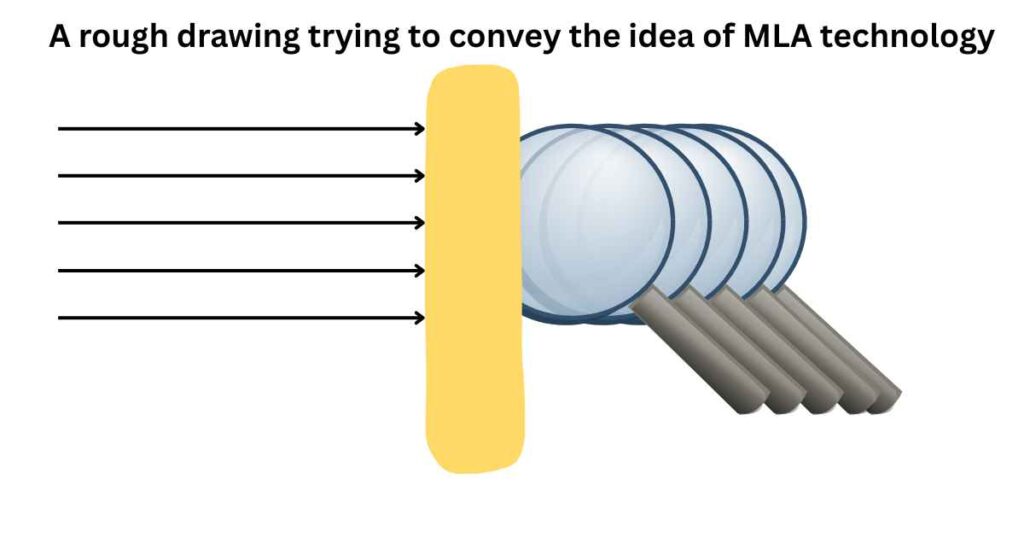
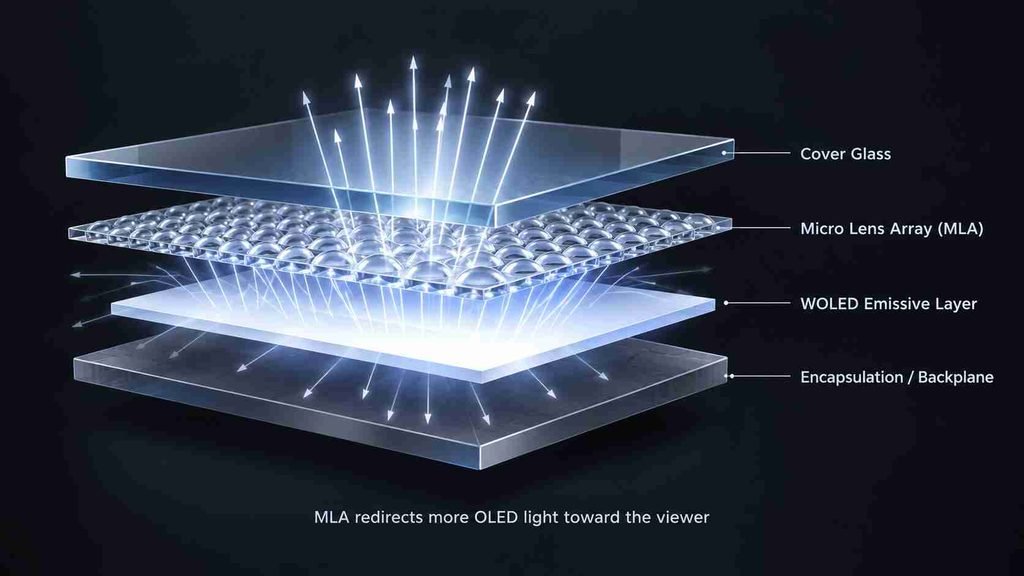
As a result, an MLA-equipped WOLED panel can produce higher brightness from the same basic WOLED technology, particularly in bright HDR highlights.
The improved light extraction can also make the panel more efficient because less of the generated light is wasted inside the display.
The important point here is that MLA does not replace WOLED or change the basic way OLED pixels work.
It is actually an additional optical layer that helps a WOLED panel make better use of the light it already produces.
Conventional WOLED: produces light → some light is lost inside the panel → the remaining light reaches your eyes.
MLA WOLED: produces light → microscopic lenses redirect more of that light toward you → higher light output and improved efficiency.
In addition, MLA improves brightness mainly through better light extraction rather than simply driving the OLED pixels harder.
This can allow a WOLED panel to produce more visible light without requiring a proportional increase in pixel output.
MLA vs WOLED
Contrast & Blacks
Both MLA OLED and conventional WOLED use self-emissive pixels, so neither requires a backlight.
Individual pixels can turn completely off, producing true black and extremely high contrast.
MLA does not fundamentally change this characteristic; as its main purpose is to improve how efficiently the OLED panel produces light.
Thus, when viewed in a dark-room, both can deliver the deep blacks, strong shadow detail and pixel-level contrast that OLED is known for.
In bright rooms, however, MLA can improve perceived contrast by delivering higher brightness than conventional WOLED.
Brightness & HDR
According to a research, MLA uses approximately 5,117 microlenses per pixel, increasing OLED brightness by around 60% while improving viewing angles by approximately 30%.
As a result, an MLA-based OLED can produce brighter highlights and a more impactful HDR image than a comparable conventional WOLED panel.
This can be especially noticeable in scenes containing sunlight, fire, reflections, bright skies and other small HDR highlights.

Thus, you will notice that MLA is most useful when HDR highlights need extra punch or when you watch OLED in a brighter room.
MLA’s higher peak brightness can also better overcome ambient light in bright rooms.
Though reflections can still be visible on either panel, depending on the TV’s screen coating (matte or glossy), MLA’s extra brightness helps maintain a punchier HDR image when direct sunlight or room lighting is present.
Color Gamut & Accuracy
Conventional WOLEDs use a white subpixel to boost brightness, but at high luminance this can reduce the saturation of highly chromatic and bright colors.
However, MLA improves light extraction across the panel, allowing its RGB subpixels to produce higher luminance as well.
MLA improves light output from both the RGB and white subpixels.
This allows MLA WOLED TVs to produce brighter and more saturated colors than conventional WOLED at higher brightness levels.
In a study, measurements of the LG G3 also showed higher RGB brightness than the non-MLA C3 above around 500 nits.
As a result, MLA WOLEDs can deliver brighter, more saturated colors and stronger color volume at high brightness.
Its advantage is most clearly visible in bright HDR content, such as snowy mountain landscapes, sunlit clouds and reflective surfaces.
Its improved light extraction produces higher brightness, making whites appear more brilliant while helping colorful elements such as blue skies and green landscapes retain their intensity.
This results in producing more impactful HDR images while preserving OLED’s deep blacks simultaneously.
Power Efficiency & Lifespan
MLA improves the efficiency of WOLED panels by directing more of the light generated by the OLED pixels toward the viewer, reducing light loss inside the panel.
This allows MLA TVs to achieve higher brightness without relying solely on increased pixel drive, which can also help with power use and heat management.
Both MLA and conventional WOLED are still OLED technologies, so they share the same long-term consideration of pixel wear and burn-in.
MLA does not eliminate burn-in, but its greater light efficiency can help achieve higher brightness without simply pushing the OLED pixels harder.
For most users, modern OLED TVs are designed with various protections to reduce uneven pixel wear, although prolonged exposure to static elements can still create a risk over time.
How does MLA WOLED stack up against other OLED and LCD displays?
MLA-based OLED TVs, such as the LG G3 and G4, compete closely with Samsung and Sony’s QD-OLED TVs in brightness and can also rival many high-end Mini-LED LCDs, although the brightest LCD TVs can still exceed the brightest OLEDs.
The best mini-LED models can compete directly with MLA WOLED and QD-OLED, with flagship Neo QLED TVs often delivering higher color volume and slightly higher HDR and SDR brightness than MLA WOLED.
Nevertheless, MLA WOLED offers excellent brightness and color volume and generally outperforms standard QLED and QNED models, leaving high-end Neo QLED and QD-OLED as its closest rivals.
When comparing to QD-OLED, both have self-emissive pixels, which maintain deep, inky blacks in virtually any lighting condition, while QD-OLED blacks can appear somewhat elevated in very bright environments.
Moreover, the extremely wide viewing angles and lack of blooming in MLA as an OLED remain advantages over LCD-based Neo QLED and QNED displays.
MLA’s strong reflection handling also helps preserve HDR impact in well-lit rooms, while the WOLED design’s dedicated white subpixel allows it to produce exceptionally bright, clean whites.
Overall, MLA WOLED combines OLED’s pixel-level black control and wide viewing angles with substantially improved brightness, making it a direct competitor to the best OLED and mini-LED TVs rather than simply a brighter version of conventional WOLED.
FAQs
1. Is MLA OLED better for HDR?
Generally, yes. MLA’s higher light output makes bright HDR highlights such as sunlight, snowy landscapes, clouds, and reflections look more vivid and impactful.
2. Is MLA better than WOLED for gaming?
MLA can provide a more impactful gaming image through higher brightness, while both retain OLED’s near-instant response times, low input lag, and excellent contrast.
3. Does MLA make WOLED brighter?
Yes. MLA uses a Micro Lens Array to redirect more of the OLED panel’s light toward the viewer, significantly increasing brightness compared with conventional WOLED.
4. Does MLA reduce OLED burn-in?
MLA does not eliminate OLED burn-in because it does not change the underlying organic emissive technology. Burn-in risk depends more on usage patterns, panel design, and protective technologies.
5. Is MLA better than mini-LED?
MLA OLED offers pixel-level contrast and no backlight blooming, while mini-LED LCDs can achieve higher peak brightness and avoid OLED burn-in.