
What is contrast and what magic does it create on a TV?
Contrast: the unsung hero of picture quality. Bright room? Not that big deal. Dark room? Game changer!!
Search for any old TV, preferably older than 15 years, in your house or your neighbour’s house.
Watch something on it and compare it with your new flagship TV.
You will likely notice that the blacks in the dark scenes in the new TV appear much better than in the older one.
Now, this raises a question: what to do with the blacks?
Well, the deeper the blacks are, typically the better is the picture quality on a TV.
In fact, the difference between the deepest black and the brightest white somewhat lays the foundation of the panel quality.
The bigger is this difference, the better is the contrast on a TV.
So, what is contrast and what does it mean on a TV?
And what does it do? Let’s understand.
What does contrast/contrast ratio mean on a TV?
Contrast ratio of a TV is defined as the ratio of the brightness of the whitest white to that of the darkest black which it can display.
For example, if a TV has a contrast ratio of 1000:1, it means that the brightest image on the TV can be 1000 times brighter than the darkest image on it.
The larger this difference is, the clearer is distinction between the brightness of different areas in an image.
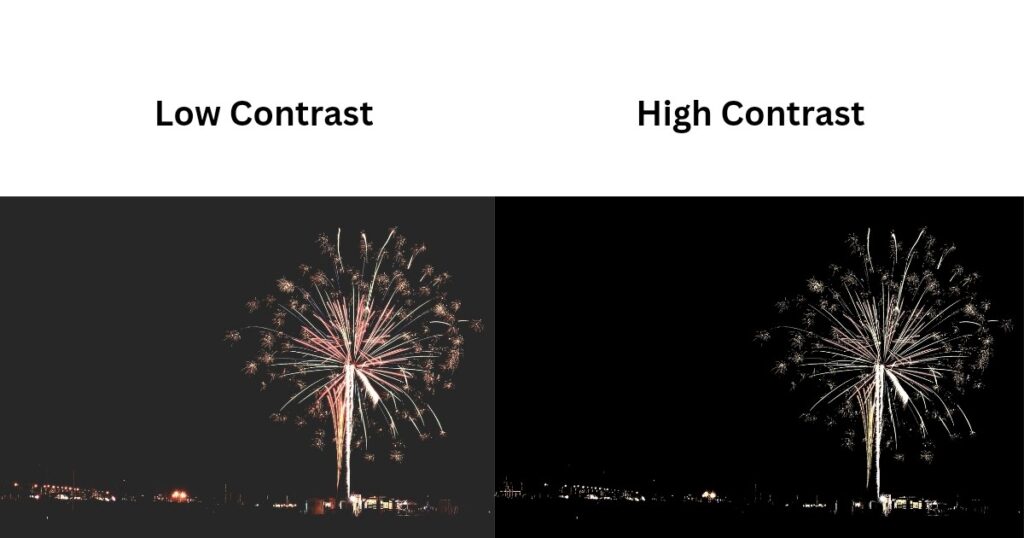
Let us take a look at a night scene from two TVs, one having a low contrast and another having a high contrast.
In the image with low contrast, the black night sky appears slightly greyish.
Moreover, the bright highlights, such as light of the firecracker, don’t appear as bright as they should be.
This is because, there is not much difference between the brightness of the bright and dark areas of the screen.
However, in the image on the right side with higher contrast, there is a clear distinction between the bright and dark areas of the image.
The road lights as well as light of the firecracker are as bright as they should be.
These bright details appear distinctly highlighted in the dark black sky.
Thus, by comparing the above two pictures, we can see how a better contrast increases the life of an image and makes it more realistic.
How do brightness capabilities of a TV affect its contrast?
As discussed above, the contrast ratio of a display is calculated by comparing its peak brightness to the darkest black level achievable by the display.
In an OLED TV, in dark scenes, pixels emit no light at all, resulting in a black level that effectively has zero brightness.
Because of this, OLED displays are considered to have a theoretically infinite contrast ratio, and are recognized for their exceptionally deep black levels.
On the other hand, LED backlit LCD TVs always experience some degree of light leakage, producing measurable black levels and therefore finite contrast ratios.
For example, a TV with a peak brightness of 2,000 nits and a black level of 5 nits has a contrast ratio of 400:1, while another one with a comparatively lower peak brightness of 1,200 nits but a much darker black level of 0.5 nits achieves a contrast ratio of 2,400:1.
Thus, although the second TV is less bright, its significantly darker blacks allow it to deliver a much higher contrast ratio.
This demonstrates that the contrast ratio depends not only on maximum brightness but also on the minimum black level a display can achieve, representing the overall range of luminance available to the screen.
In addition to brightness and contrast, there is another crucial factor affecting picture quality, which we will be discussing in the upcoming section.
Does HDR enhance contrast?
High Dynamic Range (HDR) is a technology which expands the range between the brightest and darkest parts of an image, allowing bright elements to appear more intense while preserving detail in darker regions.
HDR may not directly improve a television’s native contrast ratio, but it can greatly enhance perceived contrast, making images appear more vibrant, realistic, and visually impactful.
Bright highlights become more striking and lifelike compared with Standard Dynamic Range (SDR) content.
When displaying HDR material, a true HDR-capable TV can render elements such as sunlight, reflections, and explosions at much higher brightness levels.
That being said, the effectiveness of HDR depends heavily on the display’s native contrast ratio.
For instance, a television capable of producing extremely deep blacks, such as an OLED, can deliver outstanding HDR results even if its peak brightness is relatively modest.
Bright highlights stand out more dramatically against a perfectly black background, creating a stronger sense of depth and realism.
Native vs dynamic contrast : What is more important?
Native contrast and dynamic contrast are often confused, but they represent fundamentally different characteristics of a display.
Native contrast is an inherent property of the panel itself and reflects its ability to produce bright whites and deep blacks without relying on software or hardware manipulation.
A display with high native contrast can simultaneously reproduce bright highlights and dark shadow details while preserving subtle detail in both areas, resulting in a more natural and realistic image.
Dynamic contrast, on the other hand, is a processing technique designed to compensate for lower native contrast.
It works by adjusting the TV’s backlight intensity in accordance with the content being displayed.
During dark scenes, it may cause the TV to dim the backlight to make black areas appear darker, while during bright scenes it may increase backlight intensity to enhance overall brightness.
Although this can create the impression of improved contrast, it often introduces compromises.
Dimming the backlight may reduce the brightness of small highlights such as stars in the night sky, while increasing brightness can cause subtle details like clouds during a sunrise scene to be lost through overexposure.
A display with high native contrast, however, does not require such adjustments and can present bright highlights and dark backgrounds simultaneously without sacrificing detail.
Therefore, native contrast is generally considered a more reliable indicator of picture quality than dynamic contrast.
Can the native contrast of a display be enhanced?
Self-emissive display technologies such as OLEDs and micro-LEDs offer a virtually infinite native contrast ratio because each pixel can generate its own light and switch off completely when displaying black.
As a result, their contrast cannot be essentially improved further.
On the contrary, LCD displays rely on an LED backlight rather than having self-emissive pixels, which limits their native contrast capabilities.
That said, their contrast can be significantly enhanced through improvements in backlight design.
One of the most effective methods involves the use of mini-LED backlighting, where thousands of tiny LEDs are organized into a number of independently controlled dimming zones.
This technology, known as local dimming, allows specific areas of the backlight to brighten or dim according to the content being displayed.
Dark regions trigger the corresponding zones to reduce or completely shut off their illumination, producing deeper blacks, while bright areas receive maximum illumination, making highlights appear more vivid and impactful.
Because of this precise backlight control, local dimming can dramatically improve the native contrast of LED TVs.
That being said, TVs equipped with Full-Array Local Dimming (FALD), where LEDs are distributed across the entire back panel, have better implementation of local dimming, and thus, achieve superior contrast compared to edge-lit displays, which place LEDs only along the screen’s borders.
Moreover, panel type also plays an important role, as VA panels naturally provide higher native contrast than IPS panels.
Thus, mini-LED TVs that use VA panels, such as the Neo-QLEDs deliver deeper blacks and stronger contrast than IPS-based alternatives, like the QNED TVs.
Although high-end VA mini-LED displays can approach OLED-like black levels, they may still exhibit minor blooming, a phenomenon in which light from illuminated zones slightly spills into adjacent dark areas.
Nevertheless, blooming is usually well controlled in premium FALD mini-LED TVs. OLED displays remain the benchmark for contrast performance, as their self-emissive pixels eliminate blooming entirely and allow for the reproduction of perfectly deep blacks.
These conclusions being mostly true, the contrast we perceive while watching a TV is not always its native contrast ratio.
Several other factors too influence our viewing experience, as we will explore next.
Perceived contrast is not always the true contrast.
The contrast which we experience on a display is influenced not only by the display itself but also by the viewing environment.
To experience a TV’s true native contrast, it should ideally be viewed in a dark or dimly lit room.
In brighter environments, however, ambient light raises the perceived black level of the screen, causing blacks to appear lighter and thus, reduces the apparent contrast ratio.
The screen’s surface finish also plays an important role in perceived contrast.
Many QLED and some QD-OLED displays (like the S95F OLED) use matte or semi-matte coatings that diffuse reflected light, reducing visible reflections.
However, these coatings can also scatter ambient light across the screen, causing black areas to appear slightly gray and lowering perceived contrast.
On the other hand, glossy coatings generally preserve deeper blacks and higher perceived contrast because they scatter less ambient light, although they are more susceptible to direct reflections from open windows, lamps, and other bright objects in the room.
In brightly lit environments, even a TV with excellent native contrast may not appear significantly better than a lower-contrast display, as the ambient light raises the apparent black level of all screens.
As a result, the difference between an OLED and a high-quality VA LCD panel can become less noticeable under such conditions.
For the best viewing experience, you should ideally view a TV in a dark or dimly lit room, or select a TV with effective anti-reflective coatings if it has to be primarily viewed in bright environments.
Which TVs have the best contrast ratio?
The OLED TVs have the best contrast ratio and thus, mostly rule in picture quality.
They produce the best blacks, thanks to their self-emissive pixels. These pixels turn themselves completely off during a night scene or a dark scene, producing pure blacks on the screen.
Next to them are the best LED TVs with good local dimming, which too produce nice, deep blacks.
Although those blacks are not matchable to what you get on OLEDs due to the absence of pixel-level light control, they still are good to view.
Moreover, their peak brightness is greatly enhanced due to a number of tiny LEDs in the backlight, what we see in the premium QLED TVs.
The more is the peak brightness, typically the better is the contrast ratio. Moreover, the purer are the blacks, typically the better is the contrast ratio.
Note: Most of the hype is created around the resolution of the TV. But believe me, if you put even an HD OLED TV side by side with a 4K LED TV with good local dimming, you will prefer to buy the OLED TV almost everytime due to its phenomenal native contrast, which results into delivering more lifelike picture quality.
Due to this, some of the best 4K OLED TVs are able to beat many 8K TVs in HDR performance, despite having lower resolution.