
QNED vs NanoCell: What’s the difference? which one to buy?

If you’re shopping for an LG TV, you’ve probably come across the terms NanoCell and QNED.
Both are LCD-based TV technologies, but they occupy different positions in LG’s lineup and can offer noticeably different levels of picture quality.
Both QNED and NanoCell TVs belong to LG’s LCD TV range. NanoCell TVs are enhanced LED models that use a nanoparticles layer to improve color accuracy. QNED is a higher-tier LG LCD family that has used combinations of technologies including quantum dots, NanoCell-related color technology and, on certain models, mini-LED backlighting.
Not every QNED is mini-LED. QNED performance varies substantially by model, especially in contrast, local dimming, brightness and black levels.
NanoCell models are generally positioned below QNED in LG’s LCD range and are generally positioned as a more affordable alternative.
But does paying more for a QNED TV always make sense? And how much difference will you actually notice in everyday viewing?
In this guide, we’ll compare QNED and NanoCell TVs across contrast, brightness, color accuracy, pricing, and other important picture quality parameters to help you decide which TV you should consider buying.
Affiliate Disclosure: DisplayReviewz participates in the Amazon Associates Program. As an Amazon Associate I earn from qualifying purchases. If you buy a product through affiliate links in this article, we may earn a commission at no additional cost to you.
Quick Verdict: QNED vs NanoCell
QNED generally offers a more advanced picture than NanoCell, particularly when comparing a mini-LED QNED model with a conventional NanoCell TV. QNED models can provide higher brightness, better HDR performance, stronger contrast and more effective local dimming. However, a basic QNED without mini-LED can have a smaller advantage over a good NanoCell than a premium mini-LED QNED. NanoCell’s main advantages are its wider viewing angles on many IPS-based models and generally lower price.
If you want the brightest and most vibrant OLED, which is great for gaming and bright living rooms, the Samsung S95F OLED TV is just for you.


What is a NanoCell TV? Is it worth the money?
A NanoCell TV is an LCD TV technology/branding from LG that uses a special layer of nano-sized particles to filter out dull or impure color tones to reproduce cleaner, more accurate, and vibrant colors on the screen.
Though the colors are not as accurate as a good mini-LED or an OLED TV, they are still good for watching colorful scenes comfortably.
- NanoCell: generally simpler LCD backlighting
- QNED: generally more advanced LCD technology
- Higher-end QNED models: may add mini-LED and sophisticated local dimming
NanoCell primarily improves color reproduction, while mini-LED primarily improves backlight control and contrast.
What is a QNED TV? Is it better than a NanoCell?

QNED is LG’s higher-tier LCD TV branding, combining different display technologies depending on the model.
Depending on the model and generation, QNED TVs use LG’s QNED color technology, with some earlier models incorporating Quantum Dot technology, while newer QNED evo models use Dynamic QNED Color.
When struck by the backlight, quantum dots emit pure, highly accurate colors based on their size.
Meanwhile, the NanoCell layer filters out dull or impure tones, enhancing overall color purity.
This powerful combination enables QNED TVs to typically achieve a wide color gamut resulting in vivid, lifelike visuals.
Some higher-end QNED models use mini-LED backlighting with numerous independently controlled local dimming zones.
This gives the TV substantially better control over bright and dark areas than a conventional edge-lit or less sophisticated LCD.
Because features vary by model and region, it is important to check the specifications of the individual QNED TV rather than assuming every QNED model uses the same technology.
Explore some of the best Mini LED QNED TVs on Amazon and compare available models, picture quality, brightness, and smart features to find the right TV for your home.
Which one has a better picture quality: QNED or NanoCell?
QNED generally represents a more advanced LCD platform than NanoCell, particularly on models that combine mini-LED backlighting with quantum-dot and NanoCell color technologies.
Mini-LED allows much more precise control of the backlight through a larger number of local-dimming zones.
This can produce deeper blacks, higher contrast and better HDR performance than conventional NanoCell models.
NanoCell TVs, by comparison, primarily rely on LG’s nanoparticle-based color technology combined with an LED/LCD backlight.
Their picture can still look vibrant and accurate, but conventional models generally have less sophisticated backlight control.
As a result, dark scenes can appear more gray than black, particularly in a dark room.
However, don’t assume as a rule of thumb that every QNED is automatically superior to every NanoCell.
As said before, the picture quality on QNED TVs varies considerably depending on the actual panel, backlight, local-dimming system and processing.
What are the differences between LG NanoCell and QNED?
Let’s summarise the differences quickly.
| Feature | QNED | NanoCell |
|---|---|---|
| Display type | LCD | LCD |
| Quantum-dot technology | Model-dependent | Generally no |
| Mini-LED | Model-dependent | Generally no |
| Brightness | Generally higher on higher-end models | Generally lower |
| Contrast | Model-dependent | Generally lower |
| Black levels | Better on mini-LED/local-dimming models | More limited |
| Viewing angles | Depends on panel | Often good on IPS models |
| HDR | Better on higher-end QNED models | More limited |
| Gaming | Model-dependent | Model-dependent |
| Price | Usually higher | Usually more affordable |
Now, let’s talk about the main differences one by one.
Contrast & Blacks
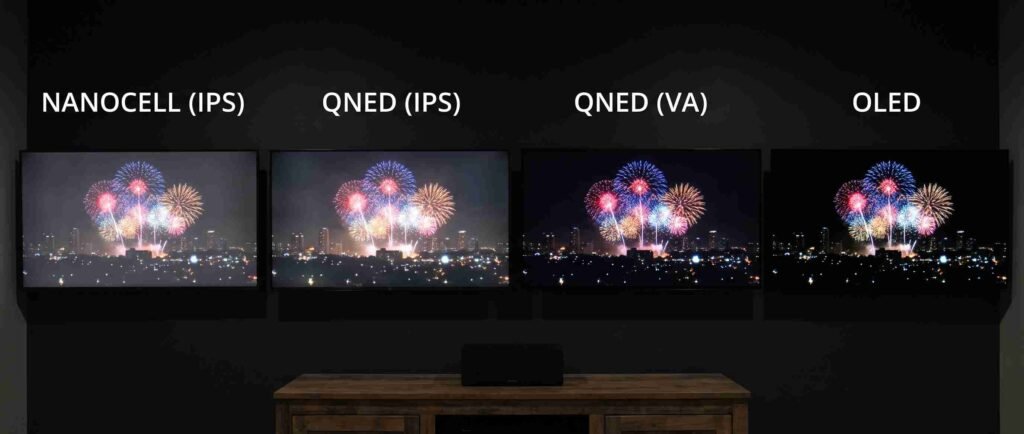
QNED TVs which use mini-LED backlighting usually beat NanoCell TVs in contrast because they have numerous local dimming zones.
However, some cheaper QNED models may still have just average contrast, even with mini-LED backlighting.
The main reason is that most QNEDs and NanoCells use IPS panels, which have much lower native contrast compared to VA panels.
Mini-LED helps improve that, but since the native contrast itself is weak, blacks still don’t look very deep.
Thus, in dark scenes, blacks may appear grey rather than truly black
Higher-end QNEDs do handle local dimming better, so they do look noticeably better than NanoCells and budget QNEDs.
Still, even the best IPS-based QNEDs can’t match the deep blacks of mini-LED VA TVs like Samsung’s Neo QLEDs.
That said, some QNED TVs are now coming with VA panels too, which helps them achieve high contrast.
And of course, OLEDs are on a whole different level when it comes to contrast.
They don’t rely on a shared backlight, so they can control each pixel independently and don’t produce traditional LCD backlight blooming.
Viewing Angles
IPS panels may lose out on contrast, but they have great viewing angles.
Colors remain accurate even when viewed from an angle rather than directly in front of the TV.
IPS-based QNED and NanoCell TVs generally offer wider viewing angles than VA-based LCD TVs, making them a good choice for rooms with a wide seating arrangement.
Still, their viewing angles fall short of OLEDs, which can control each pixel independently across the screen.
Moreover, some QNEDs are now coming with VA panels which compromise a bit on the viewing angles.
Brightness & HDR
Higher-end QNED models, particularly those using mini-LED backlighting, can deliver higher sustained and peak brightness and therefore make HDR highlights more impactful.
This is particularly useful for HDR highlights such as sunlight, explosions, reflections and bright specular details.
It can also make the picture easier to see in a room with ambient light.
Many QNED TVs use quantum-dot technology, which can help them achieve a wider color gamut and more vibrant colors than conventional NanoCell models.
When you combine high brightness with a wide color gamut, you get high color volume, which means colors look more realistic at different brightness levels.
This gives premium QNEDs a significant edge over NanoCells in overall picture punch.
Moreover, due to better brightness, contrast, and color volume, QNED TVs usually perform better than NanoCells in HDR.
Still, neither of them can quite match the HDR impact of a mini-LED VA TV or a bright OLED.
Reflection Handling
Higher-end mini-LED QNED models can be particularly useful at fighting direct reflections because their high brightness can help overcome ambient light.
However, many of them may still show clear reflections of bright objects placed in front of them, depending on their glare-fighting ability.
That said, newer models are gradually coming with enhanced reflection-handling capabilities.
Response Time
Response times on QNED and NanoCell TVs are what you’d expect from good LCDs, i.e., around 5–10 ms.
A high-end QNED gaming TV can offer considerably more gaming features than an entry-level NanoCell, like 120Hz refresh rate, HDMI 2.1, VRR and ALLM.
However, NanoCell models can also provide low input lag and good gaming-oriented features, depending on the model.
But both of them still can’t compete with OLEDs, which respond almost instantly.
Lifespan
As both QNED and NanoCell are LCD TVs, they are very durable.
Unlike OLED TVs, they are not susceptible to burn-in and the risk of organic pixel degradation.
This makes them safer choices for displaying static content like news channels, logos, etc.
Pricing
NanoCell TVs generally occupy a more affordable part of LG’s LCD lineup, while higher-end QNED models, especially mini-LED models tend to cost more because of their more sophisticated backlighting and hardware.
Therefore, we suggest you to compare similarly sized QNED and NanoCell TVs from the same generation.
QNED vs NanoCell: Which TV to buy?
When shopping for a QNED or NanoCell TV, I recommend checking the following specifications as per your priorities.
| Your priority | What to look for |
|---|---|
| Bright room | Higher-brightness QNED |
| Dark-room viewing | QNED with strong local dimming |
| Wide seating | IPS-type panel |
| Movies/HDR | Strong contrast + local dimming + brightness |
| Gaming | 120Hz+, HDMI 2.1, VRR, ALLM |
| Lower price | NanoCell |
| Best LCD picture quality | Higher-end Mini LED QNED |
What will you actually notice?
- Dark scenes: QNED’s local dimming can produce deeper blacks than conventional NanoCell, but blooming can still occur.
- Bright scenes: QNED can produce a brighter, more impactful HDR image.
- Wide seating: IPS-based models retain better off-axis color/contrast than many VA LCDs.
- Gaming: Higher-end QNED models can offer 120Hz, VRR and HDMI 2.1, while NanoCell specifications vary by model.
In summary, QNED offers a more advanced LCD option, particularly when you move into mini-LED models, while NanoCell remains a simpler and often more affordable LG LCD solution.
However, the right choice ultimately depends on the specific model, its backlight technology, panel type, brightness, local dimming and price.
That said, at the price point of a QNED TV, it’s wise to also consider good OLED and QLED TVs in the same price range, as they could have a major impact on your final purchase decision.
Do all QNED TVs come with mini-LED backlight ?
People generally assume that a QNED TV automatically comes with mini-LED backlighting, however, that may not always be true.
The QNED81 model released in 2021, for instance, did not include mini-LEDs. Instead, it relied on edge-lit backlighting.
This edge-lit local dimming leads to uneven brightness across the screen.
For example, in a scene showing a bright moon against a dark sky, the LEDs along the edges must illuminate to light the center of the image.
As a result, light bleeds in from the edges, which reduces the overall contrast.
This leads to a phenomenon called blooming when light from a bright object spills into neighboring dark areas because an LCD backlight zone cannot be controlled at individual-pixel level.
To address this issue, LG has used mini-LED local dimming in some of their newer QNED TVs.
LG has used around 2,500 individual dimming zones in some of its large-screen QNED mini-LED models, although the number of mini-LEDs and dimming zones varies by model and screen size.
Since each zone can be controlled independently, specific areas of the screen can be brightened or darkened with much greater accuracy.
Recent models such as the QNED90T released in 2024 and the QNED93 launched in 2025 use mini-LED backlighting, delivering much better contrast compared to earlier versions, with much reduced blooming.
That said, the overall contrast is still influenced by another important factor: the panel type.
LG is going to use VA panels in 65/75 inch variants of their new QNED TVs
Earlier, LG exclusively used IPS panels in its QNED TVs.
These panels offer the benefit of wide viewing angles and accurate color reproduction.
However, IPS technology suffers from relatively low contrast ratios, which can negatively affect overall picture quality.
Since contrast is a vital need of a good picture quality, LG has begun adopting VA panels in some of its high-end QNED models.
While VA panels typically have narrower viewing angles, most users prioritize better picture quality over wider angles.
Higher contrast allows for clearer separation between bright and dark areas, revealing finer details and enhancing the overall depth and realism of each scene.
Models such as the QNED90T and QNED93 use VA panels in their 65- and 75-inch (QNED90T) and 65-inch (QNED93) variants.
Combined with mini-LED backlighting, the naturally high contrast of VA panels is further enhanced.
As a result, these TVs are capable of competing directly with other premium VA-based LCD TVs and even some good OLED models available in the market.
Notable QNED models in 2026
The LG QNED90T and QNED93 are examples of higher-end QNED models with mini-LED backlighting and advanced features.
That said, their VA-panel variants perform noticeably better than their IPS counterparts.
However, since the QNED90 and QNED90T introduced newly adopted VA panels, their mini-LED implementation is not as refined on them.
As a result, some visible blooming and slight haloing around bright objects can be observed.
While their color reproduction is undeniably impressive, excessive brightness in certain scenes can wash out finer details.
In darker scenes, blacks may appear somewhat gray due to light leakage.
On the other hand, the QNED93, especially its 65 inch VA variant handles dark scenes much more effectively, with minimal blooming.
For example, on this TV, stars appear distinctly highlighted against a pitch black night sky with almost no light leakage.
And in daytime scenes, the sky retains its natural blue tone without becoming overly bright.
Although it cannot match OLED TVs in terms of contrast, it is still an excellent television that offers strong competition to the best LCD TVs on the market.
Frequently Asked Questions (FAQs)
1. Is QNED worth the extra money?
Yes, if you want better brightness, contrast, HDR, and overall picture quality—but it depends on the specific model.
Higher-end QNED TVs using mini-LED backlighting offer better contrast, brightness, and HDR performance than most NanoCell models.
2. Which is better for gaming, QNED or NanoCell?
QNED is generally better, especially models with 120Hz, HDMI 2.1, VRR, and low input lag.
3. Which is better for a bright room, QNED or NanoCell?
QNED is generally better, particularly mini-LED models with higher brightness and better reflection handling.
4. Does QNED have better blacks than NanoCell?
Yes, mini-LED QNED TVs generally produce deeper blacks than conventional NanoCell TVs through more precise local dimming.