
What does NanoCell mean on a TV? [Technology, Adv. & Disadvantages]
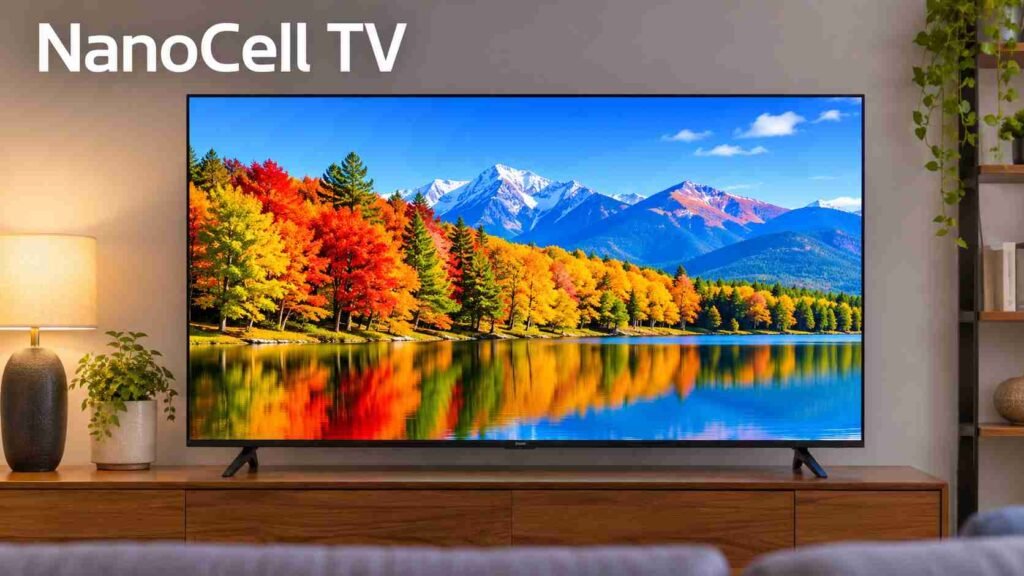
NanoCell is LG’s LCD TV technology that uses tiny nanoparticles to filter unwanted wavelengths of light, which helps produce cleaner, more distinct colors.
NanoCell TVs use an LCD panel and an LED backlight, unlike an OLED TV, whose pixels emit their own light.
NanoCell is not a separate resolution like 4K UHD or a separate backlight technology like LED LCD. Instead, it is a color-filtering approach used alongside the TV’s other display components.
This distinction is important to understand because a NanoCell TV does not automatically guarantee better black levels, higher HDR brightness or a wider color gamut than every conventional LED model.
How does NanoCell technology work?
NanoCell does not create colors independently, nor does it replace the LCD layer or backlight.
NanoCell technology works by filtering unwanted wavelengths of light to improve the purity of colors reproduced by an LCD display.
To understand its purpose, consider how an LCD TV creates an image: an LED backlight illuminates the panel, liquid crystals regulate the light passing through each pixel, and color filters create the red, green and blue components needed to reproduce an image.
However, in this process, some unwanted wavelengths can interfere with these colors, reducing their purity.
NanoCell filtering is designed to reduce this interference so that red, green and blue shades appear more distinct.
LG describes its technology as using particles approximately one nanometer in size to absorb or filter selected wavelengths.
This process can help improve color reproduction in films, sports, animation and nature documentaries, particularly where saturated colors are prominent.
Therefore, NanoCell should be understood as a color-filtering technology which tries to improve the accuracy of colors.
However, it should be noted that color accuracy is not the same as color gamut.
Color accuracy describes how closely the displayed colors match the intended ones, while color gamut describes the range of colors a display can reproduce.
What panel does a NanoCell TV use?
LG NanoCell TVs predominantly use IPS LCD panels, particularly in midrange and higher-end models, although some models and screen sizes may feature VA panels as well.
IPS panels maintain color and brightness more consistently when viewed from the side. This can be very useful when people watch from different seating positions.
However, IPS panels typically have lower native contrast than VA panels, meaning dark scenes can look grey rather than deep black, especially in a dark room.
VA panels generally produce deeper blacks because they block light more effectively, but their colors and brightness can deteriorate more noticeably when viewed off-axis.
The panel type varies by model year, series, screen size, and region. For example, 50-inch and 70-inch variants of the LG NANO75 2022 series have used VA panels, while other sizes in the same series use IPS panels.
What local dimming do NanoCell TVs use?
LG NanoCell TVs use different backlighting systems depending on the model, screen size and model year.
Entry-level and midrange models may use edge-lit LED backlighting without effective local dimming, while selected models feature full-array local dimming (FALD), which divides the backlight into zones that can dim independently.
This allows the TV to darken parts of the screen while keeping bright highlights illuminated elsewhere, improving contrast in scenes containing both light and dark areas.
However, local dimming performance depends on the number and size of these zones, the panel’s native contrast and the TV’s dimming algorithm.
Blooming around subtitles and bright objects can remain visible, particularly on NanoCell TVs with IPS panels.
For example, independent testing by RTINGS found that the 2021 LG NANO85 uses edge lighting on its 55-, 65- and 75-inch models, but full-array local dimming on its 86-inch model.
The 50-inch version available in certain markets uses a VA panel with edge lighting.
By contrast, the 65-inch LG NANO99 8K (2021) uses full-array local dimming with 96 zones, yet RTINGS found that blooming and limited native contrast still restricted its performance in dark scenes.
These examples demonstrate that a larger NanoCell TV does not automatically have better local dimming, and the feature cannot be determined from the NanoCell name alone.
NanoCell TV advantages
The main advantage of NanoCell technology may be seen in its ability to improve color purity by filtering unwanted wavelengths of light, which helps the TV reproduce cleaner, more distinct colors.
Like conventional LED TVs, NanoCell models use an LCD panel with LED backlighting and may offer features such as 4K resolution, HDR support and smart TV functionality.
While LG’s webOS platform adds access to streaming apps, supported models also include AI-assisted upscaling, picture processing and voice controls.
NanoCell TVs, which are typically equipped with IPS-type panels provide wider viewing angles, helping maintain color consistency when watching from different seating positions.
That said, these benefits vary by model, in terms of panel type, local dimming and picture-processing capabilities.
NanoCell TV disadvantages
Like conventional LED LCD TVs, the picture quality of NanoCell TVs depends heavily on the LCD panel and LED backlighting system.
Most NanoCell models use IPS-type panels, which offer wider viewing angles but have lower native contrast than VA panels, resulting in weaker blacks and less shadow detail in dark movie scenes.
Their LED backlighting can also limit HDR performance, particularly in models without local dimming, because the screen cannot independently control bright highlights and dark areas with sufficient precision.
Models equipped with full-array local dimming can improve contrast and HDR highlights, although blooming around bright objects may still occur.
NanoCell vs QNED: What’s the difference?
NanoCell and QNED are two different ranges within LG’s LCD TV lineup, with QNED positioned above NanoCell as a more advanced product category.
NanoCell uses nanoparticle-based color filtering to improve color purity, whereas QNED combines advanced color technologies with different LCD panel and backlighting designs.
Selected premium QNED models use mini-LED backlighting with full-array local dimming, offering better control over contrast and HDR highlights than conventional NanoCell models with basic LED backlighting.
For example, when a film shows a bright moon against a dark night sky, mini-LED local dimming can reduce illumination in darker zones while keeping the moon bright.
A conventional LED TV with limited dimming may illuminate a larger area, making blacks appear grey or creating halos around bright objects.
However, mini-LED does not eliminate blooming, and its performance depends on the number of dimming zones, panel contrast, processing and peak brightness.
QNED branding does not guarantee that every model outperforms every NanoCell TV, as not all QNED models use mini-LED.
NanoCell models can still offer good color reproduction and wider viewing angles, depending on their panel type.
Whereas, higher-end QNED mini-LED models generally have an advantage in HDR brightness and backlight control.
Read our detailed QNED vs NanoCell comparison to understand their technological differences and picture-quality performance.
Is a NanoCell TV worth buying?
A NanoCell TV can be a good purchase if you prioritize color purity and wide viewing angles.
However, its overall picture quality depends more on the panel type, contrast and backlighting than on NanoCell technology alone.
For deeper blacks, it is better consider a VA-based LCD with good local dimming or OLED.
Also, distinguish genuine NanoCell TVs from LG’s newer NANO 4K UHD AI models.
Despite their similar branding, the latter do not use NanoCell color-filtering technology and instead feature Nano Detail Enhancer for improved picture detail.
In a nutshell, you may choose NanoCell for its color reproduction and viewing angles, but compare its contrast, brightness and features against similarly priced QNED, QLED and OLED alternatives before buying.
Pingback: Is NanoCell better than LED TV? Which one to buy in 2026?
Pingback: QLED vs NanoCell: What's the difference and which TV to buy?
Pingback: OLED vs NanoCell: What’s the difference? Which one to buy?
Pingback: QNED vs NanoCell: What's the difference? which one to buy?