
OLED vs QNED: Which TV should you pick?
QNED might appear more impressive than OLED in a showroom, but once you have one at home, the true difference starts becoming clear.
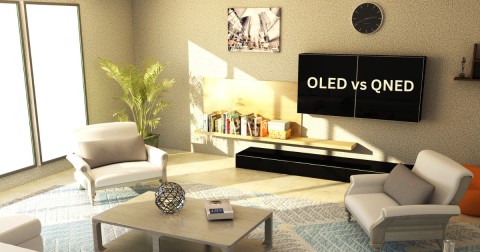
OLED TVs impress with their deep, true blacks, while QNED TVs step into the spotlight when the room gets bright.
With cutting-edge OLEDs and premium QNED models now going head-to-head at similar prices, choosing between them isn’t as simple as it used to be.
So which one actually fits your viewing style? Let’s jump in this article and find out.
OLED has self emissive pixels.
OLED stands for Organic Light-Emitting Diode. An OLED TV has individually controlled self-emissive pixels.
Each of these pixels can be turned on or off independently depending on the requirement of the scene.
Thus, when a pixel is off, it emits no light, which results in perfect contrast and pitch dark blacks.
This ability of OLEDs to produce truly deep blacks in dark enables them deliver fantastic picture quality in HDR.
Because every pixel is self-emissive and individually controlled, OLED displays deliver very accurate colors and maintain their quality even when you view it from the corners.
The ability of these pixels to switch on and off instantly also leads to ultra-fast response times, making OLEDs ideal for fast-paced action scenes.
They also deliver a superb gaming experience where every fraction of second counts.
Affiliate Disclosure: DisplayReviewz participates in the Amazon Associates Program. As an Amazon Associate I earn from qualifying purchases. If you buy a product through affiliate links in this article, we may earn a commission at no additional cost to you.
If you want the brightest and most vibrant OLED, which is great for gaming and bright living rooms, the Samsung S95F OLED TV is just for you.


QNED has a backlight full of tiny LEDs.
QNED is an LG’s display technology which stands for Quantum Nano-Emitting Diode.
It is a type of LCD TV which makes the use of a mini-LED backlight combined with nanoparticles and a layer of quantum dots.
It is, in fact, a NanoCell TV with tiny LEDs in its backlight along with a quantum dot layer.
As claimed by LG, a QNED TV uses approximately 30,000 mini-LEDs and close to 2,500 dimming zones.
Thus, compared to a normal LCD TV, the contrast is far superior on a QNED TV owing to a large number of dimming zones which can control the lighting of different areas of the screen much precisely.
While the quantum dots expand the color gamut of a QNED TV, the nanoparticles improve the purity of its colors.
Additionally, the enormous number of mini-LEDs present in the backlight can combined reach very high levels of brightness, ensuring the screen remains visible and vibrant, even in bright rooms or with sunlight coming through the window.
This makes it ideal for watching content in well-lit environments, with negligible issue from glare or reflections.
Explore some of the best Mini LED QNED TVs on Amazon and compare available models, picture quality, brightness, and smart features to find the right TV for your home.
Not all QNEDs are the same.
The design, and consequently, the performance of a QNED TV can differ significantly.
LG has traditionally used IPS panels in its QNED lineup, but it is now transitioning by incorporating VA panels in certain size variants as well.
The type of panel used plays a major role in determining overall picture quality of a QNED TV.
VA panels offer higher native contrast than IPS panels, which means local dimming has a more noticeable effect on them, boosting contrast to levels that clearly enhance image quality.
On the other hand, IPS panels provide wider viewing angles but tend to have lower contrast and typically less effective local dimming implementation.
That said, the number of dimming zones and the specific local dimming technology used also influence the picture quality.
Models that use VA LCD panels with thousands of dimming zones and full-array local dimming (FALD), where LEDs are distributed evenly across the entire backlight—generally deliver the best performance.
However, some budget TVs marketed as ‘QNED’ may feature mini-LEDs only along the edges.
These do not truly qualify as mini-LED displays and usually offer only average performance, so it’s important to be aware of them.
OLED vs QNED: Which one has better black levels?
When you view an OLED TV in a store, you may not realise it’s true potential.
The reason being too much lighting in the store, which might make QNED look just like OLED, or even better in the store owing to its higher brightness .
However, once you bring an OLED home, draw the curtains, and dim the lights, the experience is entirely different and truly stunning.
There’s no blooming around bright objects. The whites appear brilliantly bright while the blacks stay completely dark.
This level of picture perfection is something only OLED technology can deliver, no other TV type comes close.
No LCD TV can match the deep, perfect blacks of an OLED because each pixel can completely turn off when not in use.
Being an LCD TV, the colors may look somewhat washed out on a QNED TV, blacks are not like what you get on OLEDs.
You can still see some light peeping out through the screen in dark scenes also, as the LED backlight is always on.
Thus, the screen may appear slightly greyish instead of being completely black in a dark scene.
Even with advanced mini-LED local dimming, QNED TVs still can’t achieve the perfect blacks that only an OLED panel can deliver.
However, the black levels on a QNED TV (especially, VA-type) are significantly better than those on regular LED LCD TVs with not-so-good local dimming, making them a solid step up from standard LED displays.
They do have very less blooming in dark areas, however don’t come close to OLEDs in contrast, which can control their pixels individually.
On the other hand, IPS based QNEDs have just average picture quality, typically with significant amount of blooming in the dark areas.
Thus, if you are a dark room viewer, an OLED TV is the best choice to make for witnessing unparalleled picture quality.
A VA based QNED TV might be the second best budget friendly alternative.
OLED vs QNED: Which TV has wider viewing angles?
Another major advantage of OLED is the consistent picture quality from every viewing angle. No matter where in the room you watch from, the image remains just as good.
IPS-based QNED TVs have good viewing angles, though not like OLEDs, however, they compromise on the picture quality due to low contrast.
On the other hand, VA-based QNEDs have good picture quality but narrower viewing angles.
Thus, if you have a wide sitting arrangement, an OLED TV is the perfect choice with very wide viewing angles as well as excellent picture quality.
However, if you usually watch your TV from the front, or have narrower sitting area, VA based QNED TVs can be more budget-friendly good options after OLED.
OLED vs QNED: Which can become brighter?
If you usually watch TV in a bright room, a QNED TV could actually be a more practical choice because of its higher peak brightness compared to OLED.
But here’s the catch: modern OLED TVs have made great strides in brightness too, thanks to technologies like LG’s MLA (Micro Lens Array) and Samsung’s QD-OLED panels.
That said, only few OLEDs, like the Samsung S95F OLED TV having matte coating can handle the sunlight glare like a charm.
However, the black levels rise significantly on it due to diffusion of light across the display, which leads to a loss of contrast.
Adding to that, being a top-of-the-line model among the Samsung OLED TVs, it is very expensive.
Most of the OLEDs have glossy coating which causes bright objects to be reflected inside the screen, which hampers the viewing experience significantly.
Thus, if a lot of direct sunlight is coming in your room, a QNED TV (of course, with VA panel) is undoubtedly better and more affordable choice.
OLED vs QNED: Which one shows better colors?
OLED displays use self-emissive pixels, whereas QNED TVs rely on quantum dots to deliver a wide color gamut.
However, the overall color volume of a display is influenced not just by color gamut but also by peak brightness, which determines how accurately colors can be displayed at different intensity levels.
In QNED TVs, models with VA panels typically achieve higher color volume than IPS variants because they can produce deeper blacks, increasing the range of brightness levels.
OLED tech, especially in advanced forms like QD-OLED, MLA WOLED, and tandem OLED, combines very high brightness with true blacks, resulting in excellent color volume overall. As a result, they deliver the best HDR performance.
That being said, VA-based QNED TVs and QD-OLEDs tend to produce more vivid and purer colors due to their use of quantum dot technology. Colors really pop on these displays.
In contrast, advanced WOLED variants such as MLA and tandem WOLED excel at rendering clean, bright whites—so scenes like snowy mountain peaks look especially luminous.
On the other hand, while IPS-based QNEDs can achieve high peak brightness, but their lower contrast limits the range of luminance levels, leading to reduced color volume overall.
OLED vs QNED: Which one handles motion more smoothly?
OLEDs feature self-emissive pixels, giving them near-instant response times. As a result, motion appears exceptionally smooth with virtually no blur.
In contrast, QNED TVs are fundamentally LCD-based, so they can exhibit some motion blur due to slower pixel response.
That said, most QNED models still offer response times around or under 10 ms, which is fast enough to handle a wide range of content smoothly, at least up to 120 Hz.
However, for extremely fast-paced gaming at higher refresh rates like 240 Hz or heavy action scenes, OLED clearly remains the better choice.
OLED vs QNED: Which one has longer life?
OLED displays use organic pixels, which makes them more susceptible to burn-in compared to LCD-based technologies like QNED that don’t rely on organic materials.
The burn-in phenomenon happens when static elements, such as logos or fixed images stay on the screen for extended periods (weeks or even months), causing those pixels to wear unevenly and leave a faint, sometimes permanent shadow.
If the effect is temporary, it’s referred to as image retention and usually fades over time.
QNED displays, on the other hand, use inorganic LEDs that are more stable and generally last longer.
While modern OLED TVs include features like pixel shifting and pixel rotation to reduce burn-in risk, it’s still a consideration for heavy static-content use.
While QNED or LCD backlights can gradually dim over time, this happens uniformly across the screen, so it doesn’t create localized shadowing like OLED burn-in.
In general, both OLED and QNED are equally reliable well for watching varied content.
But if you want maximum peace of mind regardless of usage habits, QNED will be the safer choice.
QNED 8K vs OLED
QNED99, an IPS-based QNED TV, comes in 8K resolution. While the increased resolution suggests it should outperform 4K OLED models in picture quality, that isn’t often the case.
In practice, many 4K OLED TVs actually deliver better performance than IPS-based, even 8K QNED models.
The key factor is contrast—OLED panels offer exceptional contrast, whereas this 8K QNED TV delivers only average black levels.
Since contrast heavily influences overall image quality and HDR performance, OLEDs naturally tend to come out ahead.
That said, if you can find an 8K QNED TV at a lower price than a high-brightness OLED and plan to use it in a well-lit room, it can still be a reasonable choice.
OLED vs QNED: The Verdict
If top-notch picture quality is your highest priority, then an OLED TV is the clear choice. It’s worth every extra penny for the amazing visual experience it provides.
QNED TVs, on the other hand, can be positioned as a mid-range option, offering picture quality that sits between traditional LCDs and high-end OLEDs.
Within QNED displays, models equipped with VA panels perform significantly better than those using IPS panels.
When I initially left a comment I seem to have clicked the
-Notify me when new comments are added- checkbox
and from now on each time a comment is added I receive 4 emails with the same comment.
There has to be a means you are able to remove me from that service?
Thanks!
Hi friend.. welcome. Some glitches may be there as my site is new .. I will try to fix it soon
Pingback: QNED vs NanoCell: What’s the difference? which one to buy?