
What Is QNED Technology in LG TVs? [Pros, Cons & Picture Quality]
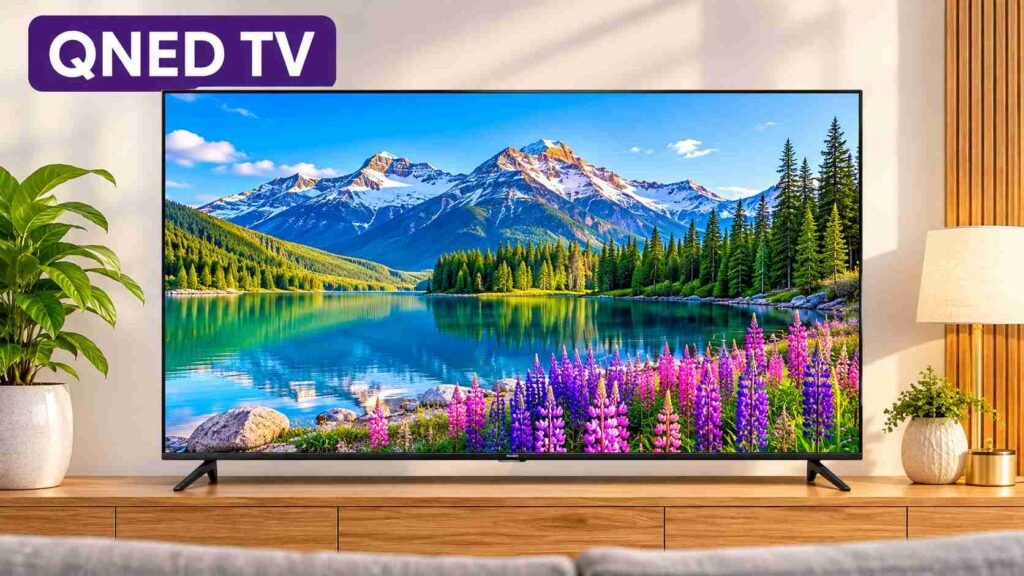
QNED is LG’s branding for its advanced LCD TV technology, which combines sophisticated colour reproduction techiques with LED backlighting to deliver brighter images, richer colours and improved picture quality.
Earlier QNED generations used a combination of Quantum Dot and NanoCell technologies to enhance colour accuracy and purity.
The Quantum Dot layer was used to enhance colour reproduction (like in QLED models), while NanoCell particles filtered unwanted wavelengths to improve colour accuracy.
On the other hand, newer QNED evo technology builds on earlier QNED generations with LG’s updated colour technology,
LG’s 2026 QNED evo range uses Dynamic QNED Color technology, which replaces the older Quantum Dot and NanoCell-based colour approach.
Selected premium models also incorporate mini-LED backlighting which typically provides more precise control over brightness and helps produce deeper blacks.
What display panel does a QNED TV use?
LG QNED TVs use LCD panels, predominantly IPS, although some models and screen sizes also use VA panels.
IPS panels provide wider viewing angles and better colour consistency when viewed from the sides, but have lower native contrast and produce comparatively greyish blacks.
VA panels offer higher native contrast and deeper blacks, making them better suited to dark-room viewing, but their narrower viewing angles typically cause colours and brightness to deteriorate when viewed from the sides.
Not all QNED TVs use the same panel technology, even within the same series.
For example, RTINGS confirms that the 2022 LG QNED80 uses an IPS panel in its 55-, 65- and 75-inch versions, while its 50-inch variant uses VA.
Similarly, the 2024 LG QNED85T uses VA panels in its 50-, 55-, 65- and 75-inch versions, whereas its 86-inch variant uses IPS.
Mini-LED backlighting can further enhance contrast of QNED TVs by controlling illumination across a number of dimming zones.
Consequently, VA-based QNED TVs with mini-LED backlighting can produce much deeper blacks than IPS-based QNED models.
However, some blooming may still occur around bright objects against dark backgrounds because LCD technology relies on a shared backlight rather than individually illuminated pixels.
Does every QNED TV have mini-LED backlighting?
No, not every QNED TV uses mini-LED backlighting.
Standard QNED models generally use conventional LED backlighting, while selected higher-end models combine QNED colour technology with mini-LED backlighting.
Mini-LED uses much smaller LEDs, allowing more light sources and independently controlled dimming zones behind the LCD panel.
This improves brightness and contrast by controlling illumination more precisely.
For example, when displaying a bright moon against a dark night sky, the TV can brighten the zones behind the moon while dimming the surrounding areas to produce deeper blacks and brighter highlights.
This process, called local dimming, improves contrast, which is very useful in playing HDR scenes.
LG employs various local dimming technologies across selected QNED models, marketed under names such as Precision Dimming, Precision Dimming Pro and Precision Dimming Pro+.
However, since each dimming zone controls multiple LCD pixels rather than individual pixels (what happens in an OLED TV), some light can spill into dark areas, causing blooming around bright objects.
Though mini-LED backlighting reduces this effect, it cannot eliminate it completely.
How good is the picture quality of a QNED TV?
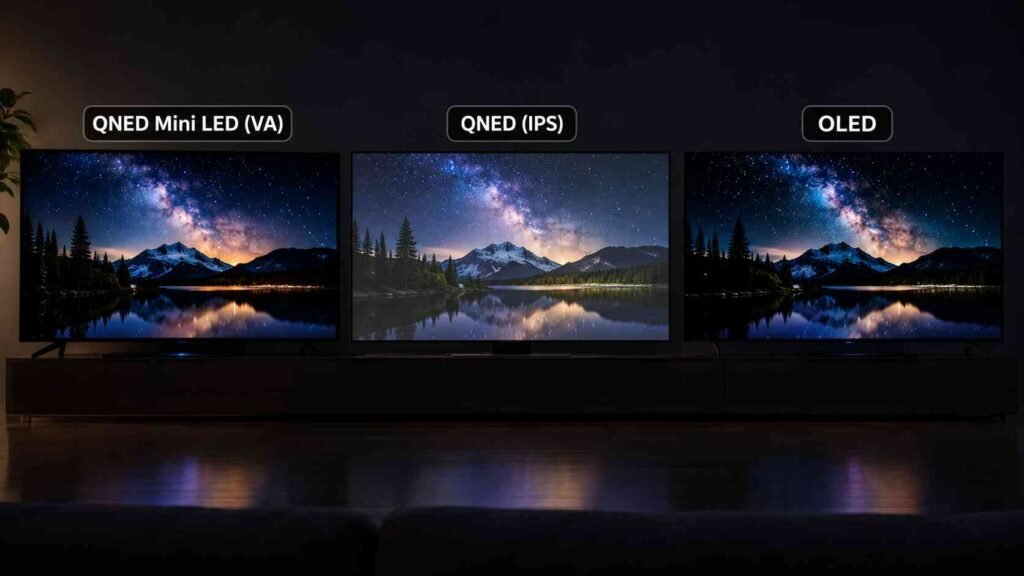
QNED TVs are designed to deliver vibrant colours, high brightness and improved contrast through advanced colour technologies.
Their colour gamut depends on the generation and colour-filtering technology used, with newer models offering a wider range of rich, accurate colours.
Peak brightness is generally higher in QNED mini-LED models than in conventional LED TVs, allowing HDR content to display brighter highlights and greater visual impact.
However, since QNED TVs use LCD panels, their native contrast and black levels depend largely on the panel type.
VA-based QNED TVs generally deliver significantly deeper blacks and better contrast than IPS-based models.
Even with mini-LED local dimming, IPS panels fall considerably short of VA panels in dark-scene performance, as their lower native contrast cannot be fully compensated for by backlight control.
This is one reason VA panels have become increasingly common in higher-end QNED models.
While IPS-based QNED models generally maintain more consistent colours and brightness across wider seating angles than VA-based models, but this advantage comes at the expense of contrast and black levels.
However, though mini-LED local dimming significantly improves contrast in VA-based models, it cannot match OLED’s perfectly deep blacks and blooming-free picture.
How is QNED compared to QLED, OLED and NanoCell?
QNED TVs can deliver excellent picture quality, particularly when equipped with a VA LCD panel and mini-LED backlighting.
However, when stacked up against premium VA-based mini-LED QLED TVs, such as Samsung Neo QLED, the competition becomes much difficult.
VA-based QNED mini-LED models are considerably better in contrast and HDR performance than conventional NanoCell TVs, which primarily use standard LED backlighting and nanoparticle-based colour filtering.
OLED remains superior than any QNED TV for perfect blacks, blooming-free images and dark-room movie watching.
That said, QNED mini-LED can offer higher brightness in selected models without the same permanent burn-in concerns associated with an OLED TV.
Overall, VA-based QNED mini-LED competes directly with premium mini-LED QLED TVs, outperforms conventional QLED and NanoCell models in backlight control, but cannot match OLED’s perfect blacks.
What are the pros and cons of QNED TVs?
The high brightness of a QNED TV makes HDR highlights more impactful and helps maintain picture visibility in brightly lit rooms.
Advanced colour technologies, including Quantum Dot and NanoCell filtering in applicable generations, enhance colour purity, saturation and overall colour reproduction.
Mini LED-equipped QNED models offer another advantage through their smaller backlight LEDs and more precise local dimming, thus improving brightness control and contrast compared with conventional LED-backlit models.
QNED TVs are also available in large screen sizes, making them suitable for expansive home entertainment setups.
Moreover, since they use LCD panels rather than organic self-emissive pixels, they are not susceptible to permanent OLED burn-in from prolonged static images.
However, their backlighting introduces certain limitations. Even with mini-LED and local dimming, light can spill around bright objects against dark backgrounds, producing blooming or halo effects.
Their black levels also cannot match OLED TVs, which switch off individual pixels to achieve true blacks and virtually eliminate blooming.
Viewing angles further depend on the LCD panel type: IPS-based QNED models maintain better colour and contrast consistency from the sides but have lower native contrast.
On the other hand, VA-based models produce deeper blacks and higher native contrast but exhibit greater picture degradation at wider viewing angles.
How good is a QNED TV for gaming, sports and movies?
QNED TVs are generally well suited for gaming, sports and movies, particularly models equipped with 120Hz or 144Hz refresh rates and HDMI 2.1 .
Higher refresh rates allow compatible games and fast-moving sports to appear smoother, while effective motion handling helps reduce blur during rapid camera movements and action sequences.
Many QNED models also support advanced gaming features such as variable refresh rate (VRR) and auto low latency mode (ALLM), thus enabling 4K gaming at up to 120Hz or higher on compatible devices.
The combination of high brightness and mini-LED backlighting on selected models can also improve HDR gaming by producing brighter highlights and better contrast.
For sports and gaming in brightly lit rooms, QNED TVs are mostly suitable because their high brightness helps overcome ambient light.
Moreover, IPS-based models offer wider viewing angles for group viewing.
For movies, VA-based mini-LED QNED models provide better contrast and deeper blacks than IPS-based versions, making them more suitable for dark-room viewing.
However, even the best mini-LED QNED models cannot ensure the complete absence of blooming and motion blur offered by OLED TVs, which remain the stronger choice for cinematic viewing and fluidic gaming in completely dark rooms.
So, is a QNED TV finally worth buying?
A QNED TV can be worth buying when it offers competitive performance against the best LCD and OLED TVs in the same price range.
VA-based QNED mini-LED models are particularly attractive, combining higher native contrast with precise local dimming for deeper blacks, brighter HDR highlights and better dark-scene performance than conventional LED TVs.
They can compete directly with premium VA-based mini-LED QLED TVs from Sony and Hisense and Neo QLED TVs from Samsung.
IPS-based QNED models are better suited to group viewing and gaming from different seating positions because of their wider viewing angles, although their lower native contrast typically obstructs cinematic performance in dark rooms.
For gaming, selected QNED models with 120Hz or 144Hz panels, HDMI 2.1 and VRR offer smooth gameplay, low input lag and strong HDR brightness, making them competitive with similarly priced premium LCDs.
Compared with OLED, QNED mini-LED generally offers higher sustained brightness and no permanent burn-in concerns, whereas OLED delivers superior cinematic performance through perfect blacks, faster pixel response and no blooming at all.
My recommendation: Choose VA-based QNED mini-LED for a balance of gaming, HDR brightness and contrast; and OLED for the best dark-room movie experience, widest viewing angles and exceptional gaming responsiveness.
Frequently Asked Questions (FAQs)
1. What is the difference between QNED and mini-LED?
QNED is LG’s LCD TV technology and product range, while mini-LED is a backlighting technology used in selected QLED, QNED and other premium LCD TVs to improve brightness and contrast through more precise local dimming.
2. Does a QNED TV have burn-in problems?
No, QNED TVs use LCD technology with LED backlighting, so they do not suffer from permanent burn-in in the way OLED TVs can.
3. How long does a QNED TV last?
A QNED TV can last well over 10 years with normal use because its LCD pixels have a very long operational lifespan and do not burn out like OLED pixels. However, LED backlight degradation or failure over time can eventually affect brightness.
4. Is QNED good for watching Netflix and HDR content?
Yes, QNED TVs support HDR formats and deliver bright, colourful images, although HDR performance and dark-scene contrast vary considerably between models.
5. Which is better, QNED or Neo QLED?
Premium Neo QLED TVs generally offer stronger contrast, more precise local dimming and higher HDR performance, although VA-based QNED mini-LED models can be competitive with similarly priced LCD TVs.
Pingback: QNED vs NanoCell: What's the difference? which one to buy?
Pingback: OLED vs QNED: Which TV should you pick?
Pingback: Neo QLED vs QNED: Which mini-LED TV is worth buying?