
Micro RGB vs QLED vs Neo QLED: Which is the best TV?
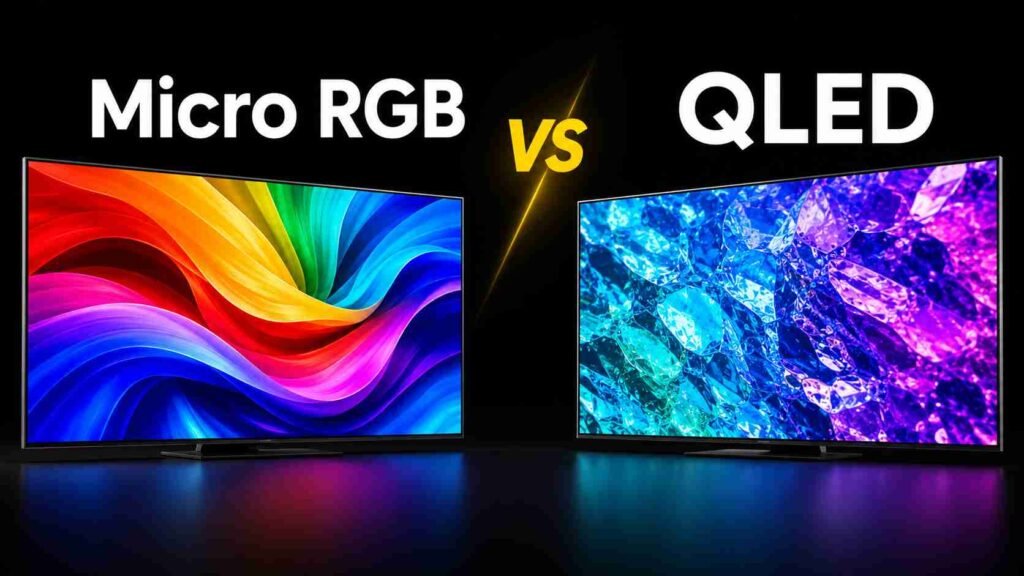
Micro RGB and QLED are both LCD TV technologies that use LED backlighting, but they differ in how they generate light and reproduce colours.
Micro RGB uses individually controlled, microscopic red, green and blue LEDs as its backlight.
The backlight illuminates an LCD panel to produce images with precise light control.
QLED TVs use a blue LED backlight combined with a quantum-dot layer to enhance colour reproduction before light passes through the LCD panel.
Neo QLED is Samsung’s more advanced QLED implementation, which combines quantum dots with mini-LED backlighting and sophisticated local dimming.
Although all three use LCD panels, their backlight designs differ, resulting in significant differences in colour reproduction and contrast.
Micro RGB vs QLED vs Neo QLED: Picture quality comparison
Contrast, blacks & blooming
Micro RGB, QLED and Neo QLED TVs rely on LCD panels, which means they cannot switch off individual pixels to produce perfect blacks.
Instead, they control the light passing through the LCD panel by adjusting their backlights.
How effectively they reproduce dark scenes therefore depends on both the backlight system and the LCD panel’s ability to block unwanted light.
Micro RGB has a big architectural advantage over conventional LED backlighting because it uses separate red, green and blue LED emitters that can be individually controlled.
This allows more sophisticated control over the light reaching different parts of the LCD panel.
QLED TVs with full-array local dimming can improve contrast significantly, effectively reducing the brightness of backlight zones behind dark portions of an image.
Their mini-LED implementations, including Neo QLED, use much smaller backlight LEDs, allowing for numerous and more precisely controlled dimming zones.
This can significantly improve black levels and reduce blooming as compared to conventional QLEDs.
That said, actual contrast depends on the number and arrangement of local dimming zones, image processing and the LCD panel’s native contrast.
VA LCD panels generally offer higher native contrast than IPS panels because they block backlight more effectively.
This allows VA-based mini-LED TVs to produce very deep blacks in dark rooms.
IPS and ADS panels offer wider viewing angles but generally have lower native contrast, which typically makes blacks appear grey even when local dimming is enabled.
Micro RGB can deliver excellent contrast as they use smallest size of leds out of all, but its black levels also depend on the LCD panel’s native contrast and local dimming implementation.
Although Samsung’s Micro RGB and Neo QLED TVs use VA panels, their actual dark-scene performance depends on how effectively each technology controls its backlight. For that, check out their individual reviews.
Black Levels: Micro RGB ~ Neo QLED > QLED (VA) > QLED (IPS)
Colour gamut
Colour gamut describes the range of colours a TV can reproduce.
QLED TVs use quantum dots to improve the colour purity of the scene.
When illuminated by blue LEDs, these semiconductor nanocrystals convert part of the light into narrow red and green wavelengths.
This allows QLED TVs to reproduce a wider colour gamut than many conventional LED-backlit LCD televisions.
Mini-LED QLED TVs use the same quantum-dot colour-generation principle but combine it with smaller backlight LEDs.
Micro RGB has a different approach to colour generation from conventional QLED and mini-LED QLED TVs.
Rather than relying on a blue LED backlight and a quantum-dot layer to generate a broad range of colours, it uses dedicated red, green and blue LEDs as its light source.
This arrangement typically produces highly saturated primary colours and cover a wider colour gamut than conventional LED-backlit LCD televisions.
Samsung states that its Micro RGB technology achieves 100% BT.2020 colour coverage and has received VDE certification for Micro RGB Precision Color.
Micro RGB has the potential to expand colour reproduction beyond that of conventional QLED TVs.
However, BT.2020 remains a long-term target for content creators, while many modern mini-LED TVs already achieve substantial coverage of the DCI-P3 colour gamut.
Color Gamut: Micro RGB > Neo QLED > QLED
Peak brightness and colour volume
Peak brightness measures the maximum luminance a TV can produce, usually expressed in nits (cd/m²).
It is particularly important for HDR highlights, reflections, sunlight and other bright details in television content.
Micro RGB uses dedicated RGB LEDs as its backlight, allowing the TV to control the intensity of individual colour components.
This offers considerable potential for high brightness and saturated colours.
QLED TVs can also achieve very high brightness, as they too use powerful LED backlights.
The mini-LED models take this further by allowing to distribute numerous small LEDs behind the LCD panel.
In this way, they can produce extremely bright HDR highlights while maintaining substantial brightness across larger portions of the screen.
For practical context, the TCL QM8 QM851G delivered an impressive peak HDR brightness of 4,540 nits in a 5% white window, while its full-screen white brightness measured 1,160 nits during Reviewed’s testing.
This demonstrates its ability to produce exceptionally bright HDR highlights while maintaining substantial brightness across the entire screen.
These figures demonstrate that high-end mini-LED QLED TVs can already achieve exceptionally high peak brightness.
Colour volume is closely linked with brightness.
While colour gamut describes the range of colours a display can reproduce, colour volume measures how well it maintains those colours across different brightness levels.
A TV might reproduce a wide colour gamut at moderate brightness but struggle to maintain saturated reds, greens and blues when displaying very bright HDR highlights.
Micro RGB’s separate RGB light sources can help maintain saturated colours at high brightness.
QLED TVs typically offer good HDR colour volume, while mini-LED models can deliver even better by combining high peak brightness with strong native contrast and effective local dimming.
Neo QLED and Micro RGB TVs using VA panels can deliver high contrast and good HDR colour volume, thanks to their stronger native contrast.
In comparison, IPS-based QLED models may struggle to maintain deep blacks and saturated colours at high brightness levels.
Peak brightness & color volume: Micro RGB ~ Neo QLED > QLED (VA) > QLED (IPS)
HDR performance
HDR performance depends on how effectively a TV combines peak brightness, black levels, contrast, colour volume and tone mapping.
VA panels generally offer higher native contrast and deeper blacks than IPS panels, making them better suited to preserving dark-scene details and HDR highlights, while IPS panels offer wider viewing angles but typically produce weaker blacks.
High peak brightness is equally important for impactful highlights, while high colour volume ensures that saturated colours remain rich even at high brightness levels.
Micro RGB uses an RGB LED backlight that can deliver high brightness and wide colour gamut.
QLED and mini-LED TVs can also deliver impressive HDR through quantum-dot colour reproduction and powerful backlights, with mini-LED offering finer local dimming control.
However, blooming can still occur when backlight light spills into dark areas, although VA panels, smaller LEDs and more precise local dimming help Micro RGB and Neo QLED TVs minimise this effect significantly.
HDR Performance: Micro RGB ~ Neo QLED > QLED (VA) > QLED (IPS)
Movies and gaming
For movies and gaming, contrast, black levels, colour accuracy and HDR performance are particularly important.
Micro RGB and Neo QLED TVs can typically deliver vibrant colours, high brightness and impressive HDR highlights.
VA panels offer higher native contrast and deeper blacks, making them better suited to cinematic viewing and HDR gaming, whereas IPS panels provide wider viewing angles for multiplayer gaming but weaker blacks.
Compared with OLED, high-end Micro RGB and Neo QLED TVs can typically achieve and sustain higher peak brightness.
That said, OLED retains a great edge in dark scenes because its self-emissive pixels deliver perfect blacks without blooming.
Moreover, OLED offers significantly faster pixel response times, resulting in sharper motion and minimal pixel-transition blur during gaming.
High-end Micro RGB and Neo QLED TVs can also deliver good response times, although generally not as fast as OLED.
Both technologies can typically support 4K at 120Hz or higher refresh rates, HDMI 2.1, VRR and ALLM.
Local dimming further enhances HDR gaming, although aggressive dimming can sometimes cause brightness fluctuations or obscure small highlights.
Burn-in and lifespan
A great advantage shared by Micro RGB and QLED TVs is that they do not use organic light-emitting pixels like OLED TVs.
Consequently, they do not carry the same permanent OLED burn-in risk from prolonged exposure to static images.
Though their backlights can typically lose brightness over time, but this is different from OLED pixel degradation and permanent image retention.
Micro RGB’s separate red, green and blue LEDs may experience different rates of output degradation over time, affecting colour balance and brightness uniformity, although its long-term reliability remains to be established through extended real-world use.
Overall, unlike OLED, Micro RGB and QLED TVs avoid organic-pixel burn-in, which makes them excellent choices for long-term static-content viewing.
Burn-in & Lifespan: Micro RGB ~ Neo QLED ~ QLED > OLED
Micro RGB vs QLED vs Neo QLED: which is better?
Micro RGB represents a significant advancement in LCD technology, using dedicated red, green and blue LEDs in its backlight to offer greater potential for colour reproduction than conventional QLED displays.
However, mini-QLED remains a formidable competitor, already delivering exceptionally high peak brightness, wide colour volume and effective local dimming.
Furthermore, VA-based models like Neo QLEDs can further achieve excellent native contrast and much deeper blacks than most IPS-based alternatives.
Therefore, Micro RGB can be considered genuinely superior only if its RGB backlight translates into better colour volume, higher brightness and more precise light control than the best mini-LED QLED TVs.
Frequently Asked Questions
Is Micro RGB better than QLED?
Micro RGB has the potential to reproduce a wider colour gamut through its dedicated red, green and blue LED backlight. However, high-end QLED TVs can already deliver excellent brightness, colour reproduction and HDR performance.
Is Micro RGB the same as QLED?
No. Both are LCD-based television technologies, but they use different approaches to backlighting and colour reproduction. Micro RGB uses separate red, green and blue LEDs as its backlight, whereas QLED uses quantum dots to enhance the colour produced by an LED backlight.
Is Micro RGB better than Neo QLED?
Micro RGB uses dedicated red, green and blue LEDs, whereas Neo QLED combines quantum dots with mini-LED backlighting. Both deliver excellent colour reproduction, high brightness and contrast, although performance varies by model and LCD panel type.
Does Micro RGB use quantum dots?
Samsung’s Micro RGB architecture uses separate red, green and blue LEDs to generate its backlight colours rather than relying on a quantum-dot conversion layer in the conventional QLED arrangement. Its colour is generated directly by the RGB light sources.
Does Micro RGB produce perfect blacks?
No. Micro RGB is still an LCD technology, so its backlight illuminates an LCD panel rather than individual self-emissive pixels. Although its advanced backlight control can improve black levels, some light can still pass through dark portions of the LCD panel, resulting in blooming or grey-looking blacks.
Is Micro RGB the same as RGB Mini-LED?
Not necessarily. While both technologies use red, green and blue LEDs for backlighting, Micro RGB refers to implementations using extremely small RGB LEDs. Samsung specifies sub-100-micrometre emitters in its Micro RGB technology. The size and control architecture of RGB Mini-LED displays can differ by manufacturer.
Does Micro RGB have better contrast than mini-LED?
Not necessarily. Contrast depends on the LCD panel’s native contrast ratio, the number of independently controlled dimming zones, backlight algorithms and optical design. A VA-based mini-LED with excellent local dimming could outperform an IPS-based Micro RGB TV in dark-scene performance.
Pingback: What is Micro RGB TV technology & how does it work? -