
What is Micro RGB TV technology & how does it work?
Micro RGB is an advanced LCD backlighting technology that uses extremely small red, green and blue LEDs to illuminate the screen.
Unlike conventional LED TVs that rely on blue or white LED backlights and additional colour-conversion layers, Micro RGB generates light directly from separate red, green and blue LED emitters.
This allows more precise control over backlight colour, brightness and local dimming.
Samsung introduced its first Micro RGB TV in 2025, featuring individually controlled RGB LEDs measuring less than 100 micrometres.
The technology was designed to improve colour reproduction, brightness control and contrast in large-screen LCD TVs.
It should be noted that Micro RGB is not the same as micro-LED, OLED or conventional mini-LED.
It still uses an LCD panel to form images, while its micro-sized RGB LEDs function as the backlight.
What is Micro RGB & how does it work?
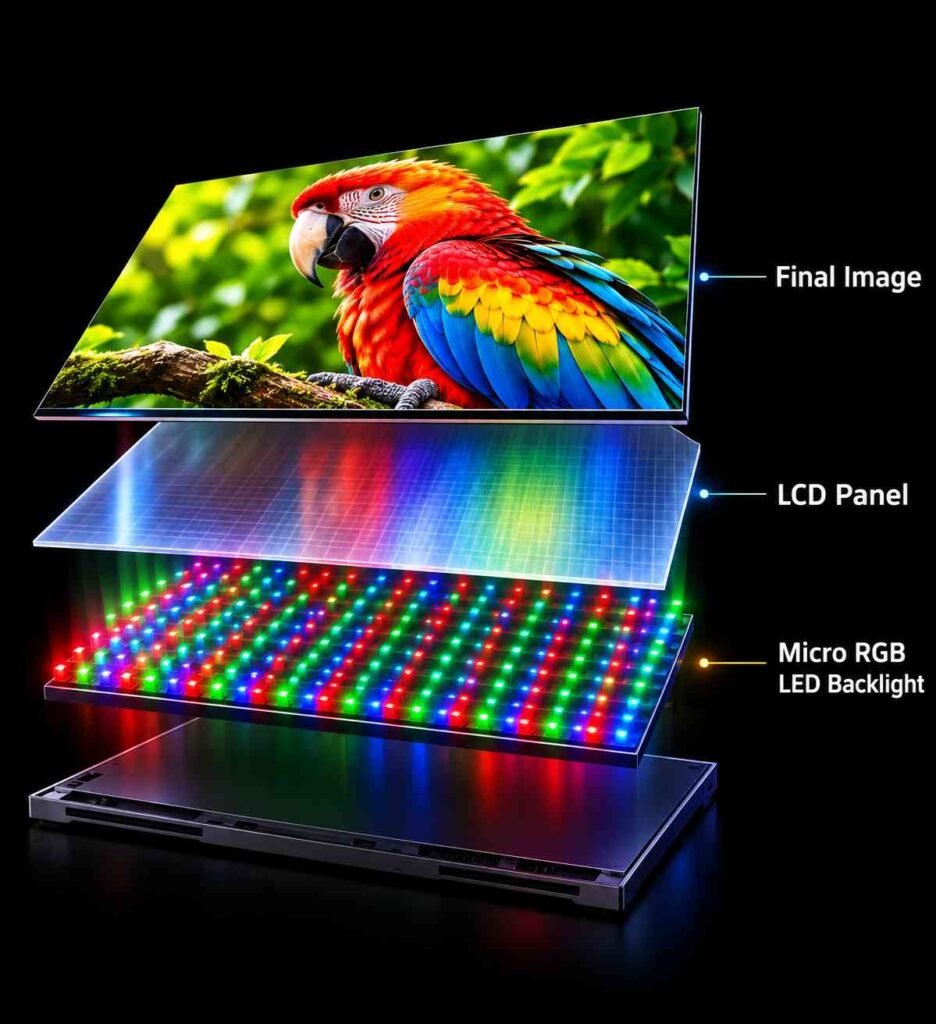
Micro RGB is an advanced RGB LED backlighting technology used in LCD TVs.
It employs extremely small red, green and blue light-emitting diodes arranged behind an LCD panel.
These individual RGB LEDs produce coloured light directly instead of relying on a conventional blue or white LED backlight to generate the required colours through additional optical layers.
The term Micro RGB describes two important characteristics of this technology. RGB refers to the three primary colours of light: red, green and blue. Micro refers to the extremely small dimensions of the LED emitters.
For example, Samsung’s Micro RGB technology uses individual red, green and blue LEDs measuring less than 100 micrometres (µm).
One micrometre is one-millionth of a metre, meaning these emitters are smaller than 0.1 millimetre.
The smaller LED dimensions allow manufacturers to arrange a dense array of RGB light sources behind the screen.
Their output can be controlled to adjust the colour and brightness of different backlight areas.
Therefore, unlike conventional LED TVs, which primarily use blue LEDs with phosphor conversion or additional quantum dot layers to produce the required colours, Micro RGB generates red, green and blue light directly at the backlight source.
How are Micro RGB LEDs different from regular LEDs?
Regular LED TVs generally use blue or white LEDs to illuminate the LCD panel.
Micro RGB uses separate, extremely small red, green and blue LED emitters to generate coloured light directly.
This eliminates the need for the same backlight colour-conversion arrangement used in conventional LED TVs.
Their smaller dimensions also allow denser LED arrangements and more precise control over the backlight’s colour composition.
Is Micro RGB a type of mini-LED?
Micro RGB and mini-LED are closely related, as both use arrays of small LEDs as LCD backlights. However, they are not the same technologies.
Mini-LED TVs (e.g. Samsung’s Neo QLEDs) typically use numerous small blue or white LED emitters to illuminate an LCD panel.
A quantum dot layer placed between the backlight and LCD panel helps produce the precise colours needed to create the image displayed on the screen.
Micro RGB uses separate red, green and blue LED emitters in its backlight to produce the required colours directly, eliminating the need for a separate quantum dot layer for colour conversion.
What is the difference between Micro RGB and RGB Mini-LED?
Micro RGB and RGB Mini-LED share the same fundamental principle:
Both of them use separate red, green and blue LEDs to generate coloured backlighting for an LCD panel.
The main difference is the size of the LED emitters.
Samsung specifies that its Micro RGB LEDs are smaller than 100 micrometres, compared with approximately 100–400 micrometres for the RGB Mini LED emitters shown in its comparison.
Smaller emitters can allow a denser backlight arrangement, which improves the precision with which the TV controls light and colour across the screen.
| Feature | Micro RGB | RGB Mini-LED |
|---|---|---|
| LED dimensions | Below 100 µm | Typically larger |
| LED configuration | Separate red, green and blue LEDs | Separate red, green and blue LEDs |
| Colour generation | Direct RGB light | Direct RGB light |
| LCD panel | Yes | Yes |
| Backlight | RGB LED array | RGB LED array |
| Local dimming | Yes | Yes |
| Main distinction | Extremely small RGB emitters | Larger RGB LED emitters |
However, smaller LED emitter does not automatically guarantee better picture quality.
Local dimming precision, backlight control algorithms and image processing also play important roles.
A well-engineered RGB Mini-LED TV with effective local dimming and image processing could therefore outperform a poorly implemented Micro RGB TV in certain aspects of picture quality, despite using larger LED emitters.
Is Micro RGB the same as RGB LED?
RGB LED is a broader description of a backlight that uses separate red, green and blue LED emitters.
Micro RGB uses the same fundamental principle but distinguishes itself through its extremely small LED dimensions and associated backlight control system.
In other words, all Micro RGB backlights use RGB LED technology, but not every RGB LED backlight qualifies as Micro RGB.
Is Micro RGB the same as micro-LED?
No. Micro RGB and micro-LED are fundamentally different display technologies, despite their similar names.
Micro RGB uses microscopic red, green and blue LEDs as a backlight behind an LCD panel.
However, the LCD layer still controls how light passes through the screen to form images.
Micro-LED, on the other hand, is a self-emissive display technology in which each pixel consists of microscopic LEDs that produce their own light.
It does not require a separate LCD panel or conventional backlight.
| Feature | Micro RGB | Micro LED |
|---|---|---|
| Display technology | LCD | Self-emissive LED |
| RGB LEDs | Used as backlight | Used as individual pixels |
| LCD panel | Yes | No |
| Backlight | Required | Not required |
| Light generation | Behind the LCD panel | At each pixel |
| Black levels | Depend on LCD and backlight control | Individual pixels can switch off |
| Blooming | Can still occur | No conventional LCD backlight blooming |
Micro RGB improves the backlight of an LCD TV, whereas micro-LED replaces the conventional LCD-based display structure with self-emissive LED pixels.
Main feature & advantages of Micro RGB
Micro RGB is designed to address limitations of conventional LCD backlighting, mainly colour reproduction and light control.
Wider colour gamut
The extremely small LED emitters allow a dense arrangement of RGB light sources behind the screen.
Combined with local dimming and dedicated processing, this can provide finer control over brightness and colour distribution.
Separate RGB emitters generate coloured light directly, thereby reducing reliance on colour-conversion layers and improving colour purity.
Moreover, direct RGB backlighting can improve colour volume, preserving saturated colours in bright HDR highlights.
Samsung claims that its Micro RGB technology achieves 100% BT.2020 colour gamut coverage, with certification by VDE.
This is an ambitious colour-performance target because BT.2020 defines a much wider colour gamut than the commonly used DCI-P3 standard.
However, this certification applies specifically to Samsung’s Micro RGB TVs and does not guarantee the same performance from all Micro RGB TVs.
Reduced blooming
Blooming occurs when light from a bright object spills into surrounding dark areas, creating a visible halo.
Micro RGB’s smaller emitters and more precise backlight control can help reduce this effect considerably.
However, as Micro RGB still remains an LCD technology with local dimming, blooming cannot be assumed to disappear completely.
The number of dimming zones, LCD native contrast (depends on the type of LCD panel) too determine how effectively the TV suppresses blooming.
Does Micro RGB offer perfect blacks like OLED?
No. Micro RGB TVs cannot deliver perfect blacks like OLEDs because they still use an LCD panel with a separate backlight.
OLED pixels generate their own light and can switch off completely when displaying black.
This provides pixel-level light control and thus, eliminates backlight blooming completely.
Micro RGB instead controls light through its RGB backlight and LCD panel. While tiny RGB LEDs improve backlight control, Micro RGB remains an LCD technology rather than a self-emissive display.
Therefore, even with advanced local dimming, some light may spill into dark areas, causing blooming and making blacks appear grey rather than perfectly black as on OLED.
Conclusion
Micro RGB is an important development in LCD backlighting technology.
By replacing conventional blue or white LED illumination with extremely small red, green and blue emitters, it aims to improve colour reproduction, brightness control and local dimming precision.
However, its fundamental display structure remains LCD-based. The RGB LEDs illuminate the screen from behind, while the liquid crystal panel continues to form the image.
This is what separates Micro RGB from micro-LED and OLED. It is not a new self-emissive display technology but an advanced approach to RGB LED backlighting that could push LCD TV performance further.
Frequently asked questions about Micro RGB TVs
1. Is Micro RGB better than mini-LED?
Micro RGB typically has the potential to deliver more accurate colour reproduction and finer backlight control than conventional Mini LED TVs, however, actual performance depends on LED density, local dimming zones, LCD panel type and image processing.
2. Does Micro RGB use quantum dots?
Micro RGB generates red, green and blue light directly from its backlight emitters, so it tyoically does not need a quantum dot layer for the same colour-conversion purpose as conventional QLED TVs.
3. Does Micro RGB suffer from burn-in?
Micro RGB uses an LCD panel and LED backlight rather than self-emissive organic pixels. Therefore, it does not have the characteristic OLED burn-in problem.
4. Does Micro RGB eliminate blooming?
No. Smaller LEDs and more precise local dimming can reduce blooming, but they cannot guarantee its complete elimination.
5. Is Micro RGB better than OLED?
Micro RGB is designed to deliver high brightness and a wide colour gamut, while OLED offers pixel-level light control and exceptionally deep blacks. Neither technology is automatically superior, as both have different strengths.
Pingback: RGB Micro LED vs RGB OLED: Which Display Reigns Supreme? -
Pingback: Are Micro-LED and Micro RGB the same display technology? -
Pingback: Micro RGB vs QLED vs Neo QLED: Which is the best TV? -