
OLED vs QLED: Which TV is more costly?
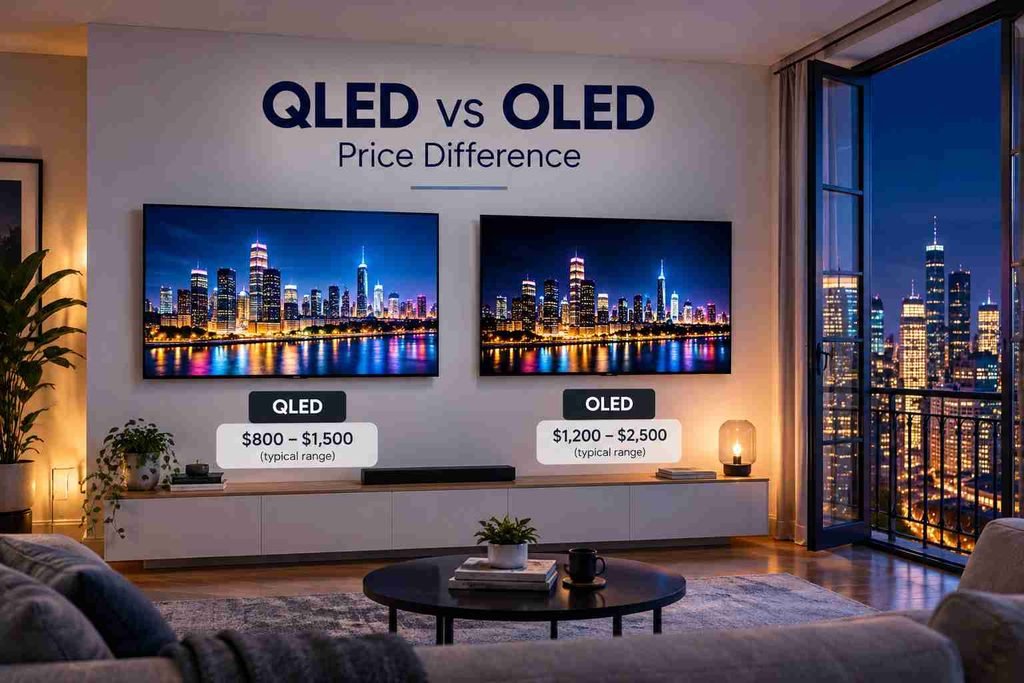
OLED TVs are generally more expensive than standard QLED TVs, particularly at the entry-level and large-screen ends of the market. However, premium QLED and mini-LED models can cost as much as, or sometimes more than mainstream OLED TVs.
What will you actually notice?
| Price | OLED TVs | QLED TVs |
|---|---|---|
| Entry-level price | Generally higher | Generally lower |
| Mid-range 55–65-inch TVs | Often overlap in price with premium QLED models | Available across a broad range of prices |
| Premium models | Can be very expensive | Premium mini-LED models can also be expensive |
| Large screens | Prices rise considerably | Often cheaper at comparable sizes |
| Cheapest option | Rarely the budget winner | Usually the budget winner |
| Overall value | Best if OLED picture quality is your priority | Often offers a larger screen and higher brightness for the money. |
OLED and QLED TVs may have similar-sounding names, but they use different display technologies—and their prices can differ significantly.
While QLED TVs are generally more affordable at the entry level, OLED models command a premium for their superior black levels, contrast, and overall picture quality.
But how much more does an OLED TV actually cost, and can a premium QLED be more expensive than an OLED?
In this guide, we compare OLED vs QLED prices across different screen sizes and market segments, explain what drives the price difference, and help you decide which technology offers the best value for your money.
First, let’s briefly look at how OLED and QLED TVs differ.
OLED
OLED stands for Organic Light-Emitting Diode.
Unlike conventional LCD LED TVs, OLED TVs use self-emissive pixels that produce their own light, eliminating the need for a separate backlight.
Each pixel can switch off completely to produce true blacks, resulting in exceptional contrast and more lifelike images.
OLED’s pixel-level light control also helps preserve fine details in dark scenes, while its wide viewing angles and excellent color reproduction make it well suited for cinematic viewing.
QLED
QLED stands for Quantum Dot Light-Emitting Diode.
Unlike OLED, QLED is not a self-emissive display technology.
Instead, it builds on traditional LCD technology by combining an LED backlight with a quantum-dot layer.
These nanoscale particles convert some of the blue light from the backlight into highly saturated red and green light.
This improves color reproduction, allowing QLED TVs to typically deliver a wide color gamut and vibrant images.
Their backlit design can also support high brightness levels, making many QLED models well suited to brightly lit rooms.
OLED vs QLED: Price comparison by segment
OLED and QLED TVs are available across a broad range of prices, depending on screen size, brand, display specifications, and features.
Although OLED TVs generally have higher starting prices, premium QLED models, particularly those with mini-LED backlighting, can cost as much as or more than some OLED TVs.
But rather than assuming one technology is always more expensive, it is more useful to compare models across similar price categories.
For a clearer picture, we’ve divided the comparison into three segments: entry-level, mid-range, and premium TVs.
Let’s examine how OLED and QLED prices compare in each segment.
OLED vs QLED: Entry-level segment pricing
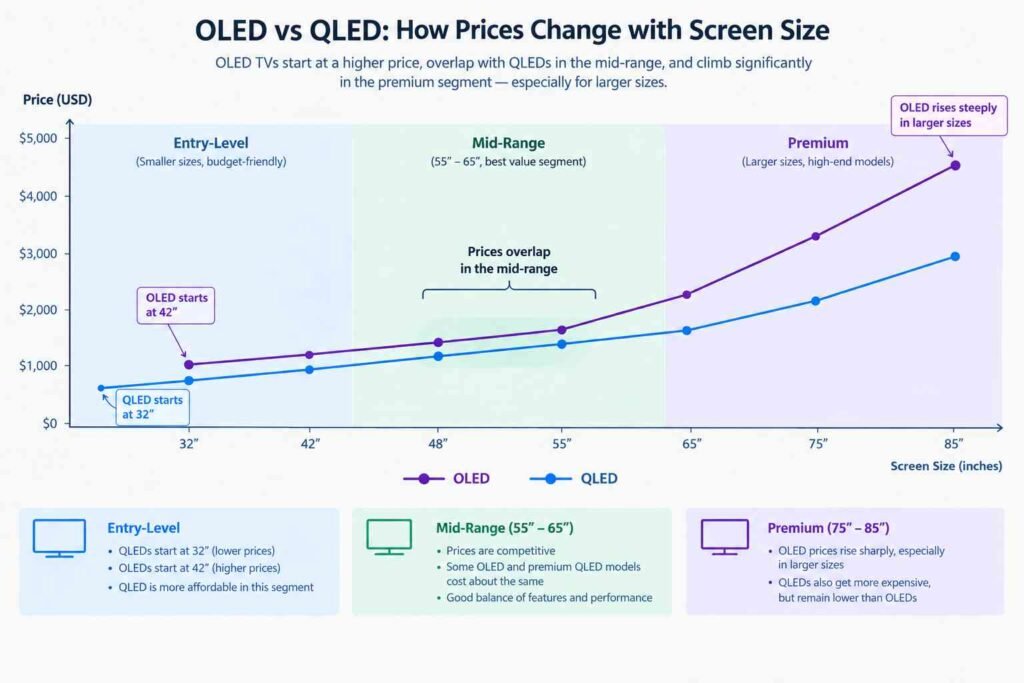
OLED TVs generally have a significantly higher starting price than entry-level QLED TVs.
One of the main reasons is the difference in display technology and manufacturing costs.
OLED TVs use millions of self-emissive pixels, each capable of producing its own light.
This pixel-level control delivers perfect blacks and exceptional contrast, however manufacturing large OLED panels to stringent quality standards remains a costly process.
Micro-LED displays are generally even more expensive to manufacture, but OLED technology is still positioned above budget-oriented LCD TVs.
QLED TVs, on the other hand, are based on traditional LCD technology enhanced with a quantum-dot layer.
They use an LED backlight to illuminate the LCD panel, making them less expensive to produce across the entry-level segment.
As a result, QLED TVs are available at much lower starting prices.
Moreover, QLED TVs are available in compact sizes, including 32-inch models, while consumer OLED TVs typically start at around 42 inches.
Smaller screens generally cost less, further widening the difference between the cheapest models.
For instance, consider the Sony A90K 42-inch 4K OLED and the Samsung Q60D 32-inch QLED.
At the cited prices of approximately $1,300 and $400, respectively, the difference is about $900.
That’s enough to buy another budget QLED TV!
But does that mean QLED is always the better buy? Well, not necessarily.
OLED TVs deliver perfect blacks, pixel-level contrast, virtually no blooming around bright objects, and excellent viewing angles.
These advantages are particularly noticeable when watching movies in a dark room.
Entry-level QLED TVs can struggle with elevated black levels and lower contrast, especially in models with basic backlighting.
Blooming can also occur around bright objects on dark backgrounds, while viewing angles depend on the LCD panel type.
Takeaway: QLED is usually the more affordable starting point, while OLED commands a premium for its superior black levels and contrast.
OLED vs QLED: Mid-range (55–65 inch) segment pricing
This is where things start getting pretty interesting!
In the 55–65-inch range, OLED and premium QLED TVs can overlap in price.
For example, the 65-inch Sony BRAVIA 8 OLED has been listed at around $1,800, while the 65-inch Sony BRAVIA 7 mini-LED QLED and Samsung QN90D Neo QLED have been available at approximately $1,600 respectively.
This illustrates how premium mini-LED TVs can compete directly with OLEDs.
Mini-LED backlighting uses numerous small LEDs grouped into local dimming zones to improve contrast, deepen blacks, and deliver high brightness for HDR viewing in bright rooms.
However, mini-LED technology does not eliminate every LCD limitation.
Even premium models can show some blooming, and their black levels and viewing angles depend on the panel type and local dimming implementation.
Whereas OLED pixels switch off individually to produce perfect blacks, excellent contrast, and wide viewing angles.
Moreover, advanced OLED technologies can narrow the brightness gap.
For example, Samsung’s QD-OLED panels combine OLED pixels with quantum dots to improve color gamut, while LG’s MLA-equipped WOLED panels use microscopic lenses to extract more light from the display.
Takeaway: Standard OLED models can compete with premium QLED TVs on price, while flagship OLED and mini-LED models can both command substantial premiums.
OLED vs QLED: premium segment pricing
Now we come to the most expensive segment of the TV market: large-screen QLED and OLED TVs ranging from 83/85 inches to 97/98 inches.
Within this category, 8K models command some of the highest prices.
8K QLED TVs are generally less expensive than their OLED counterparts, but their advanced backlighting and image-processing systems still add significantly to manufacturing costs.
Although 8K resolution does not inherently require more backlight LEDs, premium 8K mini-LED models often feature sophisticated backlighting, precise local dimming, and advanced processing to deliver detailed images.
8K OLED TVs, however, occupy an even more premium price bracket.
It is worth noting, however, that LG has been the primary manufacturer of consumer 8K OLED TVs, while other major brands, including Samsung, Sony, and TCL, have focused their 8K offerings on LCD-based technologies, including QLED and mini-LED models.
With four times as many pixels as a 4K display, an 8K OLED panel requires a much denser array of self-emissive pixels, making its manufacturing process considerably more complex and expensive.
For instance, LG’s 77-inch Z3 8K OLED launched at around $10,000, approximately $2,000 more than Samsung’s larger 85-inch QN900D 8K QLED.
But wait! The price difference becomes even more striking with LG’s 88-inch Z3 OLED, which launched at around $25,000—more than three times the price of Samsung’s 85-inch 8K QLED.
Takeaway: 8K OLED TVs are significantly more expensive than 8K QLED TVs, with their higher manufacturing complexity and limited availability pushing prices to premium levels.
OLED vs QLED: Which TV is more expensive?
The price of QLED and OLED TVs can vary significantly based on several factors such as screen size, resolution, and the type of backlight or display technology used.
To sum it up: OLED TVs generally have a much higher starting price compared to QLEDs. In the mid-range segment (55” to 65”), both technologies offer competitive pricing with comparable performance.
However, at the premium end of the market, OLED TVs are substantially more expensive than their QLED counterparts.
Therefore, in conclusion, we can say that OLED TVs are generally more expensive overall than QLED TVs.
But are OLED TVs worth the extra cost? Find out in this article.
FAQs (Frequently Asked Questions)
1. Is OLED more expensive than QLED?
Generally, yes. Entry-level QLED TVs usually cost less, although premium QLED and mini-LED models can overlap with OLED prices.
2. Why are OLED TVs typically more expensive?
OLED TVs use self-emissive pixels that produce their own light. Their panel technology and premium features may contribute to higher prices.
3. Is QLED better value for money than OLED?
QLED often offers better value if you want a larger screen, high brightness or a lower purchase price. OLED may justify the extra cost if deep blacks and superior contrast are your priorities.
4. Does a bigger OLED TV cost more than a QLED TV?
Often, but not always. Large OLED models can be expensive, while premium QLED TVs also command high prices.
Pingback: QLED vs OLED: Which TV performs better in a dark room?