
What is an LED TV and how does it work? [With adv. & disadv.]
The colorful and bright TVs you often see around are LED TVs. Whatever your budget or size preference, you’ll almost always find an LED TV that perfectly suits your needs.
What is an LED TV?
LED stands for Light-Emitting Diode.
It’s a semiconductor device that emits light when electricity passes through it.
Pretty simple, right?
But what does an LED TV mean, and why is it named so?
Let’s define LED TV first.
Well, an LED TV is just a type of LCD TV which uses LEDs in its backlight.
Mind you, these type of TVs which are commonly referred to as “LED TVs”, are not the actual LED TVs.
The true LED displays are those which have self emissive LEDs embedded in the display itself, for instance, a micro-LED display.
That said, going forward, we’ll use the term “LED TV” to refer to LED-backlit LCD TVs, since that’s the common usage.
How does an LCD TV differ from an LED TV?
While both LCD and LED TVs use the same process to produce colors on the screen, LED TVs use light-emitting diodes (LEDs) in their backlights.
Whereas, the traditional LCD TVs relied on cold cathode fluorescent lamps (CCFLs) as the primary light source.
However, LEDs offer several advantages over CCFLs, such as slimmer designs and greater energy efficiency.
Thus, they are now used as the backlight source in almost all LCD displays.
So, what we commonly call LED TVs are in fact LCD TVs that use LED backlighting.
Therefore, the terms “LED,” “LCD,” and “LED LCD” all refer to the same type of TV.
How does an LED/ LED LCD TV work?
As we discussed previously, the backlight of an LED TV is made up of multiple LEDs that work together to create the image you see on the screen.
Now, the question is that: how do these small LEDs manage to produce such a vibrant picture quality?
Let’s explore this fascinating process.
Take three small LEDs, each having dimensions about 1 inch by 1 inch, emitting red, green and blue colors respectively.
Place them very close to each other in a dark room and stand at a distance of about 5 meters away from them.
Now, ask your friend to connect battery to those three small LEDs and light them up. Do you see the individual red, green and blue colors?
Probably not! You must see a white light.
The combination of the three RGB LEDs should appear as one white light emitting LED.
This simple logic probably forms the foundation of how an LED TV works.
Now, if we could further shrink those small LEDs down to micrometer sizes, the light they emit would blend together and appear as a single color to the human eye.
By arranging many such LED combinations across a screen, it’s possible to display a number of colors on it.
However, this approach comes with certain challenges.
Since inorganic LEDs are difficult to manufacture at micrometer scales, it presents significant fabrication issues.
Although organic LEDs, known as OLEDs can be produced at extremely small sizes, that is an entirely different technology as compared to LED and comes with its own challenges.
On the other hand, while it’s technically possible to miniaturize inorganic LEDs to such small sizes where there is an LED for each subpixel (e.g., in micro-LED), doing so is currently very costly, since it needs to fabricate billions of tiny RGB LEDs in the display.
For standard LED displays, it’s far more cost-effective for manufacturers to use a few hundreds or thousands of LEDs in the backlight and then pairing them with color filters, rather than embedding them directly into the display.
Why is the use of color filters in an LED TV?
In an LED TV, color filters are responsible for producing and displaying the different colors seen on the screen.
A great benefit of using color filters is that they remove the need for separate red, green, and blue LEDs, since the filters themselves can generate a wide range of colors.
But how exactly do these filters generate various colors on the screen? How is the intensity of each color controlled? Let’s explore this in detail.
How do the LEDs work with the color filter?
For the formation of picture on the screen, we need a light source. This is accomplished by using a backlight made of several LEDs which are arranged in a unique fashion.
These LEDs in the backlight emit white light which passes through the color filters.
The color filters are actually a group of red, green and blue color filters.
Now suppose, if white light from the LEDs passes through the color filters, what color would you see on the screen?
A red color filter allows red light from white light to pass through while blocking the other colors.
The same principle applies to blue and green filters. When combined, the transmitted red, green, and blue light blend together, producing white light once again.
Thus, in the above scenario, only white light would be visible—no other colors would appear.
However, this white light is not alone sufficient to display an image with a number of different colors.
So, what’s the solution then?
The intensity of light passing through each color filter must be regulated. For this, a layer of liquid crystals is present between the LED backlight and the color filters.
The magic of liquid crystals
What are liquid crystals and how do they help in image formation? Let’s see.
Liquid crystals are the states of matter intermediate between crystalline solid and liquid.
They show the properties of both, solid crystals and liquids and thus, exhibit electrical, magnetic and optical properties.
Normally, these liquid crystals are in twisted state. In this state, if light is passed through them, they rotate it by ninety degrees.
However, when an electric field is applied to them, they become untwisted and align in a particular direction. In this state, they rotate the light according to the requirement.
Now the next question is: How can we utilise this rotation of light in the formation of picture?
For understanding this, we first need to know about polarizers used in LED TVs.
The use of polarizer in an LED TV
A polarizer is an optical filter which allows only a specific polarisation (direction of oscillation) of light wave to pass through while blocks the rest.
In an LED TV, light emitted from the backlight is passed through a polarizer which allows only its vertical component to pass through it.
Now, this vertically polarized light falls on the liquid crystal layer which rotates it in a particular direction.
Then this rotated light goes to the next polarizer which allows only its horizontal component to pass through it.
By now, I believe that you are gradually developing an idea of how an LED TV actually works.
Let’s go through the entire process and break down each step in a very simple manner.
How does an LED TV work? [The whole process at a glance]
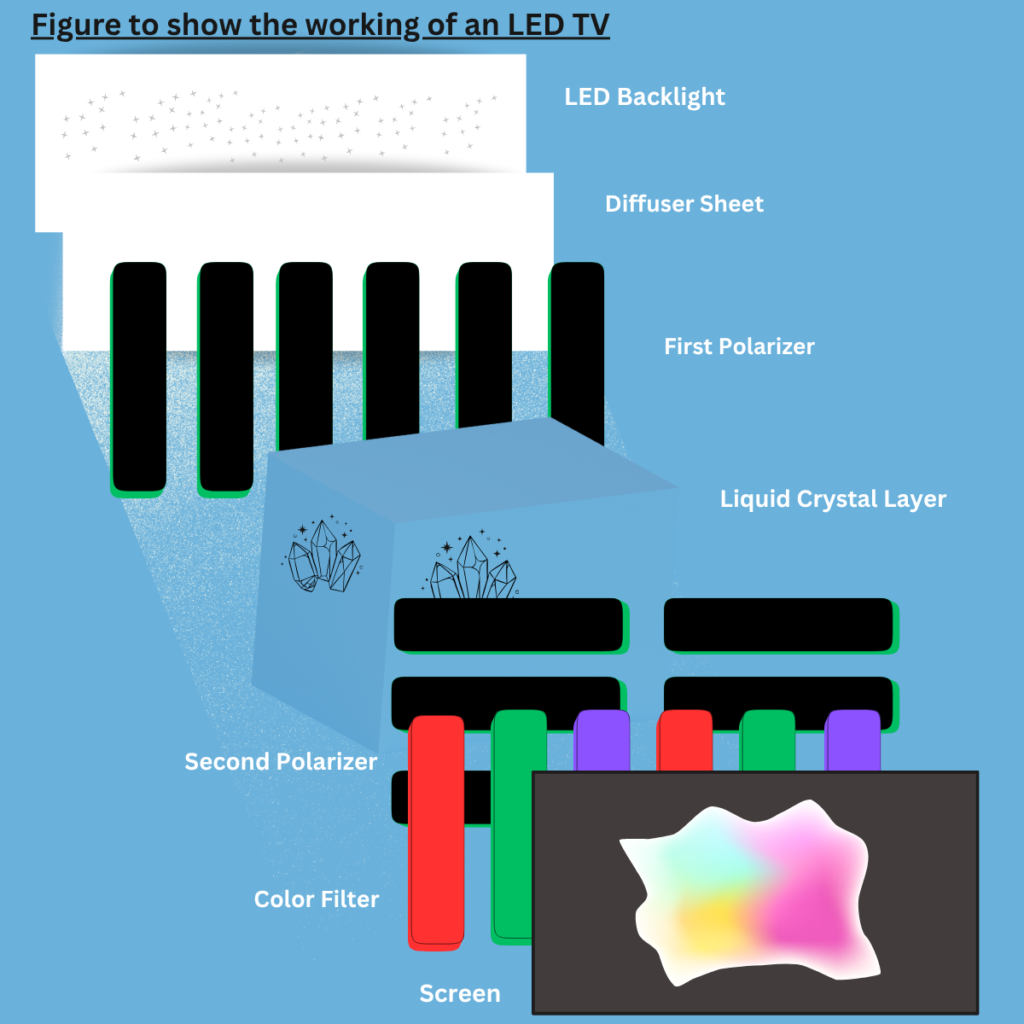
Note: The above image is just for understanding purpose and may not represent the actual working of an LED TV.
The LEDs in the backlight of an LED TV can be arranged in different ways, either spread across the entire back panel (full-array) or placed only along the edges (edge-lit).
Let the LED backlight is edge lit, i.e., the LEDs cover just its edges.
As a result, the light from the LEDs will be brighter near the edges and comparatively dimmer toward the center.
This leads to uneven brightness across the screen. The edges may appear brighter than necessary, while the center can look comparatively dim.
To solve this issue, a diffuser sheet is used to spread the light evenly in all directions.
Next, the evenly spread light moves through the first polarizer, which orients it in a vertical direction.
The liquid crystal layer receives digital high (1) and low (0) signals.
As shown in the figure below, we are concentrating on two vertically polarized light waves which are emerging from the first polarizer and then striking the liquid crystal layer.
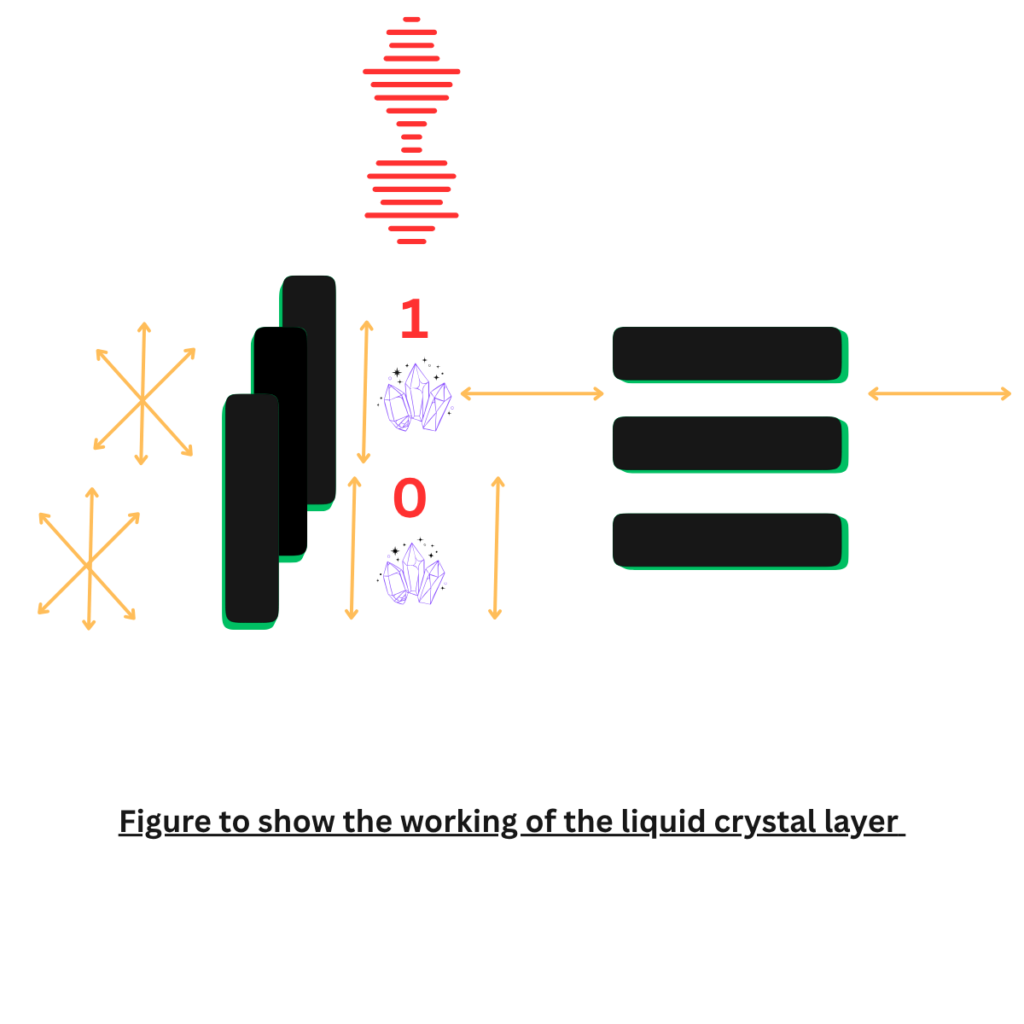
Assume the first liquid crystal receives a digital signal of “1”, while the second one receives “0”.
In response, the first crystal rotates the light by 90 degrees, whereas the second does not rotate it at all.
Consequently, the first light ray now becomes horizontally polarized (90 degrees rotation), while the second stays vertically polarized, just as it was before.
These two rays then pass to the second polarizer, which only permits horizontally polarized light to go through.
As a result, the first ray passes completely, while the second one is completely blocked.
The first light ray, now unblocked, proceeds to the color filter.
Assume it passes through a red filter. The red filter extracts the red component from the white light and allows only the red-colored light to reach the screen.
Since the second ray has already been blocked, the color filter in its path is no longer relevant.
Therefore, the region of the screen struck by the first light ray appears bright red, while the region corresponding to the second one remains dark.
This is in unison with the high and low digital signals received by the first and second liquid crystals, respectively.
In essence, a TV’s color gamut includes many shades of red, green, and blue which blend in varying proportions based on the digital signals the TV receives, allowing it to display a wide range of vivid colors on the screen.
If you’d like to learn more, you can read one of my articles on color bit depth to understand how many different colors a TV is capable of producing.
You can also check out my other article explaining how the TV makes millions of colors beyond just red, green, blue, white, and black.
That way, by varying the rotation angle of the liquid crystals, the production of various colors and their intensities across different areas of the screen can be precisely controlled.
This enables the display to produce vivid red, soft blue, light green, intense brighness, or complete darkness as needed.
What does a pixel in an LED TV mean?
Picture a direct route from the LED backlight to the TV screen, passing through the diffuser, liquid crystal layer, color filter, and the other LCD components.
The smallest segment along this route that contains everything needed to form part of the image can be called as a pixel in an LED TV.
This is typically referred to as an RGB pixel, which further consists of three subpixels: red, green, and blue.
A TV contains millions of these pixels, with the exact number determined by its resolution—but that’s a topic for another time.
Now, let’s quickly cover the various advantages and disadvantages of LED TVs.
Disadvantages of LED TVs
The LED backlight remains on at all times, illuminating the color filters no matter what the scene requires.
As a result, a bit of light can seep through even in dark portions of the image.
This prevents LED TVs from producing the deep, true blacks that OLED or micro-LED displays can achieve.
OLED TVs have pixels embedded in the display itself, thus don’t need a backlight.
They can turn off individual pixels entirely, which allows them to achieve nearly infinite contrast ratios with deep, true blacks, whereas LCD LED TVs often render these blacks as slightly gray.
For example, a night sky scene may not look completely dark on a typical LED TV, while on an OLED it appears pitch black with bright stars sharply defined against it.
That being said, LED displays can significantly improve their contrast performance through a technique called local dimming.
For instance, by using a number of tiny LEDs, commonly known as “mini-LEDs” in the backlight, the LED TVs achieve more precise control on their pixels, which helps them achieve a very good contrast ratio and produce deep blacks.
LCD TVs which use VA panels in general have good native contrast which can further be significantly enhanced (not at all like OLEDs) through local dimming.
However, this comes at the cost of viewing angles, meaning the image quality tends to degrade when viewed from off-center positions, with noticeable fading or color shift when seen from the sides.
IPS panels on the other hand, have good viewing angles but typically poor contrast.
The next disadvantage associated with LED TVs is that, when creating an image on an LED TV, the light has to normally pass through color filters that aren’t completely efficient, which reduces the overall brightness.
Consequently, LED LCD TVs have to glow brighter and thus, normally consume more energy.
That said, there are LCD TVs known as “QLED” (quantum dot- LED) displays which completely eliminate the use of color filters and thus, greatly preserve the intensity of light.
They use a blue backlight combined with a quantum dot layer that produces pure, monochromatic colors, which allows them to achieve a wide color gamut too.
One more key drawback of LED TVs is their relatively slower response than OLEDs, as the light rays experience slight delays while passing through the LCD layers.
On the other hand, self-emissive displays like OLEDs offer nearly instantaneous response times.
As a result, LED TVs are likely to encounter some motion blur during fast-paced action scenes.
Advantages of LED TVs
Although some light is lost as it travels from the backlight to the screen, LED backlights can still reach very high brightness levels because they use inorganic LEDs that do not typically degrade quickly over time, unlike OLEDs.
These inorganic LEDs are very durable and resistant to long-term wear, and thus, contribute to a very long lifespan and eliminate the risk of burn-in in LED TVs.
Moreover, a high peak brightness means these TVs are less impacted by bright viewing environments or sunlight glare.
As a result, LCD models that use mini-LED backlighting are among the best options for use in very bright rooms and can even perform well in outdoor environments.
Another benefit of LED TVs is that, they have a layered construction rather than relying on individually fabricated emissive pixels like OLED or micro-LED displays, where light-emitting elements are built directly into the panel.
This layered design makes the manufacturing of LED TVs more flexible and cost-effective, allowing them to be produced in a wide range of sizes, from compact 24-inch models to very large screens exceeding 98 inches.
Moreover, although LED response times are not as fast as those of OLEDs, they are still more than adequate if you are not a hardcore gamer.
High-end LCD TVs such as Neo QLED models also include a range of gaming features, including high refresh rates with VRR support which can help them deal with the motion blur.
Conclusion
LED-backlit LCD displays have been on the market for a very long time and are likely to remain relevant until truly self-emissive technologies become truly affordable and fully address their current limitations.
In addition, the wide range of size options, multiple resolution choices (including HD, 4K, and 8K), and a lot of price options among LED TVs make them truly stand out from the competition.
They offer high brightness, vibrant colors, affordability, and durability, making them one of the best choices for your home, especially for your bright living room.
This article explains LED TVs very well! I learned that LED TVs are actually a type of LCD TV that uses small light bulbs called LEDs for backlighting. It’s interesting how there are different types like edge-lit and full-array, which affect picture quality and brightness. The new Mini-LED technology sounds impressive too, giving better contrast and deeper blacks.
Hi ☺️ glad you found it worth .. yes about edge lit, full array related to local dimming .. I will release new articles soon.. plz keep visiting
Pingback: OLED vs QLED: Which TV is more costly and which is cheaper?