
Is an OLED TV power hungry? How much electricity does it use?
An OLED TV is not inherently power hungry, although it can consume considerable electricity when displaying bright images at high brightness levels.
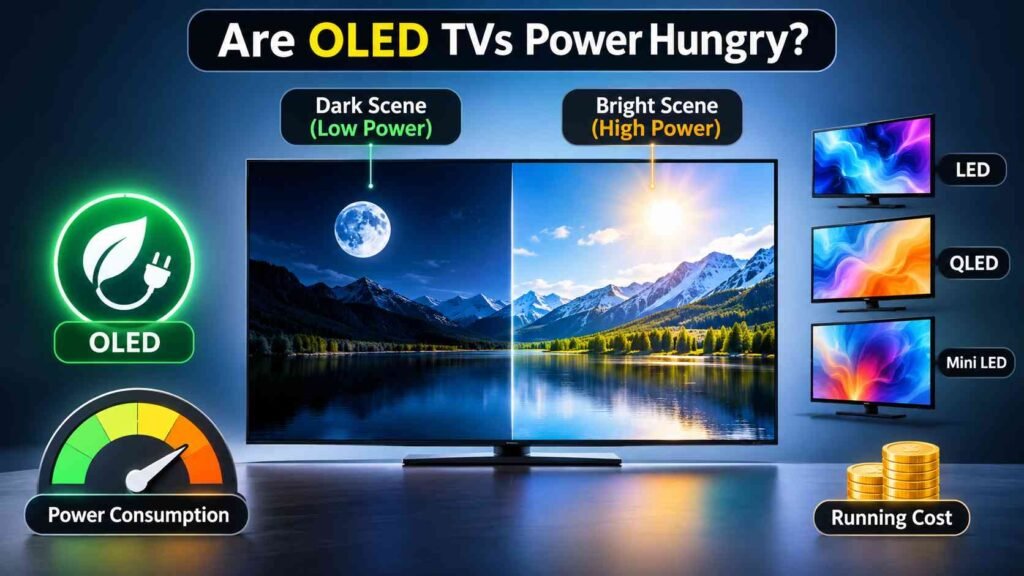
Unlike LED and QLED TVs, which use a backlight to illuminate their LCD panels, an OLED TV produces light directly from individual pixels.
This fundamental property of OLED makes its electricity consumption heavily dependent on what is displayed on the screen.
An OLED TV can consume relatively little electricity when displaying dark scenes because black pixels switch off completely.
However, displaying bright, predominantly white images can increase power consumption considerably.
Therefore, an OLED TV is not inherently expensive to operate, as its electricity consumption largely depends on screen size, brightness level, displayed content, and daily viewing hours.
Affiliate Disclosure: DisplayReviewz participates in the Amazon Associates Program. As an Amazon Associate I earn from qualifying purchases. If you buy a product through affiliate links in this article, we may earn a commission at no additional cost to you.
Is an OLED TV power hungry?
No, an OLED TV is not inherently power hungry, although it can consume considerable electricity when displaying bright images at high brightness levels.
Its power consumption changes according to the amount of light individual pixels produce, unlike conventional LED TVs, where a backlight illuminates the LCD panel.
An OLED pixel generates its own light, so it doesn’t need a separate backlight.
Each pixel can switched off itself independently to display perfect black levels and extraordinary contrast on the screen.
Consequently, displaying a dark scene requires considerably less electrical power than displaying a predominantly bright image.
While watching movies with dark cinematography, night scenes and extensive black backgrounds, a majority of OLED pixels produce little or no light, which reduces the display’s overall power requirements.
However, OLED power consumption can increase significantly when watching brightly lit sports, daytime television, animated content or scenes containing large white backgrounds.
A 2026 study by Minh Nguyen and colleagues at Fraunhofer FOKUS, published in Computers, which evaluated 14 smart TVs across 746 measurement sessions, demonstrated this behaviour.
Its measurements showed that OLED power consumption increased steadily from approximately 55 W to 180 W as image brightness increased across the luma ramp.
In contrast, LED-backlit TVs maintained relatively stable power consumption, largely unaffected by changes in picture brightness.
This explains that the electricity consumption of OLED TVs varies considerably with the brightness of the displayed content rather than remaining constant at a fixed wattage.
Let’s explore how much electricity an OLED TV uses, how its consumption compares with LED and QLED TVs, and what it actually costs to operate one.
How much electricity does an OLED TV use?
As stated before, OLED TV electricity consumption varies by screen size, panel generation, picture settings and the type of content being displayed.
A larger TV generally requires more power because it has a larger illuminated display area, while brighter OLED models can draw considerably more electricity.
For a practical example, Samsung’s official 2024 S90D OLED specifications list the following power consumption figures:
| Specification | 55-inch S90D | 65-inch S90D |
|---|---|---|
| Typical power consumption | 112W | 146W |
| Maximum power consumption | 290W | 390W |
| Standby power | 0.5W | 0.5W |
Another example comes from ENERGY STAR’s certification of the 48-inch LG B4 OLED, which has a reported average on-mode power consumption of 81.3W and annual energy consumption of 151kWh.
These figures provide a useful indication of how much electricity a modern OLED TV can consume.
Notice that the maximum rated power is considerably higher than typical consumption.
That said, the maximum power represents a higher-demand operating condition, not what the TV continuously draws during normal watching.
How many watts does an OLED TV use per hour?
An OLED TV does not consume a fixed amount of electricity every hour.
Its power consumption varies depending on screen brightness, displayed content and picture adjustments.
For example, a 55-inch Samsung S90D has a typical rated power consumption of 112 W.
If it maintained that power draw for one hour, it would consume 112 Wh, equivalent to 0.112 kWh or 0.112 units of electricity.
Similarly, a 65-inch model rated at 146 W would consume 0.146 kWh in one hour at that power level.
Here, watts (W) measure instantaneous power, whereas kilowatt-hours (kWh) measure the electricity actually consumed over time.
Therefore, saying that a TV consumes these many watts per hour is technically incorrect.
But still, to have an idea, using Samsung’s official power ratings, we can estimate the electricity consumption of these two OLED TVs per day and year when watched for three hours daily.
| Calculation | 55-inch OLED | 65-inch OLED |
|---|---|---|
| Typical power | 112 W | 146 W |
| Electricity per hour | 0.112 kWh | 0.146 kWh |
| Electricity per day (3 hours) | 0.336 kWh | 0.438 kWh |
| Electricity per month (30 days) | 10.08 kWh | 13.14 kWh |
| Electricity per year (365 days) | 122.64 kWh | 159.87 kWh |
Why does OLED TV power consumption vary with picture?
The biggest difference between OLED and conventional LED TV power consumption comes from how these displays produce light.
OLED panels use self-emissive pixels, meaning each pixel produces its own light.
When a pixel needs to reproduce black, it can switch off completely instead of producing light.
LCD TVs, on the other hand, use an LED backlight behind the liquid crystal layer.
The liquid crystals control how much backlight passes through to produce the image, but the backlight itself still requires electricity.
Consequently, OLED power consumption is closely related to the average picture level (APL), which represents the average signal level of the pixels across the displayed image, as defined by the IEC standard.
A higher APL generally means more OLED pixels are producing light, increasing the panel’s electrical demand.
A lower APL means more of the picture consists of darker areas, potentially reducing consumption.
Do OLED TVs use less power when displaying black?
Yes. OLED TVs can consume significantly less power when displaying black images because individual pixels can switch off completely.
For example, when watching a movie with black letterbox bars at the top and bottom, the OLED pixels in those areas do not need to illuminate.
The same applies to dark backgrounds, black objects and completely black portions of an image.
This is one of the important advantages of OLED’s self-emissive nature.
Unlike LCD TVs, which must manage light from a separate backlight, OLED can eliminate light output at individual pixel locations.
However, it is important to understand that switching off black pixels does not switch off the entire TV.
The processor, sound system and other electronic components continue consuming electricity.
Therefore, displaying a black screen on an OLED TV reduces power consumption considerably, but does not eliminate it entirely.
Do bright and white images consume more electricity on OLED TVs?
Yes.
Bright images, especially those containing large white areas, can increase OLED power consumption considerably.
Unlike black pixels, which can switch off, white pixels require the red, green and blue components of the OLED display to produce light simultaneously.
When a large proportion of the screen displays white, more pixels must operate at higher brightness levels.
For instance, displaying a predominantly white webpage, spreadsheet or computer desktop can require more power than watching a dark movie.
This behaviour is particularly noticeable when comparing OLED with conventional LED-backlit LCD televisions.
The LCD backlight operates relatively independently of the displayed image, whereas OLED power consumption responds directly to pixel illumination.
Consequently, an OLED TV used extensively for bright desktop applications is likely to consume more electricity than one primarily used for dark cinematic content.
How does screen brightness affect OLED power consumption?
Increasing OLED brightness requires individual pixels to produce more light, which typically increases their electrical demand.
The effect becomes more pronounced when a large portion of the screen is bright simultaneously.
For instance, watching a dark movie at moderate brightness may require relatively little power.
However, displaying a bright outdoor sports broadcast at maximum brightness can considerably the TV’s overall power consumption.
That said, modern OLED TVs also employ power-management mechanisms to regulate brightness and prevent excessive electrical and thermal demands.
Does HDR increase OLED power consumption?
HDR can increase OLED power consumption, particularly when the content contains bright highlights and a large amount of illuminated screen area.
HDR formats such as HDR10, HDR10+ and Dolby Vision allow compatible TVs to reproduce a wider range of brightness levels.
The best OLED TVs nowadays like Samsung S95F can produce exceptionally bright highlights, though maintaining high brightness across larger portions of the screen requires more electrical power.
If you want the brightest and most vibrant OLED, which is great for gaming and bright living rooms, the Samsung S95F OLED TV is just for you.


However, HDR does not automatically mean higher power consumption in every scene.
A dark HDR movie with occasional bright highlights is likely to consume less electricity than an SDR programme displaying a predominantly bright image.
Therefore, it is more accurate to associate OLED power consumption with the brightness distribution of the content, rather than simply whether HDR is enabled or not.
OLED vs LED vs QLED: Which TV consumes more electricity?
OLED uses self-emissive pixels, whereas LED and QLED TVs rely on an LED backlight behind an LCD panel.
Consequently, OLED power consumption varies significantly with image brightness, while LED and QLED power draw is generally more stable.
The 2026 study by researchers from Fraunhofer FOKUS discussed earlier in this article supports this distinction.
It shows that OLED consumption rises substantially with increasing image brightness, unlike the comparatively stable power draw of LED-backlit displays.
| Display technology | Working method | Power consumption |
|---|---|---|
| OLED | Individually illuminated pixels | Changes considerably with picture brightness |
| LED LCD | LCD panel with LED backlight | Relatively consistent backlight power |
| QLED LCD | Quantum-dot colour layer with LED backlight | Generally similar to LED TV’s backlight-dependent behaviour |
| Mini-LED LCD | LCD panel with many smaller backlight zones | Varies with backlight brightness and local dimming |
Conventional LED TVs can consume less electricity than OLED models when displaying bright images because their backlight illuminates the entire display independently of individual pixels.
OLED, however, can be more efficient with dark content because black pixels consume virtually no power.
QLED TVs follow a similar power consumption pattern to conventional LED TVs, as their quantum-dot layer improves colour reproduction without eliminating the need for a backlight.
Mini-LED TVs offer precise local dimming through numerous tiny dimming zones, which allows them to reduce illumination in dark areas, although bright scenes can still demand considerable power.
LED and QLED TVs generally consume less electricity with bright content, while OLED can consume less with dark content. Mini-LED can also be efficient through local dimming, but no technology consistently consumes the least electricity across all viewing conditions.
How much does it cost to run an OLED TV? [Monthly & annual electricity cost]
The cost of running an OLED TV depends on its average power consumption, daily viewing hours and local electricity tariff.
Using the US average residential electricity rate of approximately $0.182 per kWh (August 2026, according to the EIA), a 55-inch Samsung S90D with a typical power rating of 112 W consumes approximately 10.08 kWh per month when operated for three hours daily, costing around $1.83 per month or $22.27 annually.
Similarly, the 65-inch S90D, rated at 146 W, consumes approximately 13.14 kWh monthly, costing $2.39 per month or $29.03 annually.
| OLED TV | Monthly consumption | Monthly cost | Annual consumption | Annual cost |
|---|---|---|---|---|
| 55-inch S90D (112 W) | 10.08 kWh | $1.83 | 122.64 kWh | $22.27 |
| 65-inch S90D (146 W) | 13.14 kWh | $2.39 | 159.87 kWh | $29.03 |
Note: Estimates assume 3 hours of daily viewing and an electricity rate of $0.182/kWh. Standby consumption and additional utility charges are excluded.
That said, the residential electricity rates differ considerably between countries and regions.
Thus, it is advised use your local electricity tariff to calculate a more accurate running cost.
Do OLED TVs consume electricity in standby mode?
Yes. OLED TVs continue consuming a small amount of electricity in standby mode, although this is considerably lower than their normal operating consumption.
Standby power supports functions such as remote-control activation, network connectivity and background operations.
For example, Samsung lists 0.5 W standby consumption for both the 55-inch and 65-inch S90D OLED models.
India’s Bureau of Energy Efficiency (BEE) also specifies a maximum standby passive power consumption of 0.5 W for UHD TVs under its applicable labelling framework.
At a continuous 0.5 W draw, standby consumption would amount to approximately 0.36 kWh per month or 4.38 kWh annually.
How to reduce OLED TV power consumption
You can reduce OLED TV power consumption by lowering screen brightness when full luminance isn’t necessary, particularly when watching SDR content in a dim room.
Enabling automatic brightness control and suitable Eco settings can further limit unnecessary power draw.
Moreover, switching off the TV when not in use and disabling unnecessary quick-start or network standby features can too reduce additional consumption.
That being said, reducing excessive brightness and operating hours offers the most meaningful savings.
Are OLED TVs energy efficient?
The efficiency of OLED TVs depends heavily on the type of content they display.
Their ability to switch off individual pixels gives them a clear advantage when reproducing dark scenes.
However, producing bright images across the entire screen can require substantial electrical power.
That said, modern OLED panels have become more efficient over successive generations.
RTINGS‘ analysis of its television testing data found that 2025–2026 OLED models used approximately 33% less power than 2020–2021 models to produce the same 50% APL, 100-nit checkerboard pattern after adjusting for panel size.
This is an important development because manufacturers can now use efficiency improvements to achieve higher brightness levels.
Conclusion
OLED TVs are not inherently power hungry, and their electricity consumption is often lower than many of us assume.
Their self-emissive pixel technology allows them to consume less power when displaying dark scenes, but bright images, high screen brightness and demanding HDR content can increase electricity usage considerably.
I will consider the difference in electricity costs of an OLED alongside its picture quality, screen size and my personal viewing habits.
FAQs (Frequently Asked Questions)
1. Do OLED TVs use more electricity than LED TVs?
Not necessarily. OLED TVs can consume less electricity when displaying dark scenes, while conventional LED TVs can have an advantage when displaying bright images.
2. Does watching HDR content increase OLED electricity consumption?
It can. HDR content with bright highlights and large illuminated areas can increase power consumption, although dark HDR scenes typically consume less electricity than bright SDR content.
3. Do larger OLED TVs consume more electricity?
Generally, yes. Larger OLED screens have more display area and can require more power to produce the same brightness.
4. Does OLED consume less electricity in dark mode?
Mostly, yes. Dark backgrounds require fewer pixels to produce light, which reduces the display’s electrical demand.
5. How much electricity does a 65-inch OLED TV consume?
It varies by model. For example, Samsung’s 65-inch S90D has a typical rated power consumption of 146 W. At three hours of daily use, this corresponds to approximately 13.14 kWh per month.
Pingback: OLED TV Buying Guide 2026 [With The 7 Best OLEDs] -