
Do OLED TVs lose brightness over time? Can you leave them on 24/7?
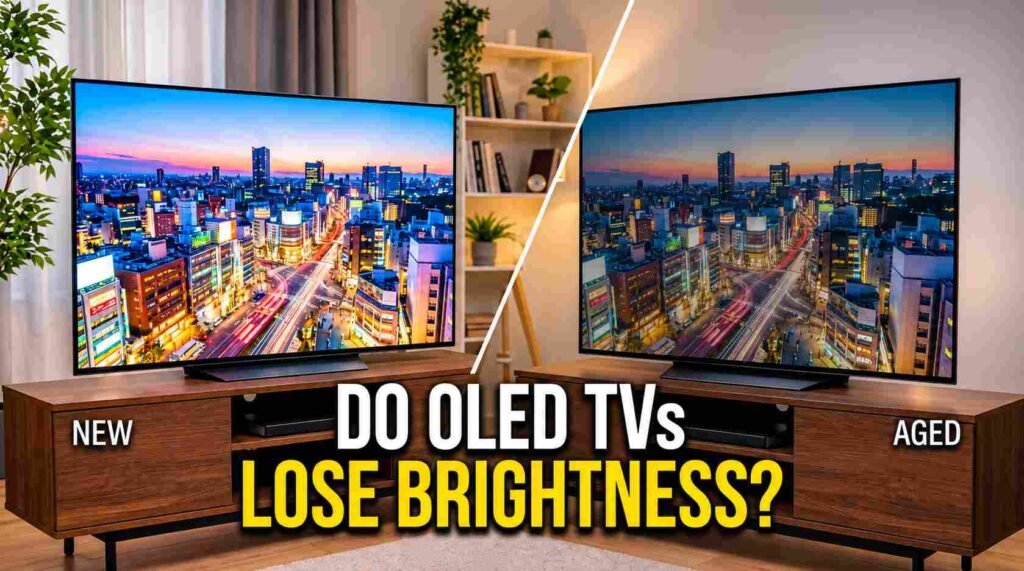
OLED TVs gradually lose brightness as their organic light-emitting materials age.
Unlike LED and QLED TVs, which use an LED backlight, OLED TVs generate light directly from their pixels.
Every time these pixels produce light, their organic materials undergo gradual degradation, which eventually reduces their ability to maintain their original luminance.
Brightness degradation is a normal characteristic of organic display technology in which the light output of OLED pixels gradually decreases with accumulated usage.
Blue-emitting materials, about which we will see later, are particularly challenging because they generally have lower operational stability than red and green emitters.
However, modern OLED TVs are considerably more efficient and brighter than earlier generations.
That said, their actual longevity depends on factors like operating hours and brightness levels as well.
You can watch an OLED TV for several hours daily without worrying about rapid brightness loss.
However, leaving it running continuously at high brightness is less favourable for its long-term performance.
But this does not mean an OLED will become noticeably dim after a few years of normal use.
Let’s examine what actually happens to OLED brightness over time, what practical longevity tests reveal, and how to keep an OLED TV looking its best for years.
Do OLED TVs lose brightness over time?
Yes. OLED TVs gradually lose peak brightness as their organic light-emitting materials age.
This process is known as OLED luminance degradation.
It happens progressively rather than suddenly, so an older TV may produce less light than when it was new, even if its picture settings remain unchanged.
OLED lifespan is often expressed in terms of the operating hours required for a display’s brightness to fall to 50% of its initial luminance, commonly called its LT50 or half-luminance lifetime.
However, this is a laboratory measurement, not a prediction that your TV will suddenly become unusable after reaching that point.
A peer-reviewed review published in Light: Science & Applications in 2018, identifies OLED operational lifetime, particularly blue OLED stability, as an important engineering challenge.
It also notes that a lifetime exceeding 30,000 hours had become a normal consumer expectation for large OLED TVs.
To understand what that means in everyday use:
| Daily viewing | 30,000 operating hours |
|---|---|
| 4 hours | 20.5 years |
| 6 hours | 13.7 years |
| 8 hours | 10.3 years |
| 10 hours | 8.2 years |
| 12 hours | 6.8 years |
| 24 hours | 3.4 years |
However, the important point to note here is that, OLED brightness degradation is gradual, and reaching a particular operating-hour figure does not mean the panel stops working.
Its brightness, colour performance, and uniformity can change at different rates.
Why do OLED TVs lose brightness?
The main reason why OLED TVs lose brightness is the gradual degradation of organic electroluminescent materials.
When electrical current passes through an OLED pixel, its organic emissive layers produce light.
Numerous repeated operations may changes the efficiency of these materials, reducing their light output over time.
Blue OLED subpixels age faster
Blue OLED emitters are generally less stable and have historically presented a greater lifetime challenge than red and green emitters.
Producing blue light efficiently has required more demanding material and device engineering, which makes blue-emitter longevity a major focus of OLED research.
This is important because an OLED display needs balanced red, green, and blue output to create accurate colours and white tones.
If blue emission loses efficiency faster than the other colour components, the display’s colour balance can shift as it ages.
That said, the exact effect depends on the panel architecture.
It means that traditional RGB OLED arrangements, LG’s white-OLED (WOLED) panels, and Samsung’s QD-OLED panels do not all generate their colours in the same way.
Therefore, a blue-emitter degradation figure from one OLED structure should not automatically be applied to every OLED TV.
Higher brightness increases electrical stress
OLED pixels require more electrical drive to produce higher luminance.
Sustained high output can therefore accelerate the degradation of their emissive materials.
For example, displaying a bright HDR scene occasionally is different from operating the panel at maximum output for many hours every day.
The latter creates a greater cumulative power demand on the light-emitting materials.
RTINGS’ August 2026 testing of OLED TVs found that 2025–2026 OLED TVs used approximately 33% less power than 2020–2021 models for a comparable 100-nit checkerboard pattern, after adjusting for screen size.
This demonstrates that modern OLED panels have become more efficient.
However, greater brightness capability does not mean their organic materials no longer age.
Heat accelerates material degradation
Higher temperatures can accelerate chemical and physical degradation within organic emissive layers.
When a TV operates at high brightness for extended periods, producing more light increases electrical demand and can increase heat generation.
Here, the panel design, heat-dissipation structures, ventilation, and internal thermal management all influence how effectively an OLED TV handles this load.
Consequently, two OLED TVs operating for the same number of hours may not experience identical ageing.
How long does an OLED TV last?
There is no single lifespan applicable to all OLED TVs.
Again, the type of organic materials, brightness, operating temperature, and daily usage pattern determine how quickly the display ages.
The commonly discussed 30,000-hour operational-lifetime benchmark provides a useful reference, but it should not be confused with a guaranteed service life.
For instance, a television used for eight hours daily accumulates approximately 29,200 operating hours in ten years.
This illustrates why OLED TVs can provide a decade or more of use without necessarily experiencing severe brightness deterioration.
There is also an important distinction between panel lifetime and television lifetime.
The display panel may continue functioning while other components, such as the power supply, mainboard, or electronic connections, might develop faults.
Conversely, the television can remain operational even after some reduction in peak brightness.
Does leaving an OLED TV on all day reduce its lifespan?
Yes, continuous operation contributes to cumulative OLED pixel ageing because the organic materials continue to experience electrical stress whenever the display produces light.
However, leaving an OLED TV on for 8–12 hours daily does not automatically cause rapid brightness loss.
Consider a TV used for eight hours daily compared with one running for 16 hours daily.
The second television accumulates 5,840 operating hours annually, compared with 2,920 hours for the first.
It therefore reaches the same cumulative operating time in half as many calendar years.
This does not mean its brightness will decrease at exactly twice the rate, because OLED degradation is not necessarily linear.
Nevertheless, unnecessary continuous operation is likely to increase cumulative usage.
If you leave your television on while nobody is watching, you are adding operating hours without gaining any viewing benefit.
This is a matter of common sense, right?
Can you leave an OLED TV on 24/7?
Technically, yes, but it is not recommended as a regular habit.
This is because, continuous operation increases cumulative panel usage and prevents the TV from entering standby for scheduled compensation processes.
Therefore, switch it off using the remote when you have finished watching, rather than leaving it running unnecessarily.
Does an OLED TV automatically reduce brightness?
Yes. OLED TVs use automatic brightness management to control power consumption, temperature, and panel stress.
However, this does not mean the TV permanently reduces its brightness as the panel ages.
One important feature of OLED TVs is Automatic Brightness Limiter (ABL).
It reduces screen brightness when a large portion of the display produces light simultaneously.
For example, an OLED TV can produce very bright highlights in a dark HDR movie but may reduce luminance when displaying a predominantly white image.
This happens because illuminating a large area requires considerably more power than illuminating a small portion of the screen.
ABL manages this demand to keep the panel within its operating limits.
Some models also incorporate thermal brightness management, which can temporarily reduce output when operating temperatures become high.
But keep in mind that these adjustments are different from permanent OLED luminance degradation, as the TV can restore its brightness when the demanding operating conditions end.
Does high brightness accelerate OLED pixel degradation?
Yes. Consistently operating an OLED panel at high brightness can accelerate organic material degradation because the pixels require greater electrical drive to produce more light.
For example, an OLED TV displaying SDR content at moderate brightness generally places less demand on its emissive materials than one continuously producing high luminance.
The difference becomes particularly relevant during prolonged viewing sessions.
RTINGS’ 2026 OLED analysis also explains that higher light output generally increases cumulative pixel stress.
Its researchers found substantial efficiency improvements in newer panels, which allows them to deliver higher brightness without proportionally increasing power.
However, they did not establish a universal number of additional operating hours gained by reducing brightness.
So, you do not need to keep your OLED TV unnecessarily dim.
Just use an appropriate picture mode for your room and content, and enjoy HDR at its intended brightness.
How to maintain OLED brightness and extend panel life
Avoid running the TV at maximum brightness unnecessarily, but enjoy HDR content at its intended settings.
Ensure adequate ventilation to prevent heat accumulation, keep automatic brightness and panel-protection features enabled, and switch off the television when not in use.
Also, allow automatic pixel compensation cycles to complete by leaving the TV connected to power in standby.
These measures help reduce unnecessary pixel stress and maintain long-term display performance.
Final Verdict
OLED TVs gradually lose brightness because their organic light-emitting materials age with use.
Blue emitters have historically been a particular challenge because of their lower operational stability, while sustained high brightness and heat can further accelerate material degradation.
Nevertheless, modern OLED panels have become considerably more efficient and brighter than earlier generations.
A TV used for 8–12 hours daily can provide many years of viewing, and there is no need to avoid normal HDR content or keep the screen artificially dim.
Moreover, you can leave an OLED TV running for extended viewing sessions, but operating it 24/7 unnecessarily increases cumulative usage.
Switch it off when not needed, allow automatic compensation cycles to complete, and provide adequate ventilation.
Finally, OLED brightness loss is a gradual part of the display’s natural ageing process.
It’s indeed worth understanding, but certainly not a reason to hold back from enjoying the exceptional picture quality OLED TVs offer.
## Frequently Asked Questions
1. Do OLED TVs lose brightness after five years?
Yes. OLED TVs gradually lose brightness as their organic pixels age, however the actual effect depends on other factors as well, like operating hours, brightness levels, etc. With normal usage, the reduction is rarely noticeable after five years.
2. Do blue OLED pixels degrade faster than red and green?
Generally, yes. Blue OLED emitters have historically been less stable than red and green emitters, making them more susceptible to brightness degradation over time. However, the extent of degradation varies with the OLED panel architecture and materials used.
3. How many hours can an OLED TV last?
OLED TVs are commonly associated with operational-lifetime expectations of 30,000 hours or more, although this is not a guaranteed lifespan for every model. Actual longevity depends on panel efficiency, operating brightness, temperature, and usage patterns.
4. Is it safe to leave an OLED TV on for 12 hours daily?
Yes. An OLED TV can handle 12 hours of daily watching, preferably when displaying varied content. However, longer operating hours might increase cumulative pixel ageing, so switching it off when not in use helps avoid unnecessary wear.
5. Does high brightness reduce OLED lifespan?
Yes. Sustained high brightness increases the electrical load on OLED pixels, typically accelerating the degradation of their organic light-emitting materials. That said, occasional bright HDR scenes are generally not a concern, but prolonged operation at maximum brightness can contribute to faster ageing.
Pingback: OLED TV Buying Guide 2026 [With The 7 Best OLEDs] -