
How does QD-OLED work and produce colors? How bright is it?
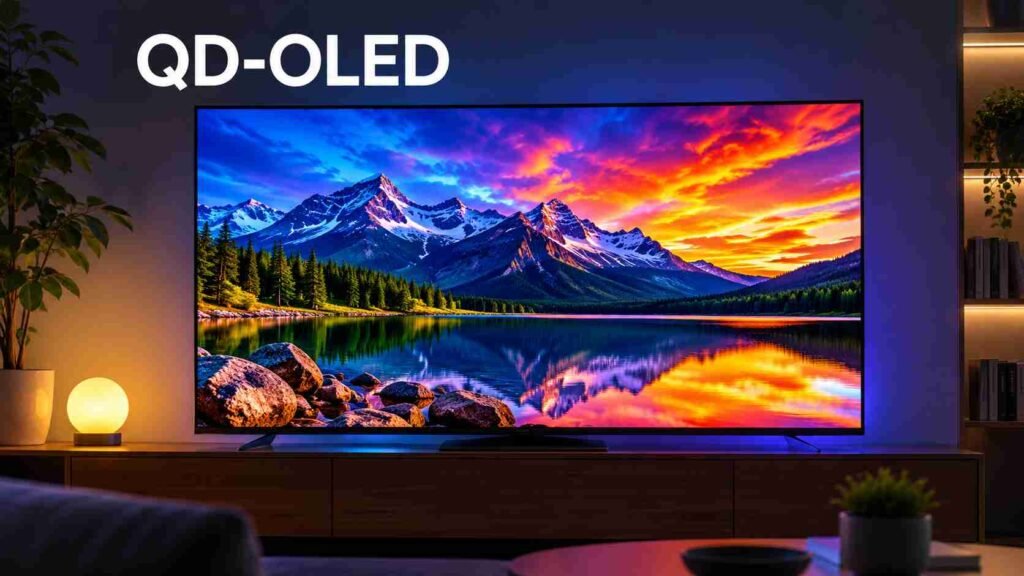
QD-OLED stands for Quantum Dot Organic Light-Emitting Diode.
It is a self-emissive OLED display technology that combines blue OLED light sources with quantum dots to produce red and green colours.
Unlike conventional QLED TVs, which use an LCD panel and LED backlight, QD-OLED pixels generate their own light, eliminating the need for a separate backlight.
Each of its pixel emits its own light, producing excellent contrast and shadow detail with no backlight blooming.
It is therefore a true OLED technology rather than a combination of conventional QLED and OLED displays.
Affiliate Disclosure: DisplayReviewz participates in the Amazon Associates Program. As an Amazon Associate I earn from qualifying purchases. If you buy a product through affiliate links in this article, we may earn a commission at no additional cost to you.
Who makes QD-OLED Panels?
Samsung Display developed QD-OLED technology and introduced its first commercial panels in 2022.
Samsung Display is the primary manufacturer of QD-OLED panels, supplying them to TV and monitor brands such as Samsung and Sony.
Successive panel generations have brought improvements in brightness and colour performance making newer QD-OLED TVs and monitors more capable than earlier models.
How does QD-OLED work and produce colours?
By controlling each self-emissive subpixel independently, QD-OLED produces a full range of colours along with true blacks.
QD-OLED uses blue OLED light sources beneath a quantum dot colour-conversion layer.
The quantum dots convert portions of blue light into highly saturated red and green light, while the remaining blue light accounts for the blue subpixels.
This differs from traditional WOLED technology, which uses white OLED light sources and colour filters to produce RGB colours.
Unlike WOLED, which uses white OLED light and colour filters to produce RGB output (along with a white subpixel in typical WRGB designs), QD-OLED uses quantum dots to convert blue OLED light into highly saturated red and green light.
It does not use a conventional white OLED layer or a separate LCD backlight.
It is important to note that quantum dots themselves are not OLED technology; they are semiconductor nanocrystals that convert light into specific colours.
Thus, it is now clear that QD-OLED generates colours using blue OLED light sources and red and green quantum dot colour converters.
Let’s simplify the process even further:-
- Blue OLED subpixels generate blue light directly.
- Red quantum dots absorb blue OLED light and re-emit it as pure red light.
- Green quantum dots absorb blue OLED light and re-emit it as pure green light.
These three RGB subpixels combine at different intensities to create the full range of colours on the screen.
As we saw, QD-OLED combines the perfect blacks and the virtually infinite contrast of OLED with the vibrant colours of quantum dots.
Its quantum dot colour-conversion layer produces results in a wide colour gamut, fantastic colour accuracy and higher colour volume than conventional WOLED displays.
QD-OLED also offers wide viewing angles, which preserves colour and contrast when viewed from the sides.
Moreover, its motion handling is also excellent because OLED pixels switch extremely quickly, reducing motion blur in fast-moving scenes.
How bright is QD-OLED and how does it handle HDR content?
QD-OLED combines blue OLED light with red and green quantum dot layers to produce pure red, green and blue light without conventional colour filters.
This improves light efficiency and allows it to deliver higher colour brightness and more saturated colours than many conventional WOLED panels, which rely on colour filters and a white subpixel to boost brightness.
For example, the Samsung S95F QD-OLED reaches approximately 2,109 nits of peak HDR brightness in a 10% window, producing intense highlights in sunlight, explosions and reflections.
Its quantum dot technology maintains rich, saturated colours at high brightness, giving it excellent HDR colour volume.
Its excellent colour volume also helps bright HDR colours retain their richness and saturation while preserving OLED’s perfect blacks.
That said, the best mini-LED TVs can still outperform it in sustained full-screen brightness.
In terms of HDR format support, Samsung QD-OLED TVs support HDR10 and HDR10+ on compatible models but lack Dolby Vision compatibility.
Sony QD-OLED models support Dolby Vision but lack the HDR10+ support.
Do QD-OLED blacks look purple in bright rooms?
Unlike conventional WOLED panels, QD-OLED displays lack a traditional polarizing layer, allowing ambient light to interact with the quantum dot and OLED layers.
As a result, black areas can develop a purple or magenta tint when exposed to strong ambient light instead of retaining their deep, inky appearance.
This raises perceived black levels and reduces contrast in brightly lit environments.
The effect is particularly noticeable when sunlight or bright room lighting falls directly on the screen.
In darker rooms, however, QD-OLED retains those true, inky blacks.
How is QD-OLED for viewing in bright rooms?
QD-OLED TVs are very suitable for moderately bright rooms as they deliver high peak brightness with vibrant colours and excellent contrast.
However, they typically cannot sustain the full-screen brightness of high-end mini-LED TVs (like the Samsung Neo QLEDs), which makes mini-LED a better choice for rooms with strong sunlight or large windows.
QD-OLED TVs use glossy or semi-glossy finishes on many models, which can reflect windows and indoor lighting.
Although anti-reflection coatings help reduce distracting reflections, they cannot eliminate them completely.
QD-OLED models with matte coatings, such as the Samsung S95F, handle reflections very effectively.
However, direct sunlight and strong ambient light can still raise perceived black levels and reduce contrast, making high-end LCD TVs better suited to very bright rooms.
Does QD-OLED have better viewing angles than LED TVs?
QD-OLED offers exceptionally wide viewing angles because its self-emissive pixels maintain colour accuracy, contrast and brightness when viewed from the sides.
This makes QD-OLED much suitable for large living rooms and wide seating arrangements where viewers watch the screen from different positions.
Unlike many VA LCD TVs, which experience noticeable contrast and colour degradation at wider angles, QD-OLED retains consistent picture quality across a wider seating area.
In fact, it offers wider viewing angles than all conventional LCD TVs, including many IPS models too while remains highly competitive with other self emissive displays, like WOLEDs and micro-LEDs.
Is QD-OLED good for competitive gaming? What gaming features does it support?
QD-OLED offers virtually instantaneous pixel response times (around 0.1 ms), low input lag and highly smooth motion with minimal motion blur. Its low input lag improves responsiveness to controller or keyboard inputs.
Moreover, its self-emissive pixels deliver deep blacks, vibrant HDR colours and excellent contrast, making it highly immersive for dark and visually demanding games.
It is also well suited to competitive gaming, especially fast-paced FPS games, where quick pixel transitions help maintain image clarity during rapid movement.
QD-OLED monitors and TVs are available with high refresh rates, including 120Hz, 144Hz, 165Hz and 240Hz on selected models, whixh makes them highly suitable for PC gaming, PS5 and Xbox consoles.
However, high-end IPS monitors can still be a more affordable choice for competitive gaming, although QD-OLED offers much superior contrast and colour accuracy.
Modern QD-OLED gaming displays support advanced features such as HDMI 2.1, 4K at 120Hz, high refresh rates, Variable Refresh Rate (VRR), AMD FreeSync and NVIDIA G-Sync compatibility, depending on the model.
These technologies synchronise the display’s refresh rate with the graphics card or console output to reduce screen tearing and stuttering.
Does QD-OLED have burn-in or image retention problems during gaming?
QD-OLED TVs can experience temporary image retention and even permanent burn-in over time, as their organic OLED pixels gradually wear with use.
Extended gaming sessions involving static HUD elements, health bars, scoreboards and other fixed graphics can increase burn-in risk, particularly when the same game is played repeatedly at high brightness.
However, built-in protection features such as pixel shifting, panel refresh cycles and logo detection help reduce the risk.
QD-OLED is generally safe for regular gaming when used sensibly, but it is not completely immune to burn-in during prolonged gaming sessions.
In a nutshell, varying content and avoiding unnecessarily prolonged high brightness can help preserve the life of the panel.
How much does a QD-OLED TV cost compared to WOLED and mini-LED?
QD-OLED TVs occupy the premium TV segment, and their prices vary by screen size, panel generation and brand.
In the US, the 65-inch Samsung S95H flagship has a list price of around $3,299, while the 65-inch Sony Bravia 8 II QD-OLED is listed at $3,299.99, with current promotional pricing around $2,499.99.
By comparison, the 65-inch LG C6 WOLED is positioned below the flagship models, generally around the $2,000 price bracket.
High-end mini-LED TVs are available at lower prices, which are attractive alternatives for buyers who prioritise brightness over OLED-level blacks.
Meanwhile, older-generation QD-OLED models can offer considerably better value when discounted.
One of the standout QD-OLED models featured in our list of the best OLED TVs is the Samsung S95F, which delivers exceptional brightness and handles screen glare remarkably well, even in brightly lit rooms.
If you want the brightest and most vibrant OLED, which is great for gaming and bright living rooms, the Samsung S95F OLED TV is just for you.


What are the main disadvantages of QD-OLED TVs?
Despite its excellent colour reproduction and contrast, QD-OLED has some drawbacks, including the risk of permanent burn-in, lower sustained full-screen brightness than high-end mini-LED TVs, and raised black levels with a purple tint in brightly lit rooms.
Its glossy screen can reflect windows, lights and other bright objects in the room, which may cause distracting glare and reducing perceived picture clarity, particularly in brightly lit environments.
Moreover, QD-OLED TVs typically cost much more than conventional LED and WOLED models of the same screen size.
Frequently Asked Questions (FAQs)
1. Does QD-OLED support Dolby Vision?
QD-OLED itself does not determine HDR format support. Samsung QD-OLED TVs support HDR10 and HDR10+ but lack Dolby Vision, whereas compatible Sony QD-OLED models support Dolby Vision.
2. What type of screen coating does a QD-OLED TV use?
Most QD-OLED TVs feature a glossy or semi-gloss screen coating for vibrant colours and image clarity. However, some models, such as Samsung’s S95F, use a matte coating to reduce reflections.
3. Does QD-OLED require regular pixel cleaning or panel refresh?
Yes. QD-OLED TVs use automatic pixel-refresh and panel-maintenance routines to compensate for uneven pixel wear and maintain screen uniformity. These processes generally run automatically during standby.
4. What is the difference between first-generation and newer QD-OLED panels?
Newer QD-OLED generations typically offer improvements in peak brightness, colour volume, power efficiency and panel durability.
5. Are QD-OLED TVs suitable for watching sports and fast-moving content?
Yes. QD-OLED’s near-instantaneous pixel response, excellent motion clarity and wide viewing angles make it particularly suitable for fast-moving sports, action movies and gaming.
Pingback: WOLED vs QD-OLED vs Mini-LED TVs: Best HDR performance?