
What is Samsung’s Glare Free and how does it compare to other brands?
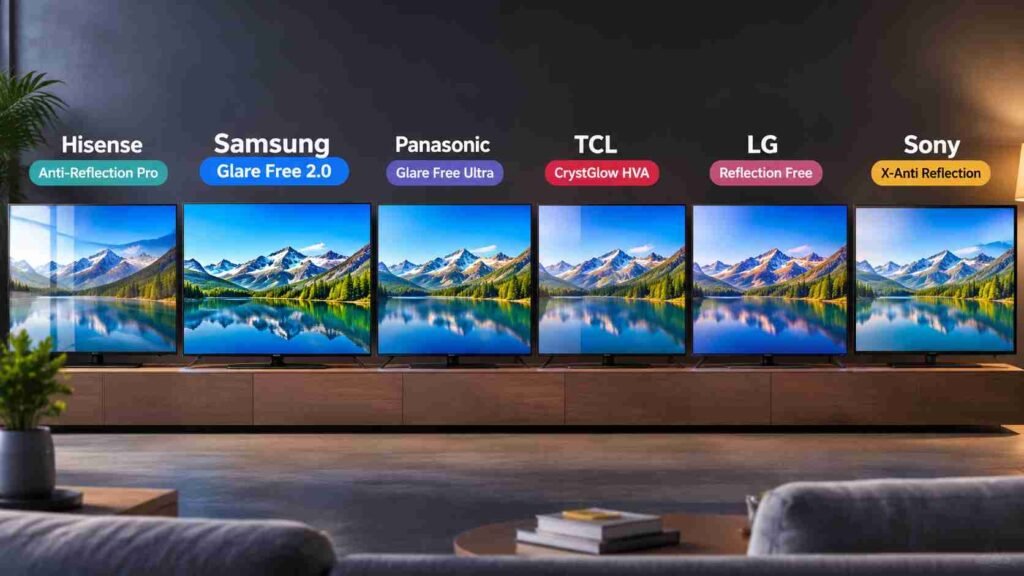
Unlike conventional glossy displays that reflect light like a mirror, Samsung uses a specially treated matte screen surface that diffuses incoming light, spreading reflections over a wider area rather than allowing them to appear as sharp, recognizable images (Click here to know the difference between glossy and matte screen coatings).
This reduces direct reflections and screen glare, helping maintain picture visibility without requiring you to close curtains or reposition the TV.
Samsung introduced this technology in its 2024 S95D OLED TV and refined it as OLED Glare Free 2.0 in the 2025 S95F, in order to improve reflection suppression and address earlier concerns about black-level performance.
Samsung Glare Free is an advanced anti-glare screen technology designed to minimize distracting reflections from windows, sunlight and indoor lighting, making TVs easier to watch in brightly lit rooms.
It is important to note that Samsung Glare Free does not make the screen completely immune to external light, nor does it eliminate every possible reflection, but it has substantially better reflection handling than conventional glossy screens.
This makes models like the S95F OLED very useful for daytime viewing, rooms with large windows or strong overhead lighting.
Affiliate Disclosure: DisplayReviewz participates in the Amazon Associates Program. As an Amazon Associate I earn from qualifying purchases. If you buy a product through affiliate links in this article, we may earn a commission at no additional cost to you.
If you want the brightest and most vibrant OLED, which is great for gaming and bright living rooms, the Samsung S95F OLED TV is just for you.


Is Samsung Glare Free better for bright rooms? How does it affect black levels and picture quality?
Samsung Glare Free is particularly beneficial for brightly lit rooms, where conventional glossy OLED screens can struggle with distracting reflections and reduced screen visibility.
Samsung claims that its second-generation Glare Free technology improves black-level preservation and colour clarity, and the S95F has also received VDE’s Real Black certification.
The certification confirms crystal-clear, reflection-free OLED visuals with near-perfect blacks below 0.005 nits, maintaining exceptional black accuracy even in bright rooms and direct sunlight.
However, its matte finish involves a slight trade-off in perceived picture quality, as diffused ambient light can make blacks appear somewhat grey and reduce perceived contrast, particularly when watching dark scenes.
This fact is confirmed in the independent testing by RTINGS that the S95F’s matte anti-reflective coating significantly reduces direct and indirect reflections, although ambient light can still raise perceived black levels to some extent.
How does Samsung Glare Free compare to LG’s Anti-Reflection technology?
Samsung uses a matte anti-glare coating that diffuses incoming light, which significantly reduces mirror-like reflections from windows, ceiling lights, and other bright sources.
LG, on the other hand, uses a glossy OLED screen with an anti-reflection technology that helps control reflected light while preserving the display’s deep blacks and glossy picture appearance.
This difference is much evident in the RTINGS’ Samsung S95F vs LG G5 comparison.
The S95F’s OLED Glare Free 2.0 technology does a better job of suppressing direct reflections, making it particularly suitable for bright rooms and daytime viewing.
The LG G5 also handles ambient light well, but bright objects and light sources can remain visible on its glossy screen, especially during dark movie scenes.
However, Samsung’s matte coating can slightly raise perceived black levels in bright environments, whereas the LG G5 retains deeper-looking blacks.
Therefore, while Samsung Glare Free is better for minimising distracting reflections, LG’s glossy anti-reflection approach prioritises maintaining OLED’s rich contrast and black levels.
Samsung Glare Free vs Sony X-Anti Reflection: Which is better?
Samsung Glare Free and Sony’s X-Anti Reflection, both technologies are designed to minimise screen glare and reflections to make OLED TVs easier to watch in brightly lit rooms.
However, their approaches to reflection handling differ. As we just saw, Samsung’s OLED Glare Free 2.0 uses a matte screen finish that diffuses incoming light and suppresses mirror-like reflections.
On the other hand, Sony’s anti-reflection technique on its glossy OLED screens reduces reflected light without using the same matte finish.
In TechRadar’s side-by-side comparison of Samsung S95F and Sony BRAVIA 8 II, Samsung’s S95F performed better at eliminating direct reflections, reducing overhead lights to a faint haze.
While Sony’s BRAVIA 8 II still showed some mirror-like reflections, although it handled them better than many conventional glossy OLED screens.
Thus, it does not eliminate mirror-like reflections as effectively as Samsung’s matte display.
Sony markets X-Anti Reflection on selected BRAVIA models, including its mini-LED range, but don’t assume that every Sony OLED has this technology.
Overall, Samsung Glare Free is the better choice for bright rooms with windows or strong overhead lighting, while Sony’s glossy OLED display offers good reflection control without compromising its traditional glossy picture appearance.
Samsung Glare Free vs Hisense, TCL and Panasonic Anti-Glare technology
Samsung Glare Free uses a matte-like screen finish that diffuses incoming light, reducing mirror-like reflections from windows, lamps, and overhead lighting.
RTINGS found that the Samsung S95F almost eliminates direct and indirect reflections, although its matte coating noticeably raises black levels in brightly lit environments.
Hisense’s Anti-Reflection Pro uses a specialised anti-reflection screen technology on selected premium TVs to reduce reflected light while retaining the brightness and clarity needed for well-lit rooms.
As evident from the RTINGS’ testing of Hisense U8QG, it delivers excellent SDR brightness and maintains deep blacks and colour saturation under ambient lighting, though direct reflections from windows and lamps remain visible.
TCL’s CrystGlow HVA takes a different approach by combining a high-contrast HVA LCD panel with a low-reflection film, helping maintain deeper blacks and contrast while controlling ambient-light reflections.
TCL’s C8K with CrystGlow WHVA uses a 0.5% low-reflection film and delivers strong daytime visibility, but practical testing found that direct light sources can still produce noticeable reflections.
Similarly, in the review of Panasonic’s Z95B OLED TV, RTINGS found that it significantly dims direct reflections while retains deep black levels in bright rooms, although reflections remain noticeable during dark scenes.
In TechRadar’s side-by-side OLED comparison, the S95F was the strongest at eliminating mirror-like reflections, while the Panasonic Z95B and LG G5 preserved richer black levels under bright lighting.
Overall, Samsung stands out for its superior suppression of direct reflections, Hisense counters ambient light with high screen brightness, TCL balances contrast and reflection handling, while Panasonic combines effective reflection control with the deep blacks of OLED technology.
Samsung offers anti-glare technology on LCD TVs too!
Samsung also offers its Glare Free technology on selected premium LCD TVs in its Neo QLED range, extending its anti-glare technology beyond OLED models.
The 2025 Samsung Neo QLED QN90F features a matte screen coating that diffuses incoming light and reduces distracting reflections from windows and indoor lighting.
Unlike conventional glossy LCD screens, it significantly minimises mirror-like reflections, making it suitable for bright living rooms and daytime viewing.
However, its matte finish can slightly diffuse ambient light across the screen rather than eliminate it entirely.
This helps maintain better picture visibility when watching TV in brightly lit rooms, although the coating may slightly reduce perceived image sharpness and contrast compared with a glossy screen.
Explore some of the best Mini LED Neo QLED TVs on Amazon and compare picture quality, peak brightness, available models, and smart features to find the right TV for your home.
Which TV brand has the best anti-glare technology?
Samsung currently offers one of the best anti-glare TV technologies with its Glare Free coating, for buyers who want to minimise distracting reflections from windows and overhead lights.
The Samsung S95F is an excellent choice if you want an OLED TV for a bright room with minimal screen reflections. In fact, it tops our carefully curated list of the best OLED TVs.
Hisense uses Anti-Reflection Pro on selected premium models, alongside high peak brightness to combat strong ambient light.
Panasonic’s Glare Free Ultra combines reflection reduction with OLED’s deep blacks, while TCL’s CrystGlow HVA focuses on reducing reflections while retaining the high native contrast of HVA panels.
LG uses a glossy OLED screen with an anti-reflective layer, whereas Sony’s X-Anti Reflection technology reduces distracting reflections while preserving the glossy screen appearance.
Overall, Samsung leads in glare reduction, Hisense in bright-room visibility, and Panasonic in combining OLED blacks with good reflection handling.
Pingback: Does an OLED TV Get Glare? [Reflections, Finishes & Real-World Viewing] -