
WCG vs HDR vs Resolution vs Quantum Dots vs Panel Type
Wide color gamut is an effort to make colors on the screen appear deeper, saturated, and more lively.
That said, it is often discussed alongside terms such as HDR, resolution, panel type, quantum dots, etc., which can easily create confusions.
In this article, we will explore how these things are connected to wide color gamut or how they differ from it.
Let’s dive in.
What is wide color gamut (WCG)?
Wide color gamut is the ability of a display or a device to expand its color range so that it can reproduce the colors more accurately.
It improves the richness and intensity of the primary colors — making reds appear redder, greens greener, and blues bluer.
As a result, color-intensive scenes and objects, such as flames, a peacock’s feathers, or the blue sky, look more punchy and immersive.
Thus, the main purpose of the wide color gamut is to expand and refine the existing color spectrum, allowing the display to present images with greater saturation, smoother gradation, and thus, improved visual realism.
How is resolution related to WCG? Is higher resolution more colorful?
The resolution of a display refers to the total number of pixels or tiny units which together form an image on the display panel.
In contrast, the color bit depth of a display refers to the number of color shades that can be assigned to each subpixel of the display.
Color gamut is closely related to the color depth of a display, as it represents the range of colors that each pixel is capable of displaying.
For example, consider a 4K 10-bit display. It consists of millions of pixels, and each pixel consists of three primary RGB subpixels: red, green, and blue.
Now, as it is a 10-bit display, each subpixel has 10 bits of color information. This means that each red, green, and blue subpixel can display: 2^10=1024 or 1024 different shades of its respective color.
Combining all three subpixels together gives: 1024×1024×1024≈1.07 billion colors. Therefore, each pixel on the display is capable of reproducing more than one billion colors.
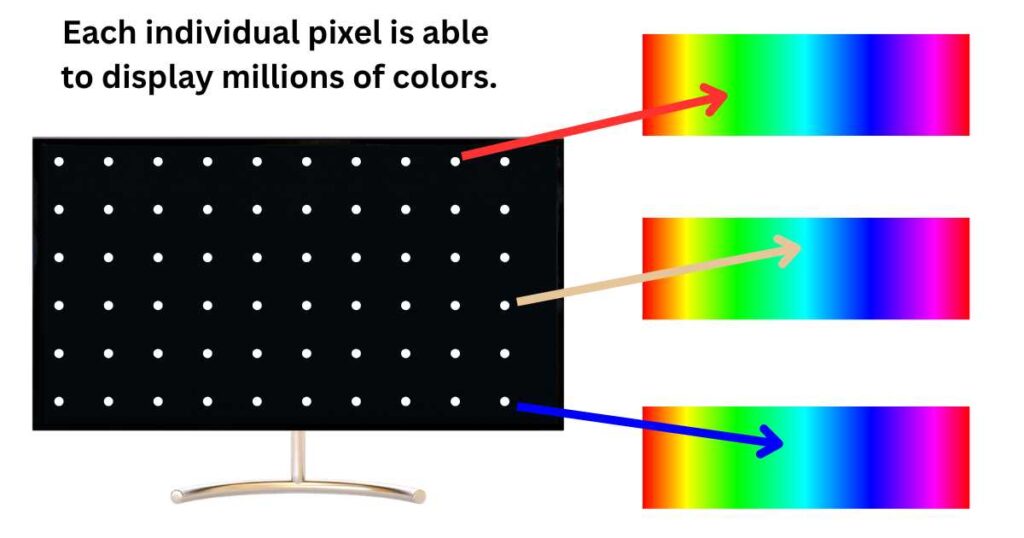
That being said, in any particular scene, a pixel displays only one color at a time from this available range.
However, it remains capable of displaying any of those colors depending on the requirements of the image being shown.
Now consider a hypothetical 4K 1-bit display.
As each of the RGB subpixels has only 1 bit, each subpixel can display only two states, resulting in a total of: 2×2×2=8 or only 8 possible colors in total.
A typical scene on such a display might contain few millions of pixels showing white, some showing black, others showing green or red, and so on, together making up the full image in only a maximum of 8 possible colors.
Therefore, resolution has very little to do with color reproduction.
More pixels simply make the image sharper and more detailed, whereas a wider color gamut and higher color depth allow each pixel to display a greater variety of colors and richer shades.
That said, almost all TVs which display WCG come in 4K resolution.
Are WCG and HDR connected to or different from each other?
A single image on a screen can contain billions of colours.
All those colours are required to be displayed in perfect shades and at the exact brightness levels.
For this to happen, a combination of wide colour gamut as well as HDR is needed.
While WCG introduces more and better colours to the scene, HDR expands the dynamic range of the image.
It means that it introduces several brightness levels between the darkest and the brightest image possible.
HDR is directly linked with contrast and allowed the bright objects to become brighter, and the dark objects become darker.
Though this statement may seem simple at first but it is very important to display objects at the correct brightness level in order to bring them close to reality.
For example, take the case of a starry night sky scene. The moon should appear brighter than all the stars, while some stars like Venus should appear brighter in comparison to many other faint stars.
A clear distinction of brightness among the stars, the moon and the dark sky is essential to bring out the true realism of the scene.
Similarly, in a morning scene, the sun should shine the brightest.
All the other objects should appear less brighter than the sun, just as all the stars appear less brighter than the moon in a night scene.
A good contrast on a TV means that the blacks appear completely dark and there is no grey appearance of blacks or any light leakage around the bright objects.
The picture appears much more realistic against a pitch dark background.
Therefore, WCG, HDR and contrast go hand in hand.

While contrast makes the image more realistic, HDR ensures that objects are displayed at their correct brightness levels by introducing several luminous levels between the darkest and brightest objects.
WCG, on the other hand, enhances the quality of colours and the number of colours both, so that the image appears more punchy.
WCG profile vs conventional (normal) color gamut
Among the conventional OLED and LCD TVs, which come without any additional enhancements, OLED TVs generally offer a wider color gamut.
This is because OLED displays use self-emissive pixels that can turn on and off independently.
On the contrary, LCD TVs rely on an LED backlight to form the image. Thus, the colors produced by OLED TVs are usually purer, more vibrant, and more accurate than those of conventional LCD TVs.
To achieve a truly wide color gamut, a display should ideally use separate red, green, and blue (RGB) LEDs as individual pixels.
If the LEDs are self-emissive and directly produce pure RGB colors, those colors can combine to create an extremely pure and accurate color palette.
However, displays based on this technology are very expensive to manufacture, for e.g., the micro-LED displays.
It is important to note that many TVs marketed as “Micro RGB or RGB mini-LED” TVs are not true RGB self-emissive displays.
Most of them are still LCD TVs that use numerous tiny RGB LEDs only in the backlight.
To improve the colour performance of TVs without using tiny self-emissive RGB LEDs for every pixel, manufacturers developed more cost-effective enhancement technologies.
One of the most important innovations was the use of quantum dots, which are semiconductor nanomaterials capable of producing highly pure colours. .
How do quantum dots affect the color gamut? Do they make it wider?
Quantum dots are now used in both OLED and LCD televisions.
TVs that combine OLED technology with quantum dots are popularly known as QD-OLED TVs, while LCD TVs enhanced with quantum dots are called QLED TVs.
Conventional OLED TVs, often referred to as WOLED TVs, use a combination of blue and yellow organic emitting layers.
The blue and yellow light together produce white light, which is then passed through colour filters to generate red, green, and blue subpixels.
However, because these RGB colours are filtered from white light, they are not perfectly pure, which limits the colour accuracy and colour gamut of standard WOLED displays.
In QD-OLED displays, blue OLED light interacts with a quantum dot layer which converts the incoming light into highly pure red, green, and blue monochromatic light very efficiently.
Because these primary colours are much purer, they can produce a wider and more vibrant colour gamut, resulting in superior colour reproduction and improved brightness compared to conventional OLED TVs.
Similarly, in LCD TVs, quantum dot enhancement significantly improves colour profile.
These TVs, marketed as QLED TVs, offer a wider colour gamut and better brightness than standard LED-LCD televisions.
Additionally, modern LCD TVs often use advanced backlighting systems such as mini-LED technology, where a much larger number of tiny LEDs are used in the backlight.
This improves local dimming, contrast, brightness control, and overall picture quality, making these displays appear more detailed and vibrant.
Does panel type like IPS, VA or OLED have an affect on the color gamut?
VA or IPS LCD TVs that use enhancements such as quantum dots offer a much wider color gamut than standard LED LCD TVs.
Thus, LCD TVs with quantum dot technology, like QLED and QNED displays generally produce richer and more accurate colors compared to conventional LCD panels.
However, when it comes to color volume, VA panels usually perform better than IPS panels.
This is because VA panels have significantly higher contrast ratios, allowing them to create clearer separation between bright and dark areas of an image.
High contrast ratio means the availability of a greater range of luminance levels between the deepest blacks and the brightest whites.
When this large brightness range is combined with a broad color gamut, it results in achieving high color volume on a VA TV.
Although IPS and VA panels may support a similar range of colors, colors on VA panels often appear more vibrant, punchy, and impactful, especially in scenes with bright highlights and deep shadows.
Similarly, OLED TVs also deliver excellent color volume because of their near-perfect contrast ratio.
When OLED technology is combined with quantum dot enhancement, the result is even better color reproduction and brightness.
In general, mini-LED LCD TVs (coming with quantum dot-enhancement, in almost all models) and OLED TVs enhanced with quantum dot technology provide extremely wide color gamuts, often surpassing 95% of the DCI-P3 color space or offering significant Rec. 2020 coverage.
Among these technologies, QD-OLED TVs and VA panel based mini-LED TVs deliver the best color volume overall.
As a result, colors on these displays look exceptionally vivid, realistic, and truly “pop” on screen.
FAQs
1. Which TV has the widest color gamut: IPS, HD Ready or 4K?
Color gamut is mainly determined by color bit depth than by resolution (such as HD Ready or 4K) or panel technology (like VA or IPS). That said, 4K TVs with quantum dot technology typically offer a wider color gamut compared to most other TVs.