
4K OLED vs 8K OLED TV: Does The Picture Justify The Premium?
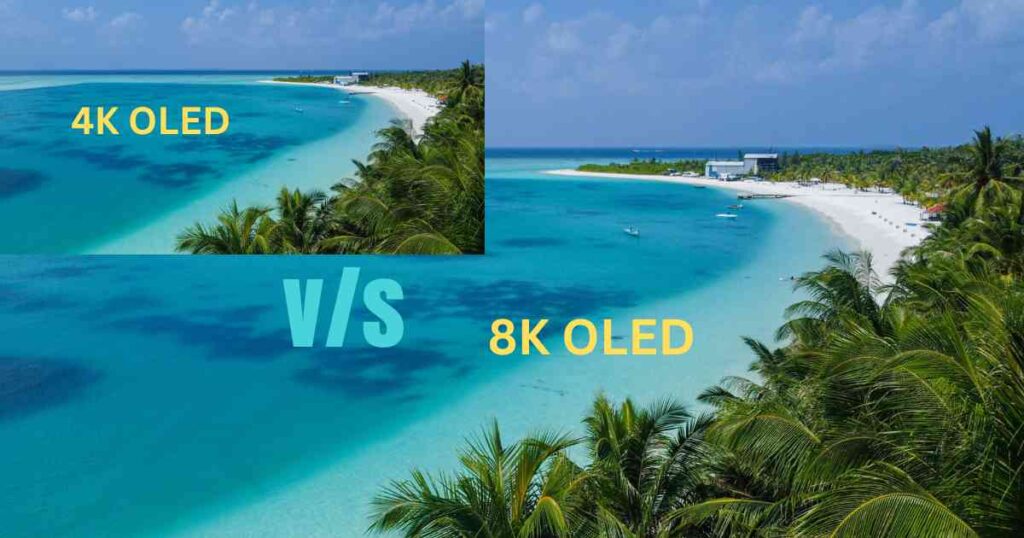
Choosing between a 4K and an 8K OLED TV sounds simple—more pixels should mean a better picture, right?
But when prices jump dramatically and content is scarce, the decision becomes less obvious.
Let’s break down what really matters so you can decide whether 8K OLED is future-proof brilliance or overkill.
Picture Quality
When it comes to the actual picture quality, OLED technology, whether traditional WOLED, MLA-enhanced WOLED, or QD-OLED, already sits almost at the top of the TV hierarchy.
Both 4K and 8K OLED panels share the same fundamental technology: self-lit pixels.
Each pixel turns on and off individually, delivering absolutely perfect blacks, infinite contrast ratios, and stunning shadow detail that LCD-based TVs struggle to match.
Talking about color performance of OLEDs, they easily achieve wide color gamut.
QD-OLED panels tend to deliver slightly richer and more saturated hues, especially in bright scenes, while MLA WOLED panels focus on boosting brightness without sacrificing black levels.
In both 4K and 8K OLED TVs, color accuracy is just excellent with smooth gradations that make sunsets, skin tones, and HDR highlights look almost natural.
Where 8K potentially pulls ahead is in rendering extremely fine details.
With 33 million self-lit pixels compared to 8.3 million in 4K, tiny textures, like fabric weaves, hair strands, or distant city lightscan look sharper and more refined.
However, this advantage is noticeable depending on screen size and viewing distance.
On a 65-inch screen viewed from typical sofa distance, the jump from 4K to 8K can be only subtle.
Many modern 4K OLEDs reach impressive brightness levels, especially those with MLA or QD-OLED tech.
8K OLEDs often match or slightly exceed these levels, but the difference is rarely dramatic.
Both offer wide viewing angles, ensuring consistent color and contrast even from the sides.
In short, 8K can look marginally sharper, however, 4K OLED already delivers breathtaking image quality that satisfies even demanding viewers.
Gaming and Smart Features
Gamers often focus on resolution, but the overall performance matters more.
Both 4K and 8K OLED TVs typically feature extremely fast response times thanks to OLED’s pixel-level light control.
Motion blur is minimal, and input lag is impressively low, making them ideal for competitive gaming.
Most high-end 4K OLEDs support 4K at 120Hz, along with Variable Refresh Rate (VRR), Auto Low Latency Mode (ALLM), and popular HDR formats such as Dolby Vision and HDR10+.
Some also support advanced features like Dolby Vision gaming at high frame rates.
This makes them perfectly matched for modern consoles and gaming PCs.
8K OLED models, in theory, can support 8K resolution at up to 60Hz and 4K at 120Hz or higher, depending on the HDMI bandwidth and processor.
However, very few games are rendered natively at 8K.
Even powerful PCs struggle to maintain smooth frame rates at that resolution.
As a result, most gaming still happens at 4K, meaning the practical benefit of 8K resolution for gamers is limited right now.
8K TVs often include more advanced processors designed to upscale lower-resolution content convincingly.
These chips analyze textures, edges, and noise in real time to enhance clarity.
That said, modern 4K OLEDs also use sophisticated processors that already deliver outstanding upscaling and motion handling.
Smart TV platforms are largely identical between premium 4K and 8K models, offering streaming apps, voice control, and smooth navigation.
In everyday use, the experience is nearly the same. For gamers, the real advantage lies more in refresh rate and HDR support than in 8K resolution itself.
Content and Size Availability, Upscaling
One of the biggest questions surrounding 8K OLED is too obvious: what will you actually watch in 8K?
Native 8K content remains extremely rare.
Most streaming services primarily deliver in 4K, with HDR and high bitrate improvements doing more for picture quality than additional pixels.
On top of that, broadcast television is still largely 1080p or 4K in many regions.
Physical media also tops out at 4K Ultra HD Blu-ray.
While some demo clips and select online videos are available in 8K, mainstream movies and series are not widely produced or distributed in that format.
This is where upscaling becomes critical.
8K TVs rely heavily on advanced AI-based processing to convert 4K and lower-resolution content to fill those 33 million pixels.
High-end processors do an impressive job, often making 4K content appear slightly sharper and more refined.
However, upscaling cannot create real detail that isn’t present in the source.
It can enhance perception, but it cannot fully replicate native 8K.
Talking about screen size availability, 8K OLED TVs are generally available in larger sizes—77 inches and above.
On these bigger screens, especially when viewed closer, the additional resolution can become more noticeable.
In contrast, 4K OLED TVs are available in a broader range of sizes, from compact living rooms to big home theater setups.
For most viewers, especially those with 55 to 77-inch screens and standard seating distances, 4K remains more than sufficient.
Upscaling on 4K sets is already excellent for HD content, making them enough versatile for displaying the content available today in the best manner.
Human Visibility Range vs Price Difference Tradeoff
At a typical viewing distance of about 8 to 10 feet, many people cannot easily distinguish between 4K and 8K on a 65 inch or even 77-inch screen.
The additional resolution becomes more noticeable as the screen size increases or as you sit closer.
In order to fully appreciate 8K detail, you either need a very large screen of size 85 inches or more, or a relatively short viewing distance.
For average living rooms, the jump from 4K to 8K should be subtle rather than huge.
The price of 8K OLED, however, is not subtle, it command a significant premium.
You are paying not just for extra pixels, but also for cutting-edge panels, more advanced processors, and limited-production manufacturing.
Meanwhile, premium 4K OLEDs with MLA WOLED or QD-OLED technology often deliver high peak brightness and exceptional HDR performance at a far lower price.
Unless you have a very large room, sit close to a massive screen, or simply want the absolute cutting edge of display technology, the price difference is difficult to justify purely on visible improvements.
Why Not Spend on 8K for 33 Million Self-Lit Pixels Rather Than Micro-LED?
In case you are already willing to pay a premium, you might well go for 33 million self-lit pixels in an 8K OLED rather than jumping to massive, ultra-expensive micro-LED displays.
As we know, OLED and micro-LED share the concept of self-emissive pixels, meaning no backlight and perfect blacks.
Micro-LED promises incredible brightness, longevity, and modular screen sizes.
However, it remains prohibitively expensive and available only in very large sizes.
For most consumers, micro-LED is more of a luxury showcase technology than a practical home solution.
On the other hand, an 8K OLED offers many of the same core visual benefits, such as pixel-level lighting, superb contrast, wide viewing angles, etc. in a budget far lesser than that of the cheapest micro-LED TV.
You get one of the futuristic resolutions combined with the cinematic qualities that have made OLED the reference standard for home theaters.
However, when comparing 8K OLED to a high-end 4K OLED using MLA or QD-OLED technology, the equation changes again.
A premium 4K OLED can often reach higher peak brightness and similar color volume while costing significantly less.
So while 8K OLED may be a more realistic premium option than micro-LED, it still needs to justify itself against outstanding 4K OLED models that already push the limits of what the eye can appreciate.
Is a 4K OLED TV Better To Buy Over an 8K OLED TV?
In theory, 8K OLED is superior: more pixels, cutting-edge processing, and immense screen sizes.
However, in actual practice, for most homes and current content, 4K OLED delivers nearly identical real-world performance at a far better price.
Unless you sit close to a very large screen and want the latest technology regardless of cost, a high-end 4K OLED remains the smarter and more balanced buy today.