4K OLED vs 8K QLED TVs: More Pixels or Better Pixels?
While 4K OLED promises perfect blacks and cinematic depth, 8K QLED boasts eye-searing brightness and ultra-sharp resolution.
While both are top-of-the line TVs of a brand, which one truly delivers the best watching experience?
Let’s break down their fundamentals and understand their key differences in simple words.
What is OLED?
OLED stands for Organic Light Emitting Diode. Unlike traditional LED TVs that rely on a backlight, OLED panels are self-emissive.
This means every pixel produces its own light and can turn completely off when needed.
When a pixel switches off, it creates true black rather than a dark gray, resulting infinite contrast and exceptional depth.
Because there’s no backlight, OLED panels are incredibly thin and offer precise light control.
Modern OLED TVs like QD-OLEDs and MLA WOLEDs have considerably improved brightness and colors through advanced panel structures, while the core technology remains the same: pixel-level lighting control.
What is QLED
QLED stands for Quantum Dot Light Emitting Diode.
QLED TVs still use a backlight, LED or mini-LED, behind an LCD panel.
They also use a quantum dot layer which enhances color accuracy and brightness by improving producing pure red and green colors.
Most premium 8K QLED TVs use VA (Vertical Alignment) LCD panels paired with mini-LED backlighting.
A mini-LED is a very small LED, with thickness of just a strand of hair.
Thousands of tiny LEDs are grouped into numerous local dimming zones that improve contrast and control light more precisely than the traditional LED TVs.
QLED technology excels in brightness and vibrant colors, making it a good choice for bright rooms.
4K OLED vs 8K QLED Comparison
Contrast
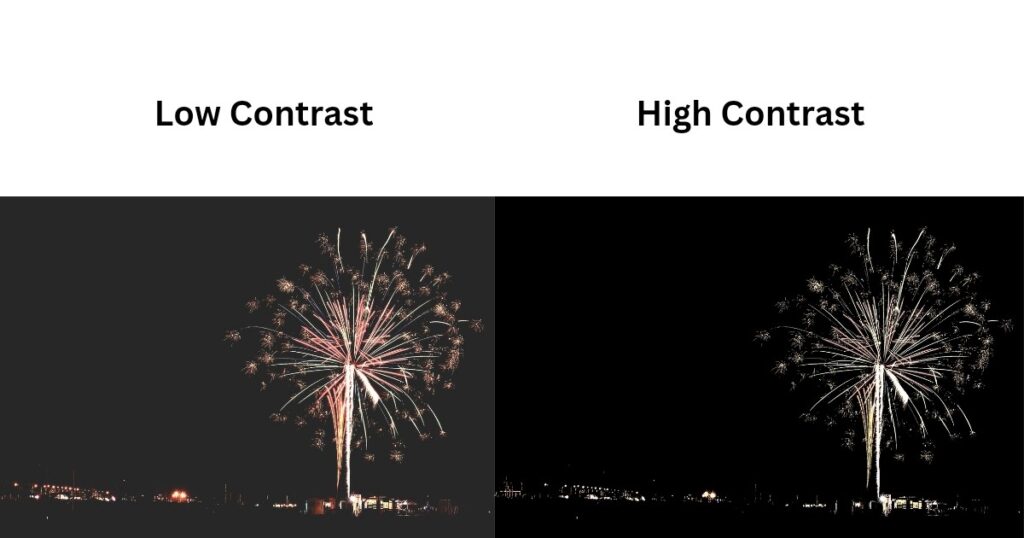
Contrast ratio is one of the biggest factors accounting for the overall picture quality of a TV.
It is the difference between the brightness whites and darkest blacks a TV can produce.
OLED TVs have at the pixel level light control.
Because of this, whenever a scene calls for darkness, like a night sky or a dim hallway, each pixel of the TV can shut off completely.
This creates true black. There’s no light leakage, no glow around bright objects, and no halo effect.
This causes seamless transition between bright highlights and dark shadows.
The movies look deeply immersive as dark scenes retain fine detail without appearing washed out.
On the other hand, 8K QLED TVs generally use VA LCD panels with mini-LED backlighting.
As VA panels naturally offer stronger native contrast than IPS panels, it helps QLED TVs achieve deeper blacks than standard LED TVs.
On top of that, the use of numerous microscopic mini-LEDs in the backlight adds thousands of dimming zones to control the pixels even more precisely.
This enhances the contrast of 8K QLED TVs to the next level.
However, these zones still manage groups of pixels rather than individual ones, unlike OLEDs which control each pixel independently.
As a result, in displaying high-contrast scenes, like subtitles on a black background or stars in space, you may notice slight blooming or haloing around bright elements on QLED.
That said, the use of advanced dimming algorithms like FALD (full array local dimming) have improved contrast dramatically.
But even then, when you see an OLED TV side-by-side with any high-end QLED TV in a dark room, OLED’s per-pixel precision produces much cleaner blacks and more natural shadow detail.
Where QLED fights back is brightness-based contrast. Because it can push highlights extremely bright, the perceived dynamic range can feel punchy, especially in HDR content.
Scenes involving explosions, sunrise involving very bright highlights can appear intense and more impactful on a 8K QLED TV (more on that in the next section).
Peak Brightness & Colors
Both 4K OLED and 8K QLED TVs support a wide color gamut, which refers to a wide range of colors.
Now, to display these colors at perfect brightness so that they look more realistic, a TV needs high peak brightness or a large number of luminance levels.
Traditionally, OLED TVs were known for exceptional black levels but moderate brightness.
However, recent improvements, such as enhanced panel structures involving the use of quantum dots in QD-OLEDs and and more efficient light extraction techniques in MLA based OLED TVs have significantly enhanced their peak brightness.
Modern OLEDs can now deliver very strong HDR highlights while still maintaining perfect blacks.
As a result, bright scenes now feel more impactful than what the older generations of OLEDs used to display.
That said, 8K QLED TVs, using mini-LED backlighting, still dominate in raw peak brightness.
Thousands of mini-LEDs working in clusters can drive extremely high luminance levels.
The HDR content involving sunrise, snowy peaks etc. can appear intensely bright.
This makes 8K QLED very effective in rooms with lots of ambient light.
High peak brightness results in high color volume for QLED TV which helps it display vibrant colors without loosing details in extremely bright scenes.
That said, with the boost of brightness in OLED technology, the top notch OLEDs are also able to display large color volume.
The QD-OLEDs are known for reproducing highly bright saturated hues while still retaining the perfect contrast while the MLA WOLEDs are known for displaying pure bright whites.
While watching in a dark room, either of them easily surpasses the picture quality of any advanced LCD TV, be it a 4K or an 8K QLED TV, with any type of backlighting or local dimming method.
That said, in a sunlit living room with large windows, or when watching outdoors, the extremely high peak brightness of an 8K QLED, especially in SDR can help the image cut through reflections and still remain vibrant.
It should be noted regarding the peak brightness of a TV that, it’s not just about the numbers written on a spec sheet. It’s more about how that brightness integrates with contrast.
For instance, many premium TVs like QLED and QNED which come with IPS panels, even with high peak brightness can’t display the HDR content as beautifully as OLEDs or VA based TVs, primarily due to the low native contrast of IPS panels.
Viewing Angles
OLED panels offer near-perfect viewing angles because each pixel emits its own light.
As a result, color and contrast remain consistent even when viewed from the side.
Whether you’re sitting directly in front of the TV or off to the edge of a sofa in a large room, the image stays accurate and clear.
Most 8K QLED TVs use VA panels, which have narrow viewing angles.
VA panels provide good native contrast but tend to lose color saturation and brightness when viewed off-center.
If you frequently host group movie nights or have a wide seating arrangement, OLED provides much more consistent performance across the room.
That said, if seating is mostly centered, QLED’s viewing angle limitations should not be a major issue.
Gaming and Smart Features
Both 4K OLED and 8K QLED TVs are mostly packed with great gaming and smart features.
OLED TVs are highly praised for ultra-fast response times, as their pixels change state individually, thus, motion appears incredibly smooth and blur is minimal on them.
Input lag is very low, with features like 120Hz refresh rates, variable refresh rate (VRR), and HDMI 2.1 support, making them excellent for competitive gaming.
8K QLED TVs too support high refresh rates and advanced gaming features, and their high peak brightness can make HDR gaming very realistic and dynamic.
However, 8K gaming content is extremely limited. Most consoles and PCs primarily output in 4K, meaning the TV has to upscale the image to 8K.
In terms of smart features, both TVs offer voice assistants, streaming apps, screen mirroring, and advanced processing engines.
That said, 8K QLED TVs rely heavily on AI upscaling to enhance lower-resolution content.
For pure responsiveness and motion clarity, OLED has a clear edge. For bright HDR gaming in a well-lit room, QLED is good.
Size and Content Availability
4K content is widely available across streaming platforms, Blu-ray discs, and gaming consoles.
Most movies and TV shows are mastered in 4K or lower. As a result, a 4K OLED TV displays native-resolution content far more often than an 8K TV.
8K content is still scarce. Very few streaming services provide native 8K material.
Most of what you watch on an 8K QLED will be upscaled from 4K or HD.
While the upscaling technology has become remarkably sophisticated, adding perceived detail and sharpness, but it cannot create true native 8K information.
8K QLED TVs are generally available in larger screen sizes, as the higher resolution makes more sense on massive displays where pixel density matters.
If you plan on buying a 75-inch or larger screen, the 8K resolution will help to maintain crisp picture details.
For most living rooms, though, 4K resolution at normal seating distances from the TV already appears very sharp.
Durability
OLED panels use self-emissive organic pixels that produce their own light, which allows for exceptional contrast and perfect blacks.
However, because these pixels are organic, they gradually degrade over time and can be susceptible to burn-in if static images, such as channel logos or game HUDs, remain on screen for extended periods.
Modern OLEDs include protective features like pixel shifting and logo dimming, which significantly reduce this risk, but heavy, repetitive static content can still affect their longevity.
In contrast, QLED TVs use an LCD panel with a quantum dot layer and LED backlighting, meaning they do not rely on organic materials.
As a result, QLED displays are not prone to burn-in and typically maintain brightness more consistently over many years.
While their LED backlights can dim slowly with prolonged use, they are generally considered more robust for long-term, high-brightness, or static-content viewing.
Overall, QLED tends to have a slight edge in durability, especially for heavy daily use.
Can Our Eyes Differentiate Between 4K and 8K?
The ability to distinguish between 4K and 8K depends mainly on the screen size and viewing distance.
On smaller screens, say 55 to 65 inches, at normal viewing distances, most viewers struggle to notice a significant difference in picture quality, as 4K already provides extremely high pixel density.
The human eye has limits, and beyond a certain point, extra resolution becomes difficult to perceive.
However, on very large screens (75 inches and above), especially if you sit closer than average, 8K can appear slightly sharper. Fine textures and edges may look more refined.
However, the difference is often subtle. For many viewers, improvements in contrast, brightness, and color accuracy are more noticeable than resolution alone.
Price vs Actual Picture Quality Comparison
8K QLED TVs mostly cost more than 4K OLED TVs. You’re paying for higher resolution, advanced processing, and cutting-edge backlighting systems.
However, in terms of pure picture quality—contrast, black levels, and cinematic realism, 4K OLED often delivers a noticeable improvement.
While the jump from LED to OLED contrast is dramatic, the jump from 4K to 8K resolution, however, is more incremental for most users.
If budget matters and you want the most visible upgrade in image quality, 4K OLED offers greater value.
On the other hand, if you want the latest resolution with ultra high brightness on a large screen, 8K QLED justifies its premium.
Which is Better for Upgrading from 4K: 8K QLED or 8K OLED?
Moving from 4K to 8K primarily increases resolution. But as discussed earlier, resolution alone may not create a dramatic visual improvement unless your screen is very large or you sit close.
Therefore, upgrading to 8K QLED makes the most sense if you’re also increasing screen size significantly, say to 75 inches or more, and want the added brightness benefits.
Meanwhile, an 8K OLED would combine ultra-high resolution with pixel-level contrast. This could provide the best of both worlds: sharpness and perfect blacks.
However, 8K OLED models are less common and typically more expensive than even 8K QLEDs.
That said, if your current 4K TV is not OLED, upgrading to a 4K OLED might actually produce a more noticeable improvement than jumping to 8K QLED.
The enhanced contrast and black levels can feel transformative.
On the other hand, if you already own a 4K OLED and want something bigger and brighter for a brightly-lit area, 8K QLED may feel like a meaningful upgrade.
Ultimately, the better upgrade depends on what you value more: resolution and brightness, or contrast and cinematic depth.
Which Brands Manufacture 4K OLED and 8K QLED TVs?
LG is well known for producing a wide range of 4K OLED TVs. It is probably the only brand to manufacture 8K OLED TV.
Sony also offers premium OLED models, while focussing on advanced processing and cinematic accuracy.
Meanwhile, Samsung is a key player in 4K and 8K QLED technology, which often come with advanced mini-LED backlighting.
While some manufacturers focus heavily on OLED innovation, improving brightness and panel efficiency, others concentrate on pushing resolution boundaries and brightness capabilities with 8K QLED.
What is 8K Neo-QLED and How Does It Compare to 4K OLED?
8K Neo-QLED refers to advanced Samsung QLED TVs that use mini-LED backlighting combined with 8K resolution.
That said, almost all the 8K QLED TVs use mini-LED backlighting.
Compared to 4K OLED, 8K Neo-QLED delivers high brightness with sharp details on large screens which makes it look more impactful in HDR.
However, 4K OLED still produces absolute black levels and pixel-level precision without any blooming at all.
While Neo-QLED tries to close the gap with better dimming algorithms and smaller LED zones, but the fundamental difference—zone-based lighting versus pixel-level lighting—remains.
Which is The Better TV to Buy: 4K OLED or 8K QLED?
There is no single “best” TV out of 4K OLED or 8K QLED for everyone.
If you value perfect blacks and cinematic realism with flawless gaming, 4K OLED is the way to go.
If your room is too bright, or you want a TV for watching outdoors, prefer very large screen sizes, and you want cutting-edge resolution with powerful HDR brightness, 8K QLEDs are better TVs to look for.
That said, 4K OLED strikes the best balance of price, picture quality, performance, and available content.