VA vs IPS vs OLED: Which TV Takes Gaming To The Next Level?
Choosing the best TV for gaming isn’t as simple as picking just the highest resolution or the biggest screen.
The real difference in gaming performance comes down to panel technology.
Today, almost all TVs fall into two categories: OLED and LCD.
The LCD TVs can be further categorised into IPS LCD and VA LCD TVs.
Each technology affects how your games look and feel, be it from deep blacks in dark story-driven titles to huge brightness in HDR sunlit cityscape and motion clarity in fast shooters.
Thus, understanding how these panels differ will help you choose the right gaming TV for your home setup.
VA LCD TVs
LCD TVs rely on an LED backlight as the light source and use liquid crystals in the path of light.
In VA (Vertical Alignment) panel based LCD TVs, crystals are aligned vertically in their natural state when no voltage is applied to them.
When powered by electric current, they tilt to let light coming from the LED backlight pass to the screen.
This allows them to strongly block light when needed, which creates high contrast and deep blacks.
However, viewing angles are narrower, which means that colors and contrast can shift when viewed from the side.
For gaming, VA offers immersive contrast but may show minor motion smearing in ultra-fast scenes.
IPS LCD TVs
IPS (In-Plane Switching) LCD panels move liquid crystals horizontally (in-plane). This improves color consistency and viewing angles.
This means the picture looks similar even when viewed from wide angles, making IPS ideal for group viewing.
Colors are generally accurate and brightness is good, but contrast is lower than VA, so blacks may appear grayish in dark rooms.
For gaming, IPS offers good motion clarity and wide viewing angles, though it lacks the deep black levels of VA or OLED.
OLED TVs
OLED (Organic-Light Emitting Diode) TVs have self-emissive pixels, meaning each pixel produces its own light and can turn completely off.
This allows for the production of true blacks which results in exceptional picture depth .
Viewing angles on OLEDs are excellent too, with consistent brightness and color from almost any position.
Moreover, OLED TVs have extremely low response times, providing ultra smooth motion with almost no blur at all.
OLED vs VA vs IPS: Gaming Performance Comparison
Done with the introduction, let’s move on to compare between these TVs to see which one comes out to be the best for gaming.
Contrast & Blacks
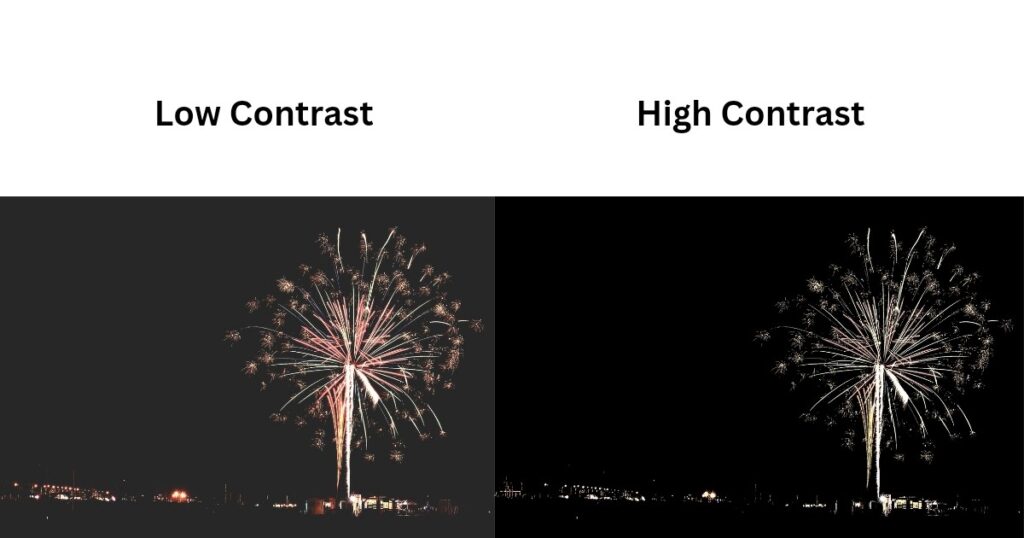
Contrast determines how deep blacks look and how well bright objects stand out against dark backgrounds.
OLED sets the benchmark here since each pixel produces its own light and can turn off completely, blacks are truly black.
In dark games, think of space environments or nighttime open-world scenes, this creates such a depth and realism that LCD technologies just can’t match.
OLEDs are followed by VA LCD TVs in contrast.
The VA panels offer higher native contrast than IPS panels, which means blacks appear darker and more convincing.
In a dim room, a good VA panel with effective local dimming can look very impressive.
However, since it still relies on a backlight, it can’t fully eliminate blooming, where bright elements slightly glow into darker areas.
IPS LCD panels, on the other hand, tend to show greyish blacks.
Even with advanced local dimming, darker scenes often look washed out, especially in dimly lit rooms.
The trade-off is that IPS panels usually maintain better image consistency from wider viewing angles.
But if you mostly game in a dark room and care about cinematic contrast, OLED is clearly superior, with VA LCD as a solid middle ground.
Response Time
Fast response is very crucial for gaming.
Response time determines how quickly pixels can change from one color to another, thus, directly impacting motion clarity.
In competitive shooters, racing games or fast action titles, slow pixel transitions can cause significant motion blur and ghosting which may ruin the overall watching experience.
OLED technology excels here. Because its pixels switch almost instantly, motion looks incredibly clean and sharp on it.
Fast camera pans remain clear, and moving objects retain detail. This gives games a smooth, responsive feel that’s especially noticeable at 120Hz or higher refresh rates.
For keen players who are very sensitive to motion blur, OLED offers a clear advantage.
VA and IPS LCD panels rely on liquid crystals to block or allow light from the backlight.
This process takes longer than OLED’s pixel-level control, and thus none of the LCD TVs whether VA or IPS are as fast as OLEDs.
The OLED TVs can respond almost instantly within 0.1 ms while LCD TVs generally take 5-10 ms.
That said, for most gamers, modern good LCD TVs are fast enough.
However, if you are a competitive gamer for whom even 1 ms matters, OLED will provide you the cleanest motion possible.
Refresh Rate
Refresh rate is the number of times a display refreshes itself in a second.
Premium IPS LCD and VA panels as well as OLEDs come with 120Hz and above support, making them great for both console and PC gaming.
Variable Refresh Rate (VRR) is another feature that adjusts the screen’s refresh rate to match your graphics card’s frame output.
All three TVs (OLED, VA, IPS) often support VRR through technologies like FreeSync and G-SYNC Compatible, helping reduce tearing and stutter so gaming feels more fluid and responsive on them.
HDR Highlights
High Dynamic Range (HDR) is where the differences between OLED and mini-LED LCD become more nuanced.
Blinding explosion scenes, sunlight reflecting off metal and neon-lit cityscapes all benefit from higher brightness and wider color reproduction.
Traditional OLED panels deliver perfect blacks, which makes HDR look much impactful even if peak brightness is lower than some LCD rivals.
That said, newer OLED variants have pushed brightness further.
QD-OLED panels use quantum dot layers to improve brightness and color vibrancy, producing richer HDR highlights while preserving perfect contrast.
MLA-enhanced WOLED TVs use micro-lens arrays to focus light much more efficiently, significantly boosting peak brightness compared to older OLED generations.
These improvements make HDR gaming more impactful than ever on OLED.
Mini-LED LCD TVs, whether VA or IPS based, use thousands of tiny LEDs in the backlight which increases their peak brightness dramatically.
In very bright rooms, this extra brightness can make HDR effects stand out more clearly than on standard OLED panels.
VA mini-LED TVs in particular combine high brightness with better native contrast, delivering strong HDR performance overall.
However, even the best mini-LED TVs may show slight blooming around bright objects against dark backgrounds.
If you want balanced HDR gaming with perfect blacks, bright OLEDs such as QD-OLEDs and MLA based OLEDs are the clear winners.
On the other hand, if you game in a very bright sunny room and want maximum brightness impact, a high-quality mini-LED VA LCD can be very impressive. You will get to experience bright eye-popping details in HDR.
Burn-in Risk
One common concern for gamers considering OLED might be burn-in.
Because OLED pixels emit their own light, they may wear unevenly if static elements remain on screen for long periods.
The static elements may include HUD elements, minimaps, health bars or score counters that stay fixed in the same position.
However, modern OLED TVs include protective measures like pixel shifting, screen refresh cycles and brightness adjustments to reduce this risk.
For most gaming uses, especially with varied content, permanent burn-in is uncommon.
However, if you play the same game with a static HUD for hundreds or thousands of hours, the risk may not be zero.
LCD TVs, including both IPS and VA panels, do not face true burn-in, since they use an LED backlight rather than organic pixels.
For gamers who spend extremely long sessions on the same title, an LCD TV tends to offer greater peace of mind.
Price vs Performance
OLED TVs sit in the premium category of TVs. You pay for perfect blacks, superior motion clarity and great HDR performance.
That said, when you switch from LCD TV to OLED, the visual jump in dark-room gaming experience totally justifies the cost.
VA LCD TVs, especially those with mini-LED backlighting, often provide an excellent balance between performance and price.
They deliver high brightness, good contrast and solid gaming features at a lower cost than premium OLEDs.
This makes them attractive for gamers who want a strong HDR impact without stepping into a high price bracket.
IPS LCD TVs come at around the cost of VA LCD TVs and offer wide viewing angles and decent overall performance.
However, because of their lower native contrast, they are usually less appealing for gamers who prioritize deep blacks.
In terms of pure value for performance, high-quality VA mini-LED models like Samsung Neo-QLED TVs often hit the sweet spot.
While OLED remains the premium choice for those willing to invest more for the best possible gaming experience.
Which One Out of VA, IPS & OLED Is The Overall Best TV For Gaming?
For gaming in a dark-room, OLED is the overall best choice.
Its perfect blacks, near-instant response time and truly immersive HDR performance create a phenomenal gaming experience.
If you want your gaming experience to be elevated to the next level, OLED TVs are undoubtedly the way to go.
For gaming in very bright rooms, however, a high-brightness mini-LED VA LCD can be the better option.
The extra luminance helps fight glare and maintain vibrant HDR highlights during daytime use.
It is also free from any burn-in concern.
Thus, if you want a versatile TV that performs well in most situations and offers strong value for money, a good quality VA mini-LED TV is worth investing in.