QLED vs LED: Which TV to buy? How does QLED work?
LED TVs brought a major leap forward from older LCD models that used CCFL (Cold Cathode Fluorescent Lamp) backlighting.
These LED TVs offered better brightness, slimmer designs, and improved energy efficiency.
Now, QLED TVs have entered the scene, with many claiming they deliver better picture quality than LED TVs.
But how accurate are these claims? Is QLED truly superior, or is it just a clever marketing?
Let’s explore the facts in this article.
QLED vs LED- Let’s start.
What is a QLED TV?
QLED stands for Quantum Dot Light Emitting Diode.
These displays utilize extremely small, nanometer-sized particles known as quantum dots to enhance image quality.
From the name “Quantum LED” or QLED, it might sound like the quantum dots themselves emit light like LEDs.
But, that’s not actually what a QLED is.
Instead of functioning as the primary light source, QLED TVs still rely on an LED backlight made up of blue LEDs which provide the initial light source for the display.
In other words, a QLED TV is a type of LED TV which makes the use of quantum dots.
What are Quantum Dots in QLED?
Quantum dots are extremely small semiconductor particles, measured in nanometers, that emit light when exposed to energy.
The color of light they emit depends on their size.
In a QLED TV, a blue LED backlight is used to energize quantum dots which are contained in a film in front of it.
When hit by the blue light, the quantum dots emit pure red and green colors of light.
These red and green colors then combine with the blue light coming from the LEDs to create a pure white light.
This high-quality white light then passes through the LCD panel to produce more accurate and vibrant colors on the screen.
How does QLED work as compared to an LED TV?
In standard LED TVs, a white LED backlight is used directly behind the LCD panel.
But in QLED TVs, a blue LED backlight is used instead, combined with a quantum dot layer to produce red and green light.
This may raise a valid question: Why go through the extra complexity?
Why not just use white light from the start itself?
The answer lies in the quality of the white light.
The white light emitted by typical LEDs isn’t perfectly pure.
It is made up of a mix of different wavelengths, some of which may be slightly impure.
These can affect color accuracy and overall picture quality on the screen.
In contrast, quantum dots emit extremely pure red and green light.
When these pure colors are combined with the original blue light from the LEDs, they create a very pure, balanced white light.
This results in more accurate color reproduction and a more vibrant, lifelike image.
Once the pure white light is generated, the rest of the process is about the same as in any LED-backlit LCD display.
The white light first passes through multiple LCD layers, which contain liquid crystal molecules (nanocrystals).
These crystals respond to digital signals and accordingly control the intensity of light that passes through them.
Next, the light reaches the RGB color filters, which separate the white light into its three primary constituent colors—red, green, and blue.
Finally, these red, green, and blue light of modulated intensities combine with each other to reproduce a full spectrum of colors, including white and black, which form the images you see on the screen.
Main differences between LED and QLED
QLED vs LED: Color Gamut
One of the biggest advantages of a QLED TV over a standard LED TV is its superior color reproduction.
In QLEDs, the white light used to generate on-screen colors is created using quantum dots, which emit highly pure red and green light.
This results in much greater color accuracy and clarity.
As a result, QLED TVs can achieve a wider color gamut, meaning they can display a broader range of colors with greater precision.
This makes images appear more vibrant, realistic, and visually striking compared to traditional LED TVs.
Winner: QLED
QLED vs LED: Color Volume
Like LED TVs, QLED TVs use powerful backlights that can reach high brightness levels, allowing them to perform well even in brightly lit rooms.
But QLED takes it a step further.
Thanks to its high peak brightness, a QLED TV can produce a greater number of luminance levels.
This means it can display colors not only more accurately, but also at the exact brightness levels required for realistic imagery.
When you combine a wide color gamut with high brightness, you get what’s known as high color volume—a key strength of QLED TVs.
This results in more vivid, accurate, and detailed highlights, especially in HDR content.
Winner: QLED
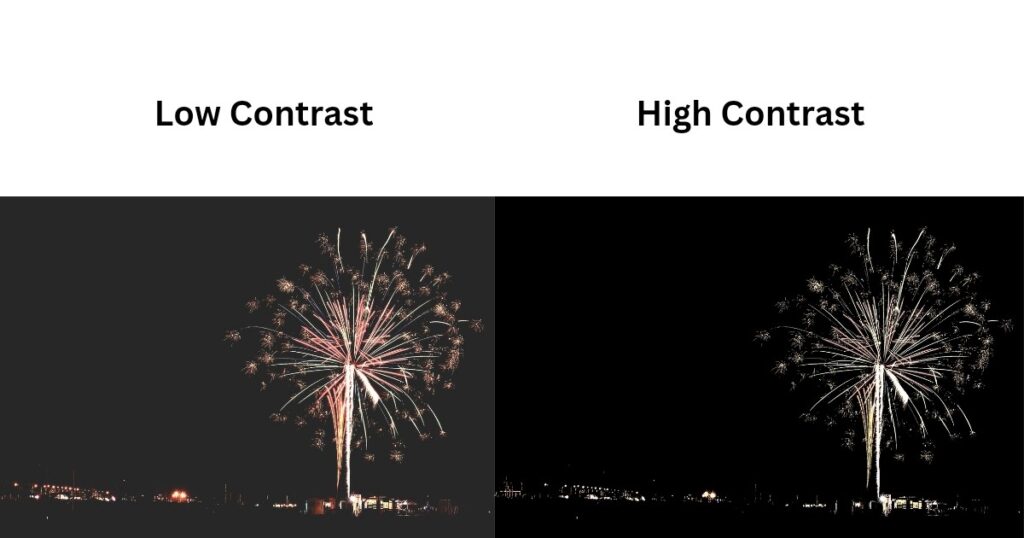
QLED vs LED: Contrast
The contrast performance of a QLED TV depends these factors:
- The type of backlight (standard LED or Mini-LED)
- The local dimming method (full-array or edge-lit)
- The panel type used (VA or IPS)
In fact, if a traditional LED TV uses a VA panel and full-array local dimming, its contrast will be comparable to a QLED TV with similar features.
That said, many QLED TVs are built with VA panels, which naturally offer higher native contrast, resulting in deeper blacks.
When paired with full-array local dimming, QLED TVs are able to control light more precisely, further enhancing dark scenes and black levels.
When it comes to contrast, OLED and Micro LED TVs are in a league of their own.
These technologies use self-emissive pixels, meaning each pixel generates its own light and can turn off completely to display true blacks.
This allows them to achieve infinite contrast, with no light bleed or blooming.
In contrast to them, both QLED and standard LED TVs rely on backlighting, which always shines through the LCD layers, even in dark scenes.
As a result, blacks may appear slightly greyish or washed out, especially in scenes with mixed lighting.
You might also notice blooming, where bright objects glow faintly into the dark background around them.
Winner: Tie
QLED vs LED: HDR Performance
A QLED TV that delivers strong contrast also provides significantly better HDR performance compared to a regular LED TV.
This advantage stems from QLED’s ability to produce a high color volume, which, when paired with enhanced contrast, results in vibrant, lifelike colors that reveal every subtle detail in a scene.
The highlights appear brighter and more striking, making the overall picture more immersive and dynamic.
In short, QLED TVs make HDR content truly pop with richer colors and more realistic brightness levels.
Winner: QLED
QLED vs LED: Viewing Angles
The viewing angles of QLED and LED TVs are influenced by the type of display panel they use.
IPS panels offer wider viewing angles compared to VA panels.
Therefore, an LED TV with an IPS panel will generally provide better viewing angles than a QLED TV with a VA panel, and vice-versa.
That said, many TVs use VA panels because they deliver higher native contrast, which enhances overall picture quality.
In contrast, IPS panels have lower contrast levels.
LED or QLED TVs with VA panels tend to have narrower viewing angles, and you might observe color shifts if you move away from the ideal viewing position, usually centered in front of the screen.
On the other hand, OLED and micro LED TVs offer very wide viewing angles since they control each pixel individually, maintaining consistent image quality across the entire screen, whether viewed from the center or the edges.
Winner: Tie
QLED vs LED: Response Time
Both QLED and LED TVs use LCD technology, where the backlight’s light must pass through multiple LCD layers before reaching the display panel.
This process causes a slight delay in response time, typically around 5 milliseconds or more.
In contrast, OLED and micro LED TVs have much faster response times. OLEDs respond in about 0.1 milliseconds, while micro LED TVs switch pixels on and off in just a few nanoseconds.
This speed advantage comes from their ability to control each pixel individually without relying on a backlight.
Winner: Tie
QLED vs LED: Lifespan
Both LED and QLED TVs are based on LCD technology and use inorganic pixels, which means they don’t degrade over time.
As a result, they are not susceptible to image retention or burn-in, issues that can potentially affect OLED TVs.
Winner: Both
LED vs QLED: Which TV to buy?
A QLED TV outperforms a traditional LED TV by offering a wider color gamut, richer color volume with more vivid hues, and improved HDR performance with brighter, more striking highlights.
However, QLEDs generally come at a higher price point than regular LED TVs.
However, it is important to note that not all QLED TVs are equal.
For instance, budget-friendly QLED models often have fewer dimming zones and less effective local dimming, which can lead to somewhat disappointing picture quality.
To get a truly good QLED experience, you usually need to invest more.
So, weigh your budget against your expectations for picture quality before making a decision.
Wait, there’s more..
QLED TV using mini LED backlight
To improve the contrast of QLED TVs further, some manufacturers use mini LED backlighting instead of standard LED backlights.
Samsung, for example, refers to its QLED models with mini LED technology as “Neo QLED.”
Mini LED backlights consist of thousands of ultra-small LEDs—each roughly the size of a grain of sand.
These are packed densely into the backlight layer, enabling the creation of hundreds of local dimming zones, compared to just a few dozens in typical QLED TVs.
This allows for far more precise control over brightness levels, significantly boosting contrast and reducing blooming effects.
As a result, QLED TVs with mini LED backlighting offer much better contrast than standard QLEDs, and some high-end models even come close to OLED TVs in contrast performance.
The dense array of mini LEDs in these TVs can produce extremely high brightness when needed.
Combined with the fine-tuned control of numerous dimming zones and a wide range of luminance levels, this allows QLEDs with mini LED backlights to display colors with exceptional accuracy and optimal brightness.
In bright rooms, these TVs perform exceptionally well, effectively combating glare and reflections.
Their vibrant HDR highlights are so impressive that even many OLEDs envy them!