MLA vs Conventional WOLED: How does MLA technology work?
Traditional LG OLED TVs, often referred to as WOLEDs, generally fall short in brightness compared to even many lower-cost LED models.
To overcome this limitation, Samsung started manufacturing quantum dot panels, which are incorporated in their QD-OLED TVs. These QD panels are also used by Sony which adds its own advanced processing and upscaling features in top of them.
These QD-OLEDs outperform conventional WOLEDs in many areas such as color gamut, color volume, brightness, and HDR performance.
In response to that, LG has introduced MLA (Micro Lens Array) technology to boost the brightness of its WOLEDs and keep them competitive.
What is MLA technology used in the LG WOLED TVs?
Micro Lens Array (MLA) technology incorporates a layer of thousands of microscopic lenses inside a WOLED TV.
These lenses help control and guide light with greater efficiency.
Now, the question is—how does this actually boost the brightness of a WOLED TV?
Let’s dive deeper into it.
Why the need for MLA tech?
In a WOLED TV, light is produced by a white-emitting organic layer. This white light then passes through different color filters to create the red, green, and blue subpixels.
Alongside these, an extra white subpixel is included—hence the name WOLED.
Unlike the RGB subpixels, the white one is left unfiltered.
But this brings up an important question: if we already have the primary colors, red, green, and blue, then why is a white subpixel needed at all?
In WOLED TVs, color filters work by removing the unwanted wavelengths from the white light, leaving only red, green, and blue.
However, since these are merely filtered components of the original light, their intensity gets reduced.
Moreover, at the filter interface, a significant portion of the light is reflected back due to total internal reflection, instead of moving forward to enhance color brightness.
As a result, some of the light energy is lost, which is why WOLED TVs generally appear less bright compared to their LCD counterparts.
While the fourth unfiltered white subpixel enhances pure whites in bright scenes and adds some extra brightness to the TV, it also compromises overall color accuracy by blending into the other colors.
To further raise the brightness of individual colors or the entire image, the white-emitting organic layer has to be driven more hard which may instead shorten the lifespan of the TV.
This is exactly where MLA technology comes into play.
How does MLA enhance the brightness of WOLED?
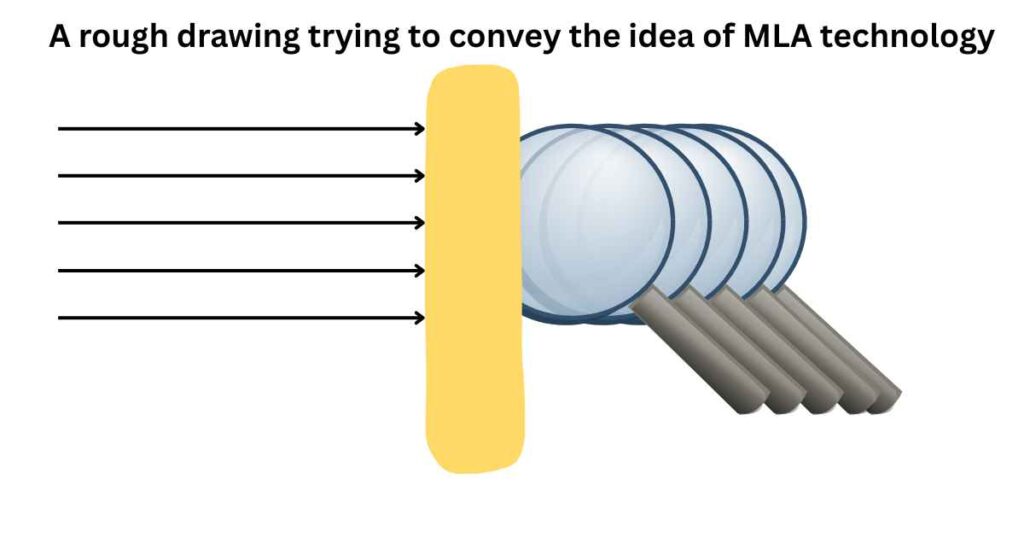
In MLA-based OLED TVs, each subpixel is equipped with countless microscopic lenses.
When light passes through these subpixels, the lenses redirect it forward rather than letting it bounce back.
By retaining and channeling a larger portion of light, these lenses naturally amplify the color intensity.
As a result, MLA OLED TVs achieve significantly higher brightness without putting any additional stress on the organic pixels.
How does MLA technology stack up against other OLED and LCD technologies?
MLA-based OLED TVs like the LG G3 and G4 stand out as strong rivals to Samsung and Sony’s QD-OLEDs in terms of brightness.
They also hold their ground against many mini-LED TVs that boast high peak brightness.
Still, the brightest LCDs can surpass the brightest OLEDs.
MLA WOLED vs mini LED vs QLED
LCD TVs that use mini LEDs for their backlighting are called mini LED TVs, while those that rely on quantum dot technology are known as QLED TVs.
Some high-end mini LED TVs also incorporate quantum dots, such as QNED and Neo QLED models—and these are often a brand’s flagship offerings.
The best of these can compete directly with MLA WOLED TVs, which sit at the top of the OLED category alongside QD-OLEDs.
Top-tier Neo QLED TVs (Samsung QLEDs with mini LED backlighting) can deliver color volume that exceeds MLA WOLEDs and is comparable to QD-OLEDs.
They also tend to reach slightly higher brightness levels than MLA WOLEDs in both HDR and SDR.
That said, MLA WOLED TVs still offer excellent brightness and color volume, outperforming most standard QLED and QNED models.
Their only true rivals are Neo QLEDs and QD-OLEDs.
However, when it comes to viewing in well-lit environments, MLA WOLEDs deliver an incomparable experience, delivering excellent HDR performance with vivid highlights while maintaining deep, inky blacks.
They have the advantage of maintaining deep black levels in nearly all lighting conditions, whereas QD-OLED black levels may appear elevated in bright rooms.
Their outstanding reflection handling further minimizes glare.
In addition, because Neo QLEDs and QNEDs are LCD-based, they cannot match the perfect inky blacks or the extremely wide viewing angles of MLA WOLED displays.
Another unique advantage of MLA-based WOLEDs is their ability to reproduce pure whites, thanks to the additional white subpixel in WOLED technology.

This makes scenes like snow-covered mountains or a clear, sunny sky appear brighter and more lifelike.