
How many nits does a TV need for a sunny room?
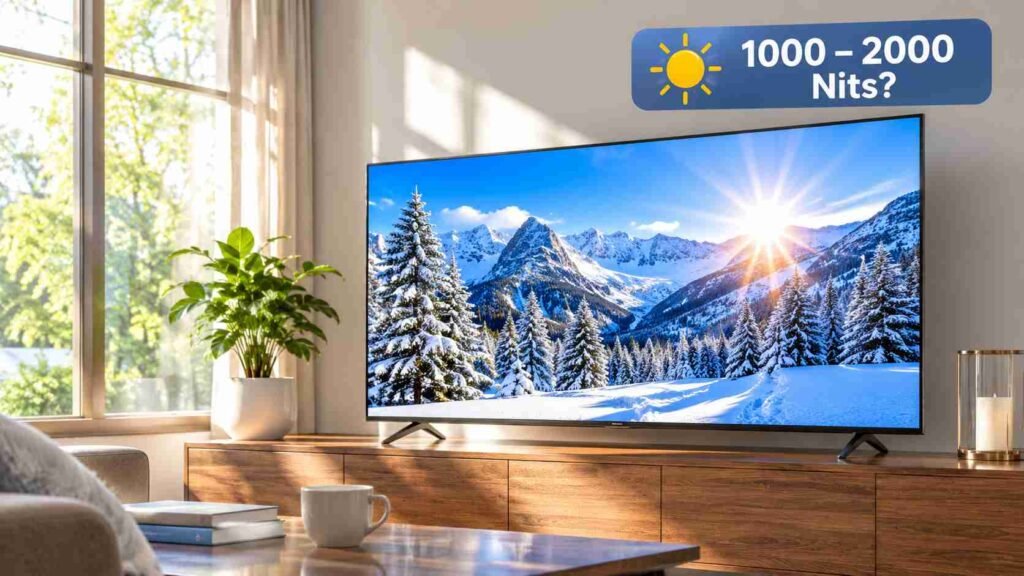
In rooms with large glass windows or strong sunlight, a TV needs sufficient brightness to maintain picture visibility.
For most bright living rooms, a TV capable of producing approximately 700–1000 nits of HDR peak brightness can be a good choice.
Models reaching 1000–2000 nits offer additional brightness headroom, especially for displaying bright HDR highlights faithfully.
That said, choosing a TV for a sunny room involves more than looking at its advertised peak brightness.
Even a 2000-nit TV cannot guarantee clear visibility when direct sunlight reflects off its screen.
Another important thing to consider is the difference between peak brightness and sustained brightness.
A TV might achieve 2000 nits in a small portion of the screen but produce considerably less when displaying a large, bright image.
This article will guide you in choosing the best TV for a sunny room.
How many nits do you need for a sunny room?
The brightness required by a TV for good picture visibility in a sunny room depends on the amount of ambient light entering the room, the direction of sunlight, as well as the screen’s ability to minimize reflections.
A TV producing 400–600 nits can work well in moderately lit rooms, while approximately 600–1000 nits provides greater brightness headroom for rooms with large windows and strong daylight.
TVs reaching 1000–1500 nits can offer additional benefits in particularly bright indoor environments, while 1500–2000 nits can be much better when HDR highlights need to remain intense under challenging lighting conditions.
Note that two TVs producing the same luminance can perform differently depending on their screen reflectivity and contrast.
In fact, a research published by Jan Bauer and Markus Kreuzer in Information Display explains how ambient illumination, reflected light and display luminance collectively determine perceived contrast.
Although the study examines automotive displays, the underlying optical principles also apply to TVs.
Is 1000–2000 nits enough for a bright room with direct sunlight?
A TV capable of reaching 1000–2000 nits can deliver very good brightness for most bright indoor environments.
High HDR peak brightness helps reproduce intense highlights, such as sunlight, bright clouds and reflections.
It is even better if the TV also has good reflection handling and maintains sufficient brightness across larger portions of the screen.
However, achieving 1000 or even 2000 nits alone may not guarantee comfortable viewing when direct sunlight falls onto the display.
Also, it is important to keep in mind that a TV may not continuously produce its advertised peak brightness across the entire screen.
These figures are often measured using small white test windows, while full-screen brightness can be considerably lower.
Furthermore, HDR peak brightness differs from SDR brightness, which matters more when watching conventional television broadcasts, standard YouTube videos and other SDR content.
Research by Jan Bauer and Markus Kreuzer, which we discussed earlier, explains how bright reflections can affect TV visibility.
A bright cloud with a luminance of around 20,000 cd/m² or nits can reflect off an untreated glossy TV screen, producing reflected brightness approaching 1,000 nits.
This reflected image of the cloud can compete with the TV’s own light, reducing perceived contrast and making the picture look washed out.
Consequently, even a 2000-nit TV may struggle when sunlight or a bright window is directly reflected in the viewing area.
Does higher peak brightness improve daytime viewing?
In HDR movies, peak brightness determines how intensely a TV can reproduce small highlights, including sunlight, explosions and specular reflections.
These highlights typically become more visible against ambient light when the display has sufficient luminance.
However, a bright living room does not contain only small HDR highlights; much of the displayed image can also be relatively bright.
For example, watching a football match, a snowy landscape or a daytime outdoor scene requires the TV to maintain brightness across larger portions of the screen.
In essence, a TV with 1500 nits of peak brightness but substantial brightness reduction on larger images may therefore produce less consistent daytime visibility than one with a lower peak but stronger sustained brightness.
In fact, RTINGS’ testing shows why a TV’s peak brightness alone does not tell us how bright it will look in real HDR content.
It measures brightness using different-sized white areas (2%, 10%, 25%, 50% and 100% of the screen).
So, what does this mean?
A TV may produce very high brightness in a small highlight, such as sunlight or a bright reflection, but its brightness can drop when a much larger part of the screen becomes bright.
The 100% window test shows how well the TV maintains brightness across the entire screen.
Peak brightness vs sustained brightness: What’s the difference?
Peak brightness refers to the highest luminance a TV can produce under specified measurement conditions, whereas sustained brightness describes how much luminance it can maintain over time.
For example, a TV might reach 2000 nits when displaying a small white highlight against a dark background but produce substantially less when displaying a large bright image.
Thus, peak brightness is more relevant to short HDR highlights, while sustained brightness becomes important when bright objects remain visible for longer periods or occupy larger areas of the screen.
That’s why, two TVs with identical advertised peak brightness may deliver noticeably different results during extended viewing of bright content.
Why does TV brightness decrease when more of the screen becomes white?
A TV’s maximum brightness can decrease as the illuminated portion of the screen increases because of power consumption, thermal limitations and brightness-management mechanisms.
This behaviour is much more relevant to OLED TVs, which typically reduce their light output when a large percentage of pixels produce bright images.
The mechanism commonly associated with this behaviour is Automatic Brightness Limiting (ABL).
For example, an OLED TV might produce extremely bright highlights in a dark HDR scene but reduce its overall luminance when displaying a full-screen snowy landscape or a predominantly white webpage.
LED, particularly mini-LED TVs can generally maintain higher brightness over larger image areas because their backlights illuminate the LCD panel.
Dolby explains this difference in its Dolby Vision HDR Display Evaluation Guideline, noting that peak luminance typically decreases as the measurement window increases, with this behaviour being more common on OLED displays than LCD-based displays.
Does screen reflection matter more than peak brightness?
By now, we understand that peak brightness and screen reflection handling work hand in hand to determine how well a TV performs in a bright room.
A TV emits light towards the viewer, while ambient light falling on its surface can reflect back and interfere with the displayed image.
Diffuse reflections increase the luminance of dark portions of the picture, while direct or specular reflections can make windows, lamps and other bright objects visible on the screen.
Both effects can reduce perceived contrast, making blacks appear grey and colours less distinct.
A study by Michael J. Flynn and Aldo Badano, published in the Journal of Digital Imaging explains how ambient light reflection and veiling glare increase luminance in dark image regions, which reduces display contrast.
That’s why, a TV with effective anti-reflection properties can typically provide better daytime picture visibility than a brighter TV with a highly reflective screen.
Are mini-LED TVs better than OLED TVs for sunny rooms?
Mini-LED TVs often have an advantage over OLEDs in bright rooms because their LCD backlights can maintain high luminance across larger portions of the screen.
This is much useful when watching sports, daytime broadcasts and bright HDR scenes where sustained brightness matters more than small-window peak brightness.
OLED TV, on the other hand, can produce excellent HDR highlights and deep blacks, but their brightness can decrease more noticeably when a large portion of the screen becomes bright.
Nevertheless, a high-end OLED with strong peak brightness and effective reflection handling can outperform a lower-end mini-LED TV with weaker brightness and a more reflective screen.
Conclusion
For most bright living rooms, a TV with 700–1000 nits of HDR peak brightness is a strong choice, while 1500–2000 nits provides extra headroom. That said, prioritize sustained brightness and reflection handling for better daytime visibility rather than focusing solely on how many nits of peak brightness a TV can produce.
Frequently Asked Questions
1. Is 500 nits enough for a sunny room?
500 nits can be sufficient in a moderately bright room where sunlight does not directly reflect off the screen. However, it may not provide enough brightness headroom in rooms with large windows, strong daylight or substantial screen reflections.
2. Is 1500 nits better than 1000 nits?
A 1500-nit TV has greater peak brightness capability than a 1000-nit TV, which can improve HDR highlight intensity. However, it is not necessarily better for daytime or bright-room viewing if it has lower sustained brightness or more screen reflections.
3. Does 2000 nits mean a TV is suitable for outdoor viewing?
A 2,000-nit peak brightness rating alone doesn’t guarantee outdoor suitability, although it can help a TV remain visible in very bright environments.
Factors like screen reflections, sustained brightness and operating temperature matter too.
4. Are nits and cd/m² the same?
Yes. A nit is another name for one candela per square metre (cd/m²), the standard unit used to measure luminance. TV brightness specifications commonly use nits to describe how much light the screen emits per unit area.
5. Is higher sustained brightness better than higher peak brightness?
Sustained brightness is more important for bright environments and large bright scenes, as it maintains higher luminance over larger screen areas. Peak brightness mainly determines how brightly a TV can reproduce small, intense HDR highlights.
Pingback: QLED vs OLED: Which TV performs better in a bright room?
Pingback: Which QLED TV performs best in a bright room? -