
RGB Micro LED vs RGB OLED: Which Display Reigns Supreme?
The race to create the perfect display has never been more exciting.
From smartphones in our pockets to massive TVs in our living rooms, screen technology is evolving at a breathtaking pace.
Among the most talked-about contenders today are RGB OLED and RGB micro LED—two cutting-edge display technologies.
But while both consist of a common RGB term, they take fundamentally different approaches to how pixels are created and illuminated.
This article dives deep into how these technologies work, where they shine, and which one might define the future of displays.
Whether you’re a tech enthusiast, a gamer, or someone looking to buy the best screen possible, this article will help you gain deep insights about these technologies and make a smarter, more confident choice.
Let’s get started.
What Is RGB Micro LED?
RGB micro LED or simply, micro LED is often described as the “ultimate display technology,” and for obvious reasons.
Unlike traditional LED displays that rely on backlights or organic compounds, micro LEDs use millions of microscopic inorganic LEDs, each acting as its own pixel.
In an RGB micro LED display, every pixel is made up of separate red, green, and blue LEDs, meaning there’s no need for color filters or white subpixels unlike the traditional OLEDs.
This direct emission of colored light results in extremely high brightness efficiency and exceptional image precision on a micro LED display.
It should be noted that RGB micro LED is not the same as Micro RGB, which actually an LCD TV. While, micro LED is a self emissive display.
As each pixel of a micro LED display can turn on and off itself completely just like OLED, it results in the reproduction of true blacks on it.
Because micro LED pixels are made from inorganic materials, they avoid one of OLED’s biggest weaknesses—burn-in and pixel degradation.
These inorganic LEDs are far more stable over time, maintaining brightness and color accuracy for years without noticeable wear.
Another major advantage is scalability. Micro LED panels can be assembled modularly, allowing manufacturers to create screens of virtually any size without compromising quality.
However, the technology is still in its infancy.
Manufacturing such tiny LEDs with perfect alignment is extremely complex and expensive.
That’s why micro LED TVs, such as those showcased by Samsung, are currently limited to ultra-premium segments.
Still, the potential is enormous. With unmatched brightness, longevity, and pixel-level control, RGB micro LED represents a glimpse into what the future of displays could look like once production becomes more accessible and cost-effective.
What Is RGB OLED?
RGB OLED, or Red-Green-Blue Organic Light Emitting Diode, takes a different but equally fascinating approach.
Each pixel in an RGB OLED display is made up of organic compounds that emit light individually when electricity passes through them.
This means no backlight is required, allowing for true blacks and infinite contrast, which is one of the main defining strengths of OLED technology.
But the key difference which separates a true RGB OLED panel from others is that, its every pixel contains distinct red, green, and blue subpixels.
This structure enables highly accurate color reproduction because each subpixel directly emits its own color rather than filtering white light.
This is different from many consumer OLED TVs like WOLEDs, which use a white OLED structure with color filters to boost brightness.
However, OLED’s reliance on organic materials introduces some trade-offs.
Over time, these materials degrade, especially blue subpixels, which can lead to uneven aging or burn-in in extreme cases.
That said, modern OLED panels have significantly improved in this regard, however, the risk still exists under improper usage conditions.
Despite these limitations, RGB OLED remains one of the most visually impressive display technologies available today.
Its ability to deliver perfect blacks, excellent viewing angles, and smooth motion makes it a favorite for smartphones and professional monitors where image quality takes priority.
Which Display Segments Do These Technologies Cover?
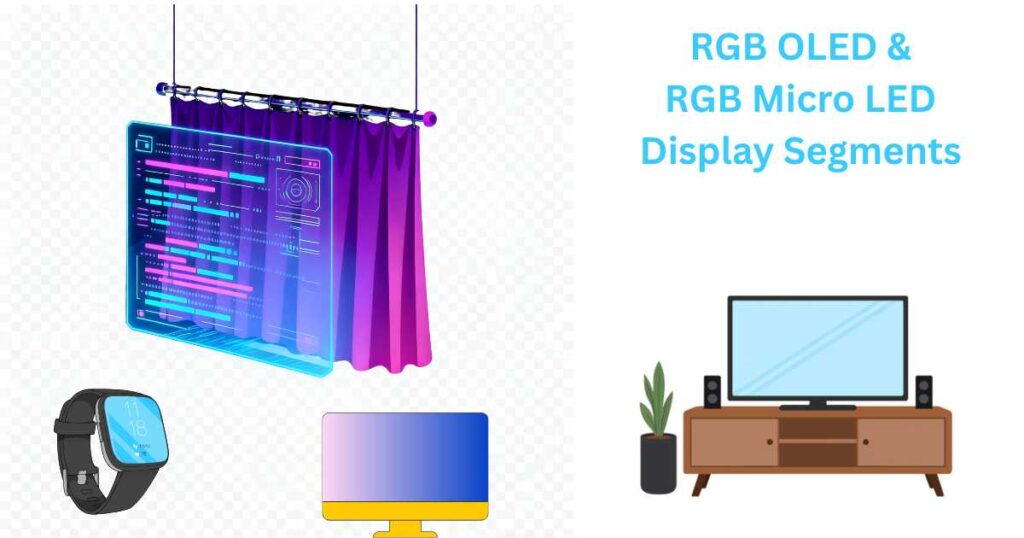
RGB OLED is more common in smaller displays or specialized panels, where image precision and color purity are the most critical things.
This technology is widely used in smartphones, although often in Pentile AMOLED form rather than full RGB layouts, due to efficiency considerations.
In laptops and professional monitors, RGB OLED is gaining traction for content creators who demand color accuracy and contrast fidelity.
RGB micro LED, on the other hand, is still carving out its space.
Currently, it’s mostly found in ultra-high-end displays, commercial installations, and luxury home theaters.
Micro LED is particularly attractive for very huge screens, where its modular design allows seamless scaling without losing image quality.
It’s also being explored for future AR/VR devices and next-generation wearables, thanks to its incredible brightness and efficiency.
While OLED is the present, micro LED is very much the future.
OLED’s maturity means it’s widely available and relatively affordable in comparison, while micro LED remains a showcase of what’s technologically possible.
But as manufacturing efficiency improves, micro LEDs could eventually expand into mainstream TVs, smartphones, and even automotive displays.
Key Differences: RGB OLED vs RGB Micro LED
Contrast
Both micro LED and OLED pixels can turn off completely, producing absolute black with zero light emission.
This results in a very high contrast, making dark scenes look incredibly rich and detailed.
That said, due to the extreme brightness potential of micro-LED along with the ability to achieve completely dark blacks, it achieves even higher contrast ratio.
Both OLED and micro LED perform at a level far beyond traditional LED or LCD displays in contrast.
Color Gamut
RGB OLED benefits from its separate RGB organic subpixels, which emit highly saturated colors directly.
This leads to excellent color accuracy and a very good coverage of DCI-P3 color gamut, making it ideal for cinematic and professional use.
RGB OLED has the ability to produce natural, lifelike tones without oversaturation.
In an RGB micro LED display too, each microscopic inorganic LED emits pure red, green, or blue light, resulting in extremely vibrant and precise colors.
This direct emission allows micro LED to achieve a much wider color gamut, which is almost 90-100% of the future Rec. 2020 color gamut, than OLED.
That said, the key difference lies in consistency at extreme brightness.
While OLED colors can slightly desaturate as brightness increases, micro LEDs maintain color intensity even at very high luminance, about which we will discuss more in the next section.
Peak Brightness and Color Volume
Brightness is where the RGB micro LED clearly pulls ahead.
OLED panels are limited by the organic materials used in their construction.
Pushing them too bright accelerates degradation, so manufacturers generally cap peak brightness to preserve lifespan.
That said, modern OLEDs like QD-OLEDs can reach very impressive brightness levels as high as 4,000 nits.
Micro LED, on the other hand, can achieve dramatically higher brightness, hitting millions of nits without compromising longevity.
Its inorganic LEDs can sustain intense luminance, making it ideal for bright rooms and HDR content.
More importantly, it maintains color accuracy even at these high brightness levels, resulting in superior color volume.
This combination of high brightness and consistent color performance makes micro LED particularly suited for next-generation HDR standards.
It delivers highlights that feel more realistic and impactful, something OLED struggles to match at the highest levels.
However, recent developments in RGB OLED display by INT Tech have shown these display are also capable of hitting as high as 100,000 nits by refining the OLED stack design and materials it uses.
Motion Handling
Both RGB OLED and RGB Micro LED offer near-instant pixel response times, which is a very crucial factor for motion clarity.
OLED has long been praised for its ability to handle fast-moving scenes without any blur, making it a favorite among gamers and sports enthusiasts.
That said, the inorganic LEDs in a micro LED display can switch on and off much more faster, providing completely fluid performance.
For instance, the typical response time of micro LED is 0.2 us, while that of OLED is around 0.1 ms.
Where micro LED may gain another edge is in sustained performance. Since it doesn’t suffer from burn-in risk, gamers can play static HUD-heavy games without concern.
OLED users, while generally safe with modern display panels, still need to be mindful of long-term static content exposure.
Price
This is where the gap becomes impossible to ignore.
RGB OLED, while premium, has become increasingly accessible over the years.
Competitive pricing and mass production have made it a viable option for many consumers looking for high-end displays.
Micro LED, however, remains prohibitively expensive. Manufacturing complexity and low yields make it one of the most costly display technologies available today.
As a result, micro LED TVs are currently priced in the luxury category, often far beyond what most consumers can justify.
For instance, Samsung The Wall 146 inch micro LED TV is placed at a staggering price of $220,000.
Until production scales and costs come down significantly, micro LED will remain a niche option reserved for high-budget installations.
Which RGB Technology Wins: OLED or Micro LED?
If you’re choosing today, RGB OLED offers one of the best balance of performance and practicality.
But looking ahead, RGB micro LED has the potential to surpass OLED in nearly every metric, be it brightness, color volume, longevity or scalability.
The only barrier is cost and manufacturing maturity.
In simple terms, RGB OLED is one of the best displays you can buy now.
Micro LED is the best display you’ll want to buy in the future.