
Full Array vs Mini-LED: Which one is the better TV?
If you’re out for shopping for an LED LCD TV, you’ve probably come across terms like full array local dimming (FALD) and mini-LED.
These terms may sound slightly complex, but the idea behind these terms is actually simple: both are technologies which control how light is produced behind an LCD screen.
Since LED/LCD TVs don’t produce their own light (like OLED does), the role of a backlight becomes very important in creating image.
The better the light control, the better blacks, contrast, and HDR performance you get.
Let’s break down each of these terms in simple words and find out whether they are similar or entirely different.
Full Array TVs have LEDs spread across the whole back.
A full array TV is an LCD TV having LED backlight running all across behind the display panel, which divides the entire screen into multiple groups of LEDs that can brighten or dim independently, also known as “local dimming zones”.
Imagine watching a dark movie scene with a bright moon in the sky.
A full array TV can entirely dim the dark sky area while keeping the moon fully bright.
That gives you better contrast and deeper blacks compared to cheaper edge-lit TVs, which have LEDs spread only across the edges, and not the entire backlight.
However, the real magic doesn’t lie just in the hardware.
The TV also uses an intelligent dimming algorithm (basically, smart software) to decide how each zone should light up and dim.
Brands like Samsung and Sony use advanced dimming algorithms that help reduce blooming— that glowing halo you sometimes see around bright objects.
A typical full array TV might have anywhere from 32 to 200 dimming zones, depending on the model.
The more number of dimming zones it has, the typically better it can control light, however this might not be always true (will see in the coming sections).
Mini-LED TVs have numerous tiny LEDs in the backlight.
The main difference between mini-LED and a regular LED TV is the size of the LEDs used in the backlight.
Traditional LED TVs use LEDs that are usually around 0.5 mm to 1 mm in size.
Mini-LEDs are much smaller, typically under 0.2 mm (200 micrometers).
Because they are so tiny, manufacturers can fit thousands of them behind the screen instead of just a few hundred.
For example, a standard FALD TV might use a few hundred LEDs grouped into some dozens of zones.
On the other hand, a mini-LED TV can use 2,000 to over 10,000 tiny LEDs, allowing for the creation of hundreds or even thousands of local dimming zones.
This is what allows mini-LED TVs to have more precise brightness control, resulting in better contrast and HDR performance than normal LED TVs.
Bright highlights look more intense, and dark scenes look more detailed.
Not all mini-LED TVs are FALD.
This is something most of the buyers don’t realize.
Mini-LED only tells you that the LEDs are smaller than normal LEDs.
However, it does not guarantee that the TV uses full array local dimming.
In fact, many of the mini-LED TVs still use edge lighting or LEDs spread just only across the edges just to reduce cost or make the TV thinner.
In those cases, even though the LEDs are tiny, the TV is not likely to deliver the level of contrast you expect.
There might be some vertical or horizontal banding since edge-lit TVs rely on light guides, which can also result in noticeable blooming.
For example, some QNED and QLED TVs use mini-LED branding, but don’t have full array local dimming. They just have mini-LEDs placed along the edges.
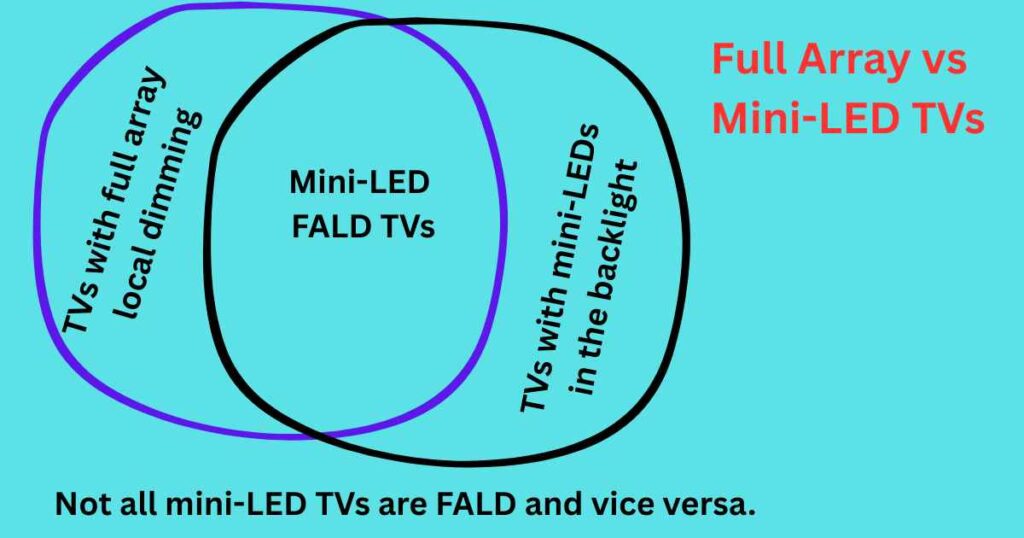
Thus, you should always check whether the TV specifically mentions “Full Array Local Dimming” or gives a dimming zone count.
True FALD means the LEDs are placed all across behind the entire panel in controllable zones.
Without that, the use of mini-LEDs alone doesn’t guarantee you premium contrast.
Mini-LED FALD TVs usually have more dimming zones.
When mini-LED backlighting is combined with full array local dimming, that’s where things get impressive.
Because mini-LEDs are so small, manufacturers can create far more dimming zones compared to regular full array TVs.
A normal FALD TV might have 60 to 200 zones while a mini-LED FALD TV can easily have 500, 1,000, or even more.
For example, the Samsung Neo-QLED QN90B TV offers hundreds of dimming zones, while the higher-end models can go even further.
More zones typically mean that the TV can control light more precisely.
If you’re watching a starry sky, the TV can light up tiny stars without brightening the entire surrounding area.
This improves black depth, and its impact is much seen while watching or playing contrasty HDR content, where bright and dark areas appear on screen simultaneously.
More dimming zones doesn’t always mean better contrast.
Here’s something important to note: more number of local dimming zones does not automatically translate to better picture quality.
Two other big factors matter here, among which first one is the panel type.
VA panels naturally produce deeper blacks than IPS panels.
So a TV with fewer dimming zones but a VA panel should look better in dark scenes than an IPS model having higher number of dimming zones.
The second one is the dimming algorithm. The TV’s processor decides how effectively to dim or brighten zones.
For instance, the Sony X95K TV does a very smart backlight control, and thus, renders better picture quality than many TVs even if they have a similar or higher dimming zone count.
So while dimming zone numbers are useful, the actual picture quality of the TV depends on LCD panel type and method of local dimming just as much.
A weak dimming algorithm can cause flickering or visible halos even if the dimming zone count is high.
Which one is the better TV: Full Array or mini-LED?
A FALD TV is always better than an edge lit TV, whether it uses normal LEDs or mini-LEDs in the backlight.
That said, for most people, the sweet spot today is a mini-LED TV with full array local dimming and a VA panel.
Samsung’s Neo QLED lineup is a strong example of this combination.
These TVs use mini-LED backlighting, high dimming zone counts, powerful processors, and high native contrast panels.
As a result, their achieve excellent brightness and strong HDR impact along with deep blacks.
If you want strong contrast for watching in dark environments along with high peak brightness for daytime viewing and fighting glare, a VA mini-LED FALD TV is a great choice.
Just remember: don’t focus only on “mini-LED” as a label.
Look for full array local dimming, and consider the panel type as well.
How does a mini-LED FALD TV compare to an OLED?
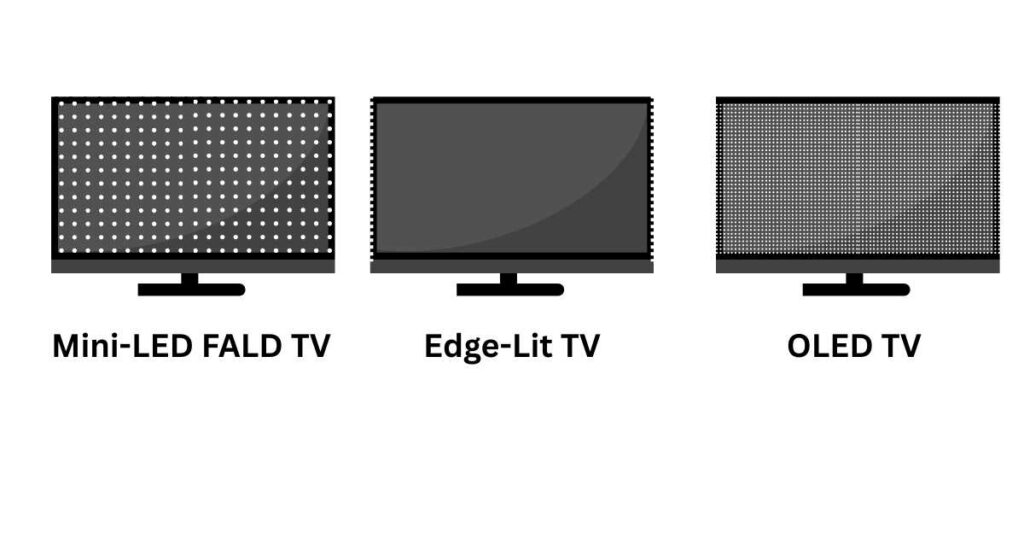
A FALD mini-LED TV is still an LCD TV, but with a advanced backlight.
It uses thousands of tiny LEDs behind the screen, grouped into a large number of local dimming zones.
These zones brighten or dim depending on what’s on screen.
Most high-end mini-LED TVs use VA (Vertical Alignment) panels which have high native contrast, meaning blacks look fairly deep even before dimming kicks in.
When combined with mini-LED FALD, their contrast ratio is enhanced significantly.
However, VA panels lose color and contrast when viewed from the side.
The mini-LED TVs which use IPS (In-Plane Switching) panels, get wider viewing angles, so that the image stays accurate even when viewed from the side.
However, the downside of using an IPS panel is lower native contrast, which means that blacks may look more gray, even with local dimming.
Even the VA panels with mini-LED FALD implementation can suffer from slight blooming (though are much better than IPS panels), as they still have to rely on a backlight which can’t be turned off completely.
OLED, on the other hand, is a completely different technology from LCD.
Each pixel lights up itself and turns completely off when required.
That results in true black with infinite contrast which translates into no blooming, no halos at all.
Thus, if you want perfect blacks with almost realistic picture quality, go for an OLED.
New OLED technologies like QD-OLEDs and MLA based WOLEDs have also overcome low peak brightness which once used to be a concern in OLEDs.
That said, a VA mini-LED TV with FALD can become extremely bright in a sunlit room so that you can watch eye popping details on it without any concern of glare.
It also offers great value for its price and being LCD, it is too free from any burn-in concern so that you can even watch repetitive content on it all day long.
Pingback: QLED vs OLED: Which TV performs better in a dark room?