
Is NanoCell better than LED TV? Which one to buy in 2026?
When we notice a NanoCell TV, we often wonder how do they keep producing such stunning colors?
In this article, we’ll take a deep dive into the NanoCell technology used in TVs, explore how it works, and compare it with traditional LED TVs.
Let’s get started.
What is NanoCell technology used in LG TVs?
To begin with, NanoCell is a type of LCD TV developed by LG that uses a layer of nanoparticles to enhance picture quality.
LG refers to each pixel in these TVs as a “NanoCell,” which together, form the image displayed on the screen.
Essentially, NanoCell TVs are advanced version of traditional LED TVs.
What is an LED TV?
Brands use the term “LED TV” for marketing their LCD TVs illuminated by LED backlighting positioned behind the panel.
The white light from these LEDs passes through color filters, where it is separated into red, green, and blue.
These primary colors then combine in different ways to reproduce the wide range of colors you see on the screen.
However, there’s a limitation to this approach.
Since the white light itself is not very pure, instead it is a mix of different colors, the resulting RGB colors are also not perfectly pure.
For example, the red produced this way isn’t truly monochromatic, it may contain many dull or unwanted color tones.
These impurities can make the image look less vibrant or slightly washed out.
This is where NanoCell technology, developed by LG, gains an advantage by improving color purity and thus, overall picture quality.
What is a NanoCell TV and how does it work?
A NanoCell TV is essentially an LCD television that uses LED backlighting, but with an added layer of nanoparticles to enhance image quality.
Similarly, technologies like QLED and QNED are also LCD TVs with LED backlights, distinguished by additional enhancements.
Please note that the LED displays actually are self-emissive, meaning each pixel produces its own light—examples include OLED and micro-LED.
I am using the term “LED TV” here to refer to LCD televisions that use LED backlighting, since various brands market them under this name.
In NanoCell TVs, the nanoparticles used are extremely small, ranging between 1 and 100 nanometers in diameter.
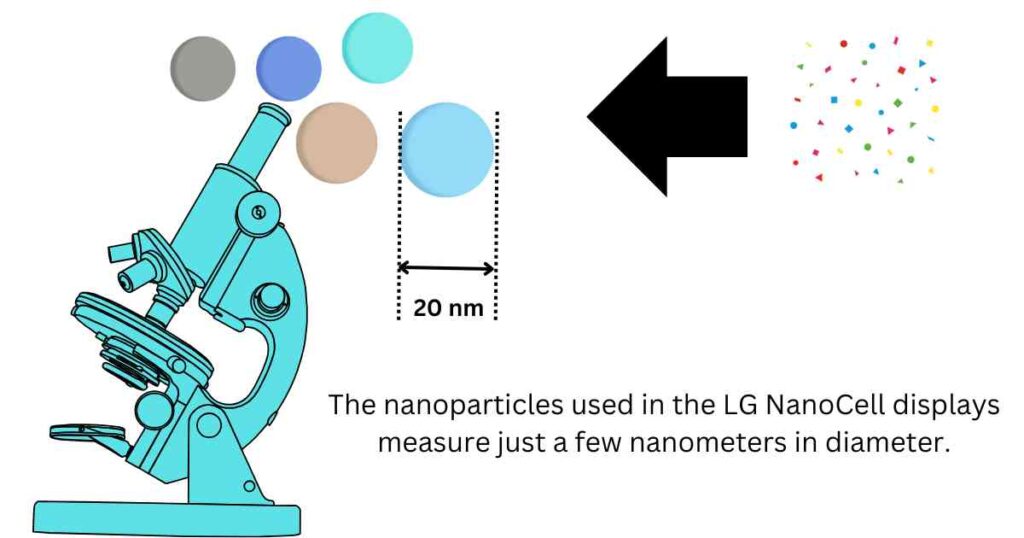
These particles are incorporated into the display to absorb unwanted or impure color wavelengths while allowing only the precise primary colors to pass through.
Positioned after the color filters (where white LED light is separated into red, green, and blue), the nanoparticle layer filters out dull or inaccurate tones from light before it finally reaches the display.
As a result, NanoCell TVs deliver a more accurate and pure color gamut, producing images that should appear more visually appealing compared to standard LED-backlit LCD TVs.
NanoCell vs LED: What are the differences?
Now, let’s compare NanoCell TVs with conventional LED TVs to find out what advantages the NanoCells have to offer over them.
Contrast
NanoCell TVs are built on IPS LCD panels, which typically have a lower native contrast ratio.
Because of this, a significant amount of blooming can occur around bright objects, where light spills into darker areas of the image.
This makes blacks appear more gray than deep black, ultimately reducing overall picture quality.
While higher-end NanoCell models feature FALD (Full Array Local Dimming), the improvement in contrast is limited by the IPS panel’s inherently low contrast ratio.
In more affordable edge-lit versions, the fewer local dimming zones further reduce contrast, often resulting in even poorer image quality.
On the other hand, standard LED-backlit LCD TVs may use either an IPS or a VA panel.
Models equipped with VA panels generally offer much higher contrast ratios than NanoCell TVs that rely on IPS panels.
As a result, VA-based TVs produce deeper blacks and a more pleasing overall picture.
In fact, many VA panel TVs are available at lower prices than NanoCell models while still delivering superior image quality.
Winner: LED
Viewing Angles
NanoCell TVs perform strongly in this area as they use IPS LCD panels.
These panels provide wide viewing angles, allowing the picture to remain clear and accurate even when viewed from the side.
Similarly, LED-backlit LCD TVs equipped with IPS panels also offer wide viewing angles.
In contrast, LED TVs that use VA panels generally have narrower viewing angles, causing the image quality to decline as you move away from the center position of the TV.
Winner: NanoCell
Color Accuracy
NanoCell TVs deliver highly accurate colors because their nanoparticle layer filters out impure color tones.
They also generally support a wide color gamut, producing precise colors that make them appear more colorful compared to standard LED TVs.
Winner: NanoCell
Brightness
Although NanoCell TVs are technically a type of LCD and should offer high brightness, they often fall short of this expectation.
They are usually not very bright in HDR, which is likely because the nanoparticle layer that filters out impure colors could also reduce overall light intensity.
In contrast, LED TVs, especially those with full-array local dimming—can achieve high brightness and handle glare well in well-lit environments.
Winner: LED
Response Time & Durability
NanoCell TVs are essentially an enhanced version of standard LED-backlit LCD TVs.
Like conventional LED TVs, they too use a backlight from which light travels through multiple layers to reach the display panel.
As a result, the pixel response time for a NanoCell TV is typically around 5–10 ms, which is almost the same as the average response time of LED TVs.
Being LCD-based technologies, both NanoCell and LED TVs are very durable and rarely prone to pixel degradation or burn-in issues.
Winner: Both
Which TV is better to buy out of NanoCell and LED TVs?
After carrying out a brief comparison between NanoCell and LED TVs, we can now make a reasonable judgment about which one performs better overall.
When it comes to the picture quality, the main decisive factors are contrast, color accuracy, and brightness.
NanoCell TVs excel at reproducing colors but typically lag in contrast and brightness, which can diminish subtle details and overall image quality.
In comparison, a VA LCD TV with an LED backlight offers strong contrast and good brightness, marking clear distinction between dark and bright areas and producing more natural-looking colors.
Thus, if you’re looking at a full-array VA LED TV in the same price range as a NanoCell, the VA LED is clearly the better option to pick.