
Samsung TV Buying Guide 2026 [With The 8 Best Samsung TVs]
Samsung continues to be one of the most dominant names in the TV market in 2026.
The company offers a wide range of displays that cater to the demand of every type of customer, be it a casual viewer or a hardcore gamer or a home theatre enthusiast.
With advancements in display technologies like QD-OLED and mini-LED, along with Samsung’s ongoing refusal to adopt Dolby Vision in favor of HDR10+, choosing the right Samsung TV can feel exciting but confusing as well.
The brand’s lineup is now more diverse than ever, blending premium innovations with competitive mid-range and budget options.
This Samsung TV buying guide will help you select the best Samsung TV according to your requirements and budget.
Whether you’re upgrading from an older LCD or stepping into OLED for the first time, this guide will help you navigate the vast range of Samsung TVs confidently.
So, let’s get started now.
Samsung TV Market Scenario
According to Samsung’s official announcements, the company has been the world’s No.1 TV brand for 20 consecutive years, which reflects its consistent innovation and strong consumer demand worldwide.
The company leads categories such as high-end TVs priced above $1,500 and $2,500, with a significant share of over 50% of the premium TV market, driven by advanced technologies like Neo QLED and OLED displays.
However, the global TV market is becoming increasingly competitive.
Insights from Counterpoint Research’s Monthly TV Market Tracker reveal that while Samsung continues to hold the top position with a 17% market share, its lead is gradually narrowing.
Competitors such as TCL are rapidly expanding, coming close to Samsung’s share and signaling a shift in market dynamics.
Despite this growing competition, Samsung’s overall leadership remains intact. Even in periods where rivals briefly outperform in monthly shipments, Samsung retains its dominance over longer periods such as quarterly and annual performance.
What To Look For When Buying A Samsung TV?
After knowing the Samsung’s position in the TV market, it is very essential to understand how Samsung approaches contrast, brightness, motion, and display panel technologies before making a purchase decision.
Contrast
This is where the main difference between Samsung OLED and LCD TVs becomes visible.
Samsung OLED TVs deliver perfect contrast, as each pixel emits its own light.
This means when a scene goes dark, pixels can turn off completely, producing true inky blacks with no blooming or halo effects.
On the other hand, Samsung LED LCD TVs rely on a backlight, and therefore can’t achieve that level of contrast found on OLEDs.
That said, Samsung LCD TVs with VA panels and mini-LED backlighting (also called Neo-QLEDs) improves contrast significantly by increasing the number of dimming zones, reducing blooming, and enhancing black levels.
They can achieve excellent contrast compared to traditional LCDs, but still cannot match the pixel-level precision of OLED.
Slight haloing around bright objects in dark scenes can still occur.
Samsung generally uses VA panels instead of IPS in most of its premium LCD TVs, which is good for contrast.
VA panels naturally produce deeper blacks than IPS, though they sacrifice viewing angles. OLED, however, doesn’t have this limitation, making it superior in both contrast and viewing angles.
Color Gamut
Samsung TVs are known for producing vibrant and punchy colors, largely due to the use of quantum dot technology in their LCD and OLED TVs, also known as QLED and QD-OLED.
Quantum dots enhance color reproduction, which results in a wider color gamut.
This means you get richer reds, deeper blues, and more accurate colors, especially when watching HDR content.
While traditional OLED or WOLED relies on a white subpixel that can dilute colors at high brightness, QD-OLED maintains strong color saturation even in bright scenes.
This results in much better color volume overall.
Samsung’s QLEDs also perform very well in this area. The QLED TVs which use mini-LEDs in their backlight get very bright and possess high color volume.
Even mid-range QLED models offer very good color coverage of DCI-P3 color space requirements used in movies and streaming.
This translates into more lifelike visuals and a more immersive viewing experience.
However, the budget LCD models might not perform that well.
Peak Brightness
Samsung mini-LED TVs can get extremely bright, thus suit very well for well-lit rooms or daytime viewing.
High brightness also elevates HDR performance, allowing highlights like sunlight, fire, etc. to appear more realistic.
Unlike traditional OLED TVs, many of the Samsung OLED TVs are as bright as their mini-LED counterparts, thanks to QD-OLED technology used in them.
Due to this, they offer excellent color volume. This means colors remain vibrant even at higher brightness levels, which is a major advantage over conventional WOLED panels.
Many of the Samsung TVs come with advanced anti-reflective coatings that reduce glare significantly.
This makes a big difference if your room has windows or strong lighting.
Combined with high brightness, these TVs are among the best choices for bright environments.
HDR performance is strong across the lineup, though Samsung still sticks with HDR10+ instead of Dolby Vision.
While some users may miss Dolby Vision, Samsung compensates with strong tone mapping and brightness capabilities.
Motion Handling
Samsung TVs are excellent for motion handling, making them a top choice for sports and gaming.
Most mid-range and high-end models feature 120Hz refresh rates, with premium models pushing even higher.
This ensures smoother motion and reduced blur during fast-moving scenes.
For gamers, Samsung includes features like Variable Refresh Rate (VRR), Auto Low Latency Mode (ALLM), and support for AMD FreeSync.
These technologies help reduce screen tearing, lower input lag, and provide a more responsive gaming experience.
Samsung’s Game Mode is particularly well-optimized, offering low input lag across the board.
Many 2026 models also include a dedicated gaming hub, allowing access to cloud gaming services without a console.
That said, Samsung OLED TVs have an advantage in motion clarity due to their near-instant pixel response times, while LCDs may show slight blur despite high refresh rates.
Samsung adjusts this with motion interpolation features, which can be adjusted based on our requirement.
Size and Resolution
Samsung offers one of the widest size ranges in the industry, from compact 43-inch models to massive 85-inch and even larger screens.
This makes it easy to find a TV that fits your room, whether it’s a small bedroom or a large living space.
In 2026, 4K remains the standard resolution across most models, which provides excellent sharpness for streaming, gaming, and broadcast content.
Samsung also continues to push 8K TVs in its premium lineup, though native 8K content is still limited.
These 8K TVs rely heavily on AI upscaling to enhance lower-resolution content.
Lifespan
Samsung’s QD-OLED TVs, like all OLEDs, carry a theoretical risk of burn-in if static images are displayed for long periods.
However, Samsung has implemented various protections like pixel shifting and screen savers to minimize this risk.
LCD TVs, including mini-LED models, do not suffer from burn-in, making them a safer choice for heavy news watchers or those who leave static content on screen frequently.
In terms of build quality, Samsung TVs are generally excellent.
Premium models feature slim designs, sturdy stands, and high-quality materials.
Even mid-range models feel well-built, offering good durability for long-term use.
Compared to other TV brands Samsung sits in a very competitive position in the TV market.
Compared to Sony, Samsung TVs often offer better brightness and gaming features at similar price, though Sony TVs tend to have slightly better processing and motion accuracy.
Compared to LG, Samsung’s QD-OLED and mini-LED TVs provide better color volume, while LG models offer Dolby Vision support and slightly better software ecosystems.
When compared to TCL and Hisense, Samsung is generally more expensive, but it also offers more consistent quality control, better build, and a more refined user experience.
TCL and Hisense provide strong value in the budget and mid-range segments, however, Samsung often leads in premium innovation.
Overall, Samsung offers strong value, especially in the mid-to-high-end range, where performance and features often justify the price.
Samsung TV Nomenclature
Samsung’s 2026 TV lineup continues its structured naming system.
It may seem confusing at first but becomes easier once you understand it.
OLED models fall under the “S” series, such as S90F and S95F, where higher numbers indicate more premium features like better brightness and processing.
LCD TVs are divided into several categories.
The QN series represents Neo-QLED TVs, which come with mini-LED backlighting.
For example, QN90F or QN95F models are high-end options with excellent brightness and local dimming.
Lower-tier QLED models fall under Q7F, Q8F, and similar naming patterns, and generally offer decent performance at more affordable prices.
Samsung also continues to offer lifestyle TVs like The Frame and The Serif, which focus more on design and aesthetics rather than raw performance.
Samsung TV Naming At A Glance
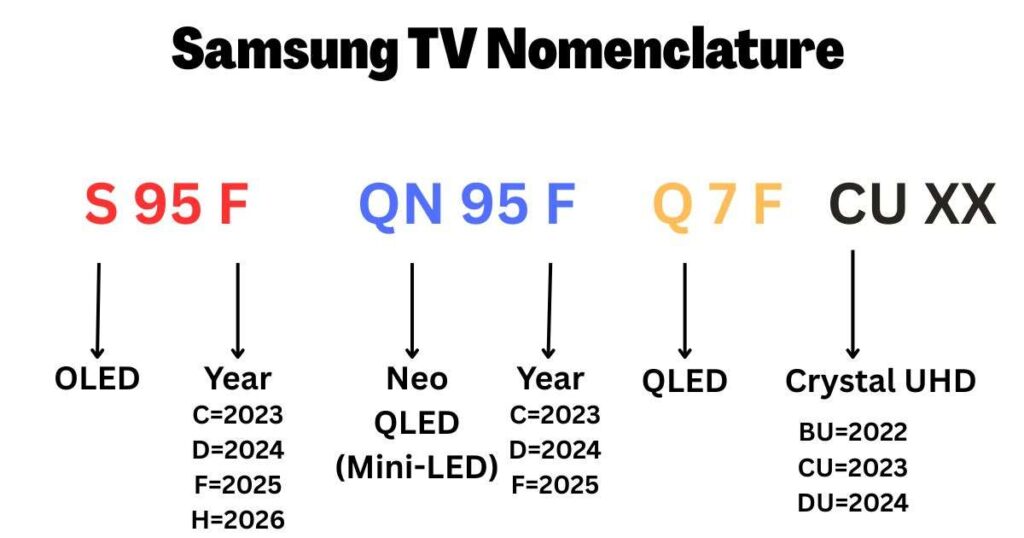
S-series → OLED TVs
S95H > S90H > S85H (higher = better)
QN-series → Mini LED (Neo QLED)
QN80H > QN70H
R-series → Micro RGB (new flagship LCD tech)
F vs H suffix
F = 2025 models
H = 2026 models; and so on.
Understanding the naming helps you quickly identify where a TV sits in the lineup.
Samsung OLED TV Lineup 2026
Samsung’s OLED range in 2026 is more expanded than before, covering multiple price points, from entry-level to flagship.
Flagship OLEDs (Expected)
S99H, S95H
These are Samsung’s top-tier OLED TVs using QD-OLED panels, expected to be launched in 2026.
They are expected to offer the best brightness, color volume, and processing.
The S95H is confirmed as the successor to the S95F, coming with higher brightness and improved AI processing.
The S99H is expected to sit above it as an ultra-premium model.
Mid-range OLED
S90H
This is the sweet spot model which offers the best balance between price and performance.
It is the successor of last year’s most value providing OLED S90F, uses QD-OLED (in most sizes) and now includes glare-free matte coating like flagship OLED models.
Entry level OLED
S85H
This is Samsung’s entry level OLED model. Depending on size/region, it may use QD-OLED or WOLED panels, which is very important to know for a buyer.
It comes more affordable, but has slightly less consistent performance.
After the OLED, let’s proceed to the Samsung LCD TV lineup 2026.
Samsung LCD TV Lineup 2026
Samsung’s LCD lineup is now more complex because it introduces newer next-gen flagship Micro RGB LED TVs.
Flagship LCDs (Expected)
R95H, R85H
These are Micro RGB LED TVs, a new category above mini-LED.
They use separate red, green, and blue LEDs instead of a backlight, improving color and brightness significantly.
These sit above even Neo QLED in performance as well as cost.
Neo QLED (Mini-LED)
QN80H, QN70H
Samsung has slightly repositioned Neo QLED in 2026 as more mid-to-premium instead of ultra-flagship.
Carryover Neo-QLEDs of 2025
QN90F, QN85F, QN80F, QN70F
These are still very relevant in 2026 markets and often have better value due to price drops.
These TVs use VA panels with mini-LED backlighting, offering high brightness and strong contrast.
They show strong HDR performance and great gaming features.
Crystal UHD (CU / DU series)
These use standard LED backlighting (no mini-LED), often paired with VA or IPS panels depending on size and region.
They are decent TVs for budget buyers, but have much lower contrast and brightness than premium TVs like Neo QLED.
Lifestyle TVs (Design-focused)
The Frame (2026), The Frame Pro (Mini-LED but edge-lit)
These TVs focus on aesthetics rather than raw performance. The Frame TV has a unique feature of displaying artworks when not in use. Thus, when off, it looks like an artwork on the wall instead of a big black screen.
However, the HDR brightness and overall features don’t justify its price compared to other similarly priced TVs.
The Frame Pro comes with much improved brightness and is a very good improvement over Frame TV. However, though advertised as a mini-LED TV, it is not that in reality.
It uses mini-LEDs only across the edges, and therefore the black levels on it are no where near to the flagship full array mini-LED backlit LCDs, i.e., Neo QLED TVs.
Samsung TV Lineup 2026 At A Glance
Top-end OLED: S99H, S95H
Mid range OLED: S90H
Entry level OLED: S85H
Next-gen LCD: R95H, R85H (Micro RGB)
Mini-LED LCD: QN80H, QN70H etc.
Budget LCD: QLED & Crystal UHD
Best Samsung TVs of 2026
1. Samsung S95F OLED
Samsung S95F OLED TV is Samsung’s flagship OLED for 2026 and represents the absolute peak of QD-OLED technology. In fact, we have picked it as the best OLED TV of 2026. It delivers fantastic brightness, color accuracy, and reflection handling, making it one of the best TVs you can buy for both dark home theater setups, as well as bright living rooms.
The upgraded QD-OLED panel produces incredibly vibrant colors with much higher luminance than previous generations, ensuring HDR content looks stunningly lifelike. One of the biggest improvements in the S95F is its anti-reflective coating and brightness control. Unlike most glossy OLED TVs, it performs exceptionally well even in rooms with direct sunlight or large windows. Reflections are significantly minimized compared to lower-tier OLED models. This makes it a rare OLED that performs equally well in all lighting conditions.
With support for 4K at 144Hz, HDMI 2.1 on multiple ports, VRR, and extremely low input lag, the S95F OLED is ideal for high-end gaming setups. Motion handling is near perfect, and fast-paced games feel smooth and responsive.
Samsung’s gaming hub and optimization features further enhance the experience. On the smart side, the Tizen OS continues to be fast and feature-rich, offering access to all major streaming platforms. The design is ultra-premium with a slim profile and minimal bezels, making it a centerpiece in any room.
However, like most Samsung TVs, it still lacks Dolby Vision, relying instead on HDR10+. Sound quality is improved compared to previous models, but it still cannot replace a dedicated sound system for a full cinematic experience.
Specifications of the Samsung S95F OLED TV
- OLED panel type: QD-OLED
- Sizes: 55, 65, 77, 83 inches
- Resolution: 4K
- Refresh Rate: 144Hz
- HDR: HDR10, HDR10+, HLG
- Screen finish: Matte
Why should you buy Samsung S95F OLED?
- It delivers the best brightness and color performance in OLED
- Excellent reflection handling for bright rooms
- Top-tier gaming features with 144Hz support
- Perfect contrast and HDR performance
Why should you not buy the Samsung S95F OLED?
- Black levels raise in bright environments
- Very expensive compared to other OLEDs
- No Dolby Vision support
- Audio is good but not class-leading
If you want the absolute flagship OLED with unmatched brightness, anti-glare tech, and elite gaming performance, the Samsung S95F OLED TV is the ultimate choice.
2. Samsung S90F OLED
Samsung S90F OLED TV is one of the best value OLED TVs as it offers a perfect balance of picture quality, gaming and price. Its QD-OLED panel delivers richer colors than traditional WOLED TVs. It also becomes significantly bright in HDR and fights the reflections effectively.
Like the traditional OLEDs, it comes with a glossy screen finish, which very much tries to keep the black levels very deep even in bright rooms. However, in highly rooms with direct sunlight and opened windows, the reflections may become visible on its glossy screen. This is an area where S95F takes much lead and handles the reflections extremely well in every situation. However, S95F comes a lot costlier than S90F. For moderately lit rooms, S90F offers far better value for money.
It also comes with 4K@144Hz gaming support with HDMI 2.1. It shows excellent HDR highlights and contrast. Thus, the S90F OLED TV offers near-flagship picture quality for a much lower price than S95F.
Specifications of the Samsung S90F OLED TV
- OLED panel type: QD-OLED
- Sizes: 42, 48, 55, 65, 77, 83 inches
- Resolution: 4K
- Refresh Rate: 144Hz
- HDR: HDR10, HDR10+, HLG
- Screen finish: Glossy
Why should you buy Samsung S90F OLED?
- It has fantastic color and contrast
- Much cheaper than flagship QD-OLED
- Very good gaming features
- Very good HDR brightness
Why should you not buy the Samsung S90F OLED?
- No Dolby Vision
- Average built-in speaker
- Black levels may be slightly raised in bright environments
If you want premium OLED picture quality with excellent brightness and gaming features at a more accessible price, the Samsung S90F OLED TV is a perfect balance.
3. Samsung S85F OLED
Samsung S85F OLED TV is the entry-level OLED offering from Samsung in 2026, designed for users who want OLED picture quality at a more affordable price point. It uses a QD-OLED panel but is tuned slightly lower than the S90F and S95F, resulting in reduced brightness and slightly less vibrant colors.
However, inspite of being the most affordable OLED in Samsung’s lineup, it still delivers excellent contrast with perfect black levels, making it ideal for movie lovers who watch content in dim or moderately lit rooms. HDR performance is good, though it does not reach the brightness levels of its higher-end siblings, which means highlights may not pop as dramatically.
The S85F also includes solid gaming features such as HDMI 2.1 support, VRR, and low input lag, though it may be limited to 120Hz instead of 144Hz depending on the variant. Motion handling is smooth, making it suitable for both gaming and sports viewing. Reflection handling is average due to its glossy panel, so it performs best in controlled lighting environments. Sound quality of S85F is pretty basic, and users will benefit from pairing it with a soundbar.
Specifications of the Samsung S85F OLED TV
- OLED panel type: QD-OLED
- Sizes: 55, 65, 77 inches
- Resolution: 4K
- Refresh Rate: 120Hz
- HDR: HDR10, HDR10+, HLG
- Screen finish: Glossy
Why should you buy Samsung S85F OLED?
- Affordable entry into OLED technology
- Excellent contrast and black levels
- Good gaming features
- Slim and premium design
Why should you not buy the Samsung S85F OLED?
- Lower brightness than S90F and S95F
- Average reflection handling
- Limited audio performance
If you want an affordable entry into OLED with rich contrast and vibrant colors for everyday entertainment, the Samsung S85F OLED TV is a great option.
4. Samsung QN90F QLED
Samsung QN90F QLED TV is one of the best mini-LED TVs of 2026, which comes with exceptional brightness and performs excellently in bright rooms. It uses Quantum mini-LED backlighting with precise local dimming, allowing it to achieve deep blacks while maintaining very high peak brightness.
This TV is just awesome for daytime viewing, as it can easily overcome glare and reflections. The matte anti-reflective coating is highly effective, making it suitable for rooms with lots of natural light. While it cannot match OLED’s perfect black levels, it comes impressively close for an LED-based TV.
Gaming feels very good on the QN90F QLED TV, with support for 4K at 144Hz, VRR, and low input lag. The TV also includes Samsung’s gaming hub, making it a versatile choice for gamers. Motion handling is sharp and smooth for sports and action content.
Specifications of the Samsung QN90F QLED TV
- Panel type: VA LCD
- Sizes: 50, 55, 65, 75, 85 inches
- Resolution: 4K
- Refresh Rate: 144Hz
- HDR: HDR10, HDR10+, HLG
- Screen finish: Matte
Why should you buy Samsung QN90F QLED?
- Extremely bright and great for bright rooms
- Excellent reflection handling
- Strong gaming performance
- Very good contrast for an LED TV
Why should you not buy the Samsung QN90F QLED?
- Not true OLED black levels
- Slight blooming in dark scenes
- No Dolby Vision
If you want ultra-bright Neo QLED performance with good contrast for gaming and daylight viewing, the Samsung QN90F Neo QLED TV is built to impress you.
5. Samsung QN80F QLED
Samsung QN80F QLED TV is a step below the QN90F, offering mini-LED technology at a more affordable price. It delivers solid brightness and good contrast, making it a great all-rounder for mixed usage.
While its local dimming is less precise than the QN90F, it still performs well for HDR content. Colors are vibrant, and the TV handles motion smoothly, making it suitable for sports and gaming.
Specifications of the Samsung QN80F Neo QLED TV
- Panel type: VA LCD
- Sizes: 50, 55, 65, 75, 85 inches
- Resolution: 4K
- Refresh Rate: 120Hz
- HDR: HDR10, HDR10+, HLG
- Screen finish: Glossy
Why should you buy Samsung QN80F Neo QLED?
- Good balance of price and performance
- Bright and colorful display
- Reliable gaming features
- Suitable for bright rooms
Why should you not buy the Samsung QN80F Neo QLED?
- Less precise dimming than QN90F
- Blooming is noticeable in dark scenes
- Average audio
If you want a powerful Neo QLED experience with strong brightness and smooth motion at a better value, the Samsung QN80F Neo QLED TV is a good pick.
6. Samsung Q7F QLED
The Samsung Q7F QLED TV is positioned as an entry-level QLED option, aimed at users who want a reliable 4K TV without stretching their budget too far. It delivers solid everyday performance, making it a practical choice for general entertainment like TV shows, movies, and streaming content.
The TV uses a VA LED panel, which typically offers better contrast than IPS panels, resulting in reasonably deep blacks. However, since it lacks advanced backlighting technologies like mini-LED or full-array local dimming, its contrast control and brightness levels are limited. This becomes noticeable when watching HDR content, where highlights don’t pop as much and darker scenes can lose detail.
Color reproduction is decent thanks to Samsung’s QLED technology, offering vibrant and pleasing visuals for casual viewing. That said, it doesn’t reach the accuracy or intensity seen in higher-end QLED or OLED models.
For gaming also, the Q7F is fairly basic. The 60Hz refresh rate means it’s fine for casual gamers, but it lacks features like variable refresh rate (VRR) or HDMI 2.1, which are important for modern consoles and high-performance gaming.
Specifications of the Samsung Q7F QLED TV
- Panel type: VA LCD
- Sizes: 43, 50, 55, 65, 75 inches
- Resolution: 4K
- Refresh Rate: 60Hz
- HDR: HDR10, HDR10+, HLG
- Screen finish: Glossy
Why should you buy the Samsung Q7F QLED?
- Affordable entry into QLED technology
- Decent contrast for everyday TV watching
- Pleasant colors for streaming and general use
Why should you not buy the Samsung Q7F QLED?
- Limited brightness affects HDR performance
- No advanced local dimming
- Not suitable for serious gaming
If you want a budget-friendly QLED TV with vivid colors and reliable performance for normal usage, the Samsung Q7F QLED TV gets the job perfectly done.
7. Samsung The Frame LS03F
Samsung The Frame LS03F TV is less about raw performance and more about aesthetics and lifestyle integration. Designed to blend seamlessly into your home décor, it transforms into a digital art display when not in use, making it one of the most unique TVs on the market.
Its standout feature is the matte display, which significantly reduces glare and reflections. This gives the screen a canvas-like look, especially when displaying artwork in Art Mode. Combined with customizable bezels, it can convincingly resemble a framed painting on your wall.
In terms of picture quality, the TV performs adequately but doesn’t excel. It uses a QLED panel that delivers decent brightness and color, but it lacks the contrast and precision found in premium models like mini-LED TVs. The matte coating, while excellent for reducing reflections, slightly softens image sharpness and reduces perceived contrast.
Like the Q7F, it has a 60Hz refresh rate, making it fine for casual viewing but not ideal for gaming enthusiasts. It also lacks advanced gaming features, which limits its appeal for console or PC gamers.
Specifications of Samsung The Frame LS03F TV
- Panel type: VA LCD
- Sizes: 32, 43, 50, 55, 65, 75, 85 inches
- Resolution: 4K
- Refresh Rate: 60Hz
- HDR: HDR10, HDR10+, HLG
- Screen finish: Matte
Why should you buy the Samsung The Frame LS03F?
- Elegant, art-inspired design
- Matte anti-glare screen enhances visibility
- Unique Art Mode for displaying artwork
Why should you not buy the Samsung The Frame LS03F?
- Picture quality is only average for the price
- Expensive compared to similarly performing TVs
- Not designed for gaming or high-performance use
If you want a TV that appears as stunning wall art with customizable frames and a matte display, Samsung The Frame LS03F is made for your space.
8. Samsung The Terrace
Samsung The Terrace TV is a specialized TV built for outdoor environments, making it a standout option for patios, balconies, and gardens. Unlike regular TVs, it is engineered to handle exposure to sunlight, dust, and varying weather conditions. Its most impressive feature is its extremely high brightness level, which ensures the screen remains visible even under direct sunlight.
This is paired with an anti-reflective coating that minimizes glare, making outdoor viewing comfortable throughout the day. The build quality is rugged and weather-resistant, typically rated for protection against water and dust. This durability is what sets it apart from standard indoor TVs, allowing it to function reliably in outdoor setups.
Performance-wise, it includes a 120Hz refresh rate, which is better than the other two models and allows smoother motion, especially for sports and gaming. However, despite its strong performance, the primary value lies in its outdoor capability rather than raw picture quality.
But, the biggest drawback is its price. The Terrace is significantly more expensive than most indoor TVs, and for that cost, you could get a much higher-performing display—if outdoor use isn’t required.
Specifications of Samsung The Terrace TV
- Panel type: VA LCD
- Sizes: 55, 65, 75 inches
- Resolution: 4K
- Refresh Rate: 120Hz
- HDR: HDR10, HDR10+, HLG
- Screen finish: Anti-reflective (outdoor optimized)
Why should you buy the Samsung The Terrace?
- Specifically designed for outdoor environments
- Extremely high brightness for daylight viewing
- Durable, weather-resistant construction
Why should you not buy the Samsung The Terrace?
- Very expensive compared to indoor TVs
- Overkill for general home use
- Better-value options exist for indoor viewing
If you want a weatherproof outdoor TV with high brightness for patios and open-air entertainment, Samsung The Terrace is built to shine outside.