
Which QLED TV performs best in a bright room?
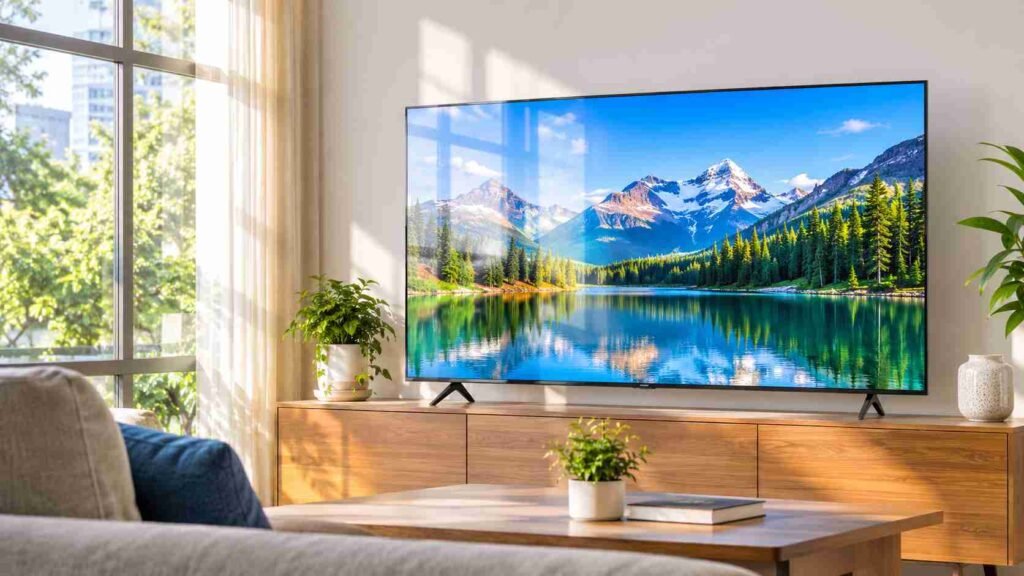
Watching TV in a bright room can be more or less challenging when sunlight enters through large windows or strong indoor lighting reflects off the screen.
Even a TV with good picture quality can look washed out when its brightness is insufficient to compete with ambient light.
QLED TVs are particularly well suited to bright rooms because of their high peak brightness, though choosing the best model involves more than simply looking at its advertised brightness.
Modern QLED TVs, particularly those equipped with mini-LED backlighting, can produce exceptionally bright images while simultaneously maintaining good contrast.
However, their ability to handle reflections varies considerably.
Some models prioritise the peak brightness, while others use specialised anti-reflective coatings to improve daytime visibility.
Affiliate Disclosure: DisplayReviewz participates in the Amazon Associates Program. As an Amazon Associate I earn from qualifying purchases. If you buy a product through affiliate links in this article, we may earn a commission at no additional cost to you.
Which QLED TV performs best in a bright room?
| QLED TV | Best suited for | Main advantage |
|---|---|---|
| TCL X11L | Extremely bright rooms | Exceptional brightness and local dimming |
| Samsung QN90F | Rooms with windows and reflections | Glare Free screen |
| Hisense U7SG | Daytime viewing with direct reflections | Matte anti-reflective coating |
1. TCL X11L [Best for exceptional brightness]
The TCL X11L is a flagship QD-Mini LED TV with exceptionally high peak brightness, strong local dimming and vibrant quantum dot colours.
Its VA LCD panel produces deep blacks, while its 144Hz refresh rate, four HDMI 2.1 ports and Google TV interface make it much suitable for gaming and streaming.
Although the TCL X11L features a glossy screen, which can produce noticeable reflections, its exceptional brightness is more than sufficient to overcome glare, even in extremely bright rooms.
Its screen coating also reduces the intensity of direct reflections, although it does not eliminate them.
Choose the TCL X11L if you want spectacular HDR impact, class-leading brightness, and exceptional picture visibility, even in rooms flooded with ambient light.
2. Samsung QN90F [Best Samsung QLED for bright rooms]
The Samsung QN90F Neo QLED combines mini-LED backlighting with Samsung’s Glare Free screen technology.
Its high SDR brightness helps maintain picture visibility during daytime viewing, while its matte anti-reflective coating significantly reduces distracting reflections.
It also offers excellent local dimming, a native refresh rate of up to 165Hz and four HDMI 2.1 ports.
However, its limitation is the absence of Dolby Vision HDR format support, although it supports HDR10 and HDR10+.
Choose the Samsung QN90F if you want excellent reflection control, vibrant picture quality, and consistently clear images in brightly lit living rooms with windows or overhead lighting.
3. Hisense U7SG [Best mid-Range QLED for anti-glare performance]
The Hisense U7SG is a 2026 mini-LED QLED TV with a matte anti-reflective screen, high SDR brightness and effective local dimming.
Its matte screen coating significantly reduces direct reflections, making daytime viewing easier even when bright windows face the TV.
It also supports Dolby Vision, HDR10+, 4K at 165Hz and four HDMI 2.1 connections.
Although it does not reach the TCL X11L’s exceptional brightness levels, it strikes an excellent balance between reflection handling and picture quality.
Buy it if you want an excellent balance of reflection control, great picture quality, and bright-room performance without prioritising extreme peak brightness.
That said, some larger U7SG screen sizes feature a glossy finish instead of a matte screen, so check the display coating of the specific size before purchasing.
Are QLED TVs good for direct sunlight?
QLED TVs can perform well in sunlit rooms as many of them offer high brightness and vibrant colours.
The LED backlight allows them to produce high brightness so that the displayed image remains visible when ambient light enters the room.
That said, a QLED TV is not necessarily suitable for direct sunlight simply because it is bright.
When sunlight falls directly on the screen, reflected light can reduce perceived contrast and make dark details difficult to distinguish.
Even a TV producing more than 2,000 nits may fail to completely eliminate strong reflections.
Here, the type of screen coating makes a big difference.
For instance, a matte anti-reflective display can diffuse direct reflections and make them less distracting.
It is important to distinguish between a brightly lit room and one where direct sunlight falls on the TV screen, as these present two different challenges.
A TV may handle strong ambient light effectively but still struggle with direct sunlight, which can cause glare, reflections and reduced screen visibility.
Additionally, you should also try to avoid prolonged exposure to direct sunlight, as excessive heat may cause damage to the display and its internal components.
Is QLED better than OLED for bright rooms?
QLED TVs typically have an advantage in bright-room viewing, particularly when comparing high-end mini-LED models with conventional OLED TVs.
Their powerful LED backlights can produce high brightness across larger portions of the screen, helping maintain visibility when watching sports, news and other bright content during the day.
Nevertheless, it is no longer accurate to claim that every QLED is brighter than every OLED.
Premium OLED models have made substantial improvements in brightness, and some offer excellent reflection handling.
For example, the Samsung S95F is our top pick among the best OLED TVs for handling reflections.
It features a matte anti-glare display that effectively reduces reflections while delivering some of the highest brightness levels available on an OLED TV.
If you want the brightest and most vibrant OLED, which is great for gaming and bright living rooms, the Samsung S95F OLED TV is just for you.


However, it is also worth knowing that OLED TVs with matte coating typically lose some of their perceived black depth when ambient light reflects off the screen, even though their pixels can switch off completely.
While, high-end mini-LED QLED models mostly maintain better perceived contrast in a brightly illuminated room.
Which QLED TV has the highest brightness?
The TCL X11L is one of the brightest QLED televisions available in 2026.
RTINGS describes it as one of the brightest TVs it has ever tested, with exceptional HDR highlight brightness and excellent real-scene brightness.
In RTINGS’ tests, the TCL X11L reached approximately 2,470 nits in HDR real-scene measurements using its Brightness Priority setting and Peak Brightness set to High, which demonstrates its exceptional ability to produce intense HDR highlights.
The Hisense U7SG also delivers strong brightness, although it sits below the TCL X11L.
Samsung’s QN90F is another powerful option, particularly when its high SDR brightness is considered alongside its reflection handling.
That being said, when comparing the brightest QLED TVs, look beyond a single peak-brightness figure.
A TV that produces 2,000 nits in a small HDR highlight might not maintain the same luminance when displaying an entire bright scene.
Is mini-LED better than QLED for bright rooms?
First of all, mini-LED and QLED are not competing display technologies.
QLED refers to the use of a quantum dot layer that improves colour performance, while mini-LED describes the backlighting system.
A TV can use both technologies, which is why many premium models are marketed as QD-Mini LED or mini-LED QLED.
Mini-LED uses much smaller backlight LEDs than conventional LED TV.
This allows manufacturers to incorporate more dimming zones and control brightness more precisely across different areas of the screen.
Therefore, in a bright room, while quantum dot layer helps produce vibrant colours at high brightness, the mini-LED backlight provides the luminance needed to maintain picture visibility and the local dimming needed to improve contrast.
However, not every QLED uses mini-LED.
Many entry-level QLED TVs use conventional LED backlighting and lack the brightness and local dimming capabilities of premium mini-LED models.
The TCL X11L, Samsung QN90F and Hisense U7SG combine quantum dot technology with mini-LED backlighting.
This makes them much more compelling choices for demanding bright-room environments than many basic QLED TVs.
Does an anti-glare screen improve daytime viewing?
A TV screen reflects some of the light that falls on it. These reflections can obscure picture details, reduce perceived contrast and make dark scenes appear washed out.
Anti-reflective coatings are designed to reduce the intensity or visibility of this reflected light.
Samsung’s Glare Free technology and the matte anti-reflective coating on the Hisense U7SG are two examples.
This is why the Hisense U7SG can be a better choice than a brighter glossy TV in bright rooms.
Its matte finish reduces the visibility of direct reflections, while its high SDR brightness helps maintain picture visibility.
Nevertheless, anti-glare technology may have some trade-offs.
The matte coatings typically scatter light across the display, which makes dark areas appear less deep or giving the picture a slightly hazy appearance.
The quality of the coating and the television’s underlying contrast performance both matter.
Is a matte screen better than a glossy screen?
A matte screen is generally better at reducing the visibility of direct reflections, whereas a glossy screen can preserve a cleaner-looking image with deeper perceived blacks.
A matte finish scatters reflected light across a wider area instead of allowing it to appear as a sharply defined mirror image.
This can be helpful when windows, lamps or other bright objects are directly opposite the TV.
Contrary to this, a glossy screen reflects light more directly, so bright objects can appear as noticeable mirror-like reflections.
However, it can retain more perceived image depth because reflections are not spread as widely across dark areas.
RTINGS explains this trade-off in its testing of direct reflections on televisions.
Its research shows why neither screen finish is universally superior: the better choice depends on the room’s lighting and the display’s coating.
For a room with large windows facing the screen, a TV like the matte Hisense U7SG or Samsung QN90F can be a much better choice.
However, in a room with controlled lighting where reflections are less troublesome, the glossy TCL X11L can deliver an excellent viewing experience.
Can sunlight wash out a QLED TV?
Yes. Sunlight can wash out a QLED TV by increasing the amount of reflected light reaching the viewer.
This reduces the perceived difference between bright and dark areas, making the picture look less contrasty.
The effect is particularly noticeable when sunlight falls directly onto the screen or when a bright window is reflected in its surface.
Dark scenes are often affected more visibly because reflected light can make black areas appear grey.
A high-brightness QLED can help overcome some of this effect, but brightness alone cannot eliminate reflections.
Here, a matte anti-reflective coating can make a significant difference by reducing the visibility of direct light sources.
Is Neo QLED better than regular QLED for bright rooms?
Neo QLED is Samsung’s branding for its QLED TVs that use mini-LED backlighting.
The mini-LED backlight allows for more precise local dimming and can deliver higher brightness than many conventional LED-backlit QLED models.
This can significantly improve HDR highlights, daytime visibility and contrast.
That said, Neo QLED does not automatically mean better reflection handling. The screen coating still matters.
For example, the Samsung QN90F combines Neo QLED technology with Samsung’s Glare Free screen technology, which makes it very effective at reducing distracting reflections in brightly lit rooms.
What is the best TV for a room with large windows?
For a living room with large windows, the Samsung QN90F and Hisense U7SG are particularly strong QLED choices as their matte or anti-reflective screens reduce distracting reflections.
You can choose Samsung QN90F if you want a premium TV with high brightness, mini-LED local dimming and Samsung’s Glare Free technology.
The Hisense U7SG is an attractive alternative if you want strong reflection handling at a more accessible product tier.
The TCL X11L can be a good option when maximum brightness is the priority, although its glossy screen makes it less specialised for direct window reflections.
That said, your windows are positioned behind the seating area rather than directly opposite the screen, the difference between matte and glossy finishes may be less important.
In that situation, the TCL’s exceptional brightness and HDR performance can make it a very appealing choice.
Final Verdict: Which QLED is best for a bright room?
The TCL X11L is the clear choice if you want the highest brightness and most impressive HDR impact.
Its advanced QD-Mini LED backlight delivers exceptional peak brightness, making it particularly effective at maintaining picture visibility in very bright rooms.
However, its glossy screen is more susceptible to direct reflections.
If your TV faces windows or sits in a room with strong overhead lighting, choose the Samsung QN90F or Hisense U7SG instead.
Both combine high brightness and mini-LED local dimming with anti-reflective screen technology.
The QN90F stands out with Samsung’s Glare Free coating, while the U7SG offers a matte screen on selected sizes.
Our recommendation: Go for the TCL X11L if maximum brightness and HDR performance matter the most for you. Choose the Samsung QN90F for its combination of strong picture quality and effective reflection control, or the Hisense U7SG if you want similar bright-room advantages at a more accessible price.