
Does an OLED TV Get Glare? [Reflections, Finishes & Real-World Viewing]

Walk into any living room during the day and you’ll quickly notice something-your TV isn’t just showing a movie, it’s also showing your windows, lamps, and sometimes even your own reflection.
If you’re considering an OLED TV, you might be wondering: do these premium displays handle glare any better, or are they just as reflective as traditional screens?
The answer isn’t as simple as yes or no.
OLED TVs are known for stunning contrast and deep blacks, but their performance in bright rooms depends heavily on screen coatings and finish types.
Let’s explore how glare works on OLED TVs and what you can realistically expect.
Are OLED TVs Really Anti-Glare? The Truth Behind The Marketing
OLED TVs are often marketed with terms like “anti-glare” or “anti-reflection,” but these phrases can be misleading if taken at face value.
OLED panels themselves don’t inherently eliminate glare. Instead, manufacturers apply coatings to the screen surface to reduce reflections.
This means glare handling varies significantly from one model to another.
Unlike older LED LCD TVs that sometimes used aggressive matte coatings, most OLED TVs prioritize image quality first.
Since OLED technology excels at producing perfect blacks and infinite contrast, manufacturers are careful not to compromise these strengths.
As a result, many OLED screens use advanced anti-reflective coatings rather than fully matte finishes.
These coatings work by minimizing the intensity of reflections rather than eliminating them entirely.
In practical terms, you may still see reflections in a bright room, but they’ll appear dimmer and less distracting.
High-end OLED models from brands like Samsung and LG have improved significantly in this area, especially with newer coatings designed for well-lit environments.
So, while OLED TVs are not completely glare-proof, modern models are much better at handling reflections than earlier generations.
So, the key takeaway is that “anti-glare” doesn’t mean “no glare”—it means “reduced and controlled glare.
Matte Magic: How Diffused Coatings Tame Reflections
Matte coatings on OLED TVs take a different approach to handling glare.
Instead of reflecting light directly back at your eyes, these coatings scatter incoming light in multiple directions.
This process, known as diffusion, reduces the intensity of visible reflections.
Imagine sunlight hitting a glossy mirror versus a frosted glass surface.
The mirror creates a sharp, clear reflection, while the frosted glass spreads the light into a soft glow.
Matte OLED screens work similarly. They don’t eliminate reflections but make them less defined and less distracting.
A good example of this can be seen in newer OLED models that incorporate “glare-free” technology.
These screens perform exceptionally well in bright rooms by diffusing harsh light sources such as windows or overhead lighting.
Instead of seeing a clear reflection of your surroundings, you’ll notice a faint haze.This makes matte OLED TVs particularly useful in rooms with uncontrolled lighting.
If your TV is placed opposite a large window or in a sunlit living space, a matte finish can significantly improve viewing comfort.
However, this benefit comes with a trade-off, which we’ll explore next.
Glossy Screens: Mirror-Like Reflections but Stunning Clarity
Glossy OLED screens take the opposite approach. Instead of diffusing light, they aim to preserve image clarity by allowing reflections to remain sharp but less intrusive through anti-reflective treatments.
Most traditional OLED TVs use glossy finishes because they prioritize contrast and color vibrancy.
When you’re watching content in a dim or dark room, glossy screens truly shine. Blacks appear deeper and colors truly pop.
However, in bright environments, glossy screens can act like mirrors. You might clearly see reflections of lamps, windows, or even people moving in the room.
That said, high-end OLED models mitigate this with advanced coatings that reduce the brightness of reflections, but they can’t eliminate them entirely.
Glossy OLEDs perform well in moderately lit rooms but struggle when direct light hit the screen.
You might notice a reflection of a window during daytime viewing, especially in darker scenes.
But many users still prefer glossy finishes because they deliver the best picture quality when lighting conditions are controlled.
If you primarily watch TV at night or can manage your room lighting, glossy OLEDs remain an excellent choice.
Does Matte Kill Contrast? Understanding Light Diffusion
One of the biggest concerns with matte OLED screens is whether they reduce contrast—and the answer is yes, to some extent.
Matte coatings work by diffusing light, but this diffusion doesn’t only affect external light sources.
It can also slightly scatter the light emitted by the OLED pixels themselves.
As a result, the deep, inky blacks that OLED is famous for may appear a bit less intense compared to a glossy screen.
This doesn’t mean matte OLEDs look bad. In fact, they still outperform the best of the mini-LED TVs in contrast.
However, when placed side by side with a glossy OLED in a dark room, you may notice that the glossy version looks more punchy and vivid.
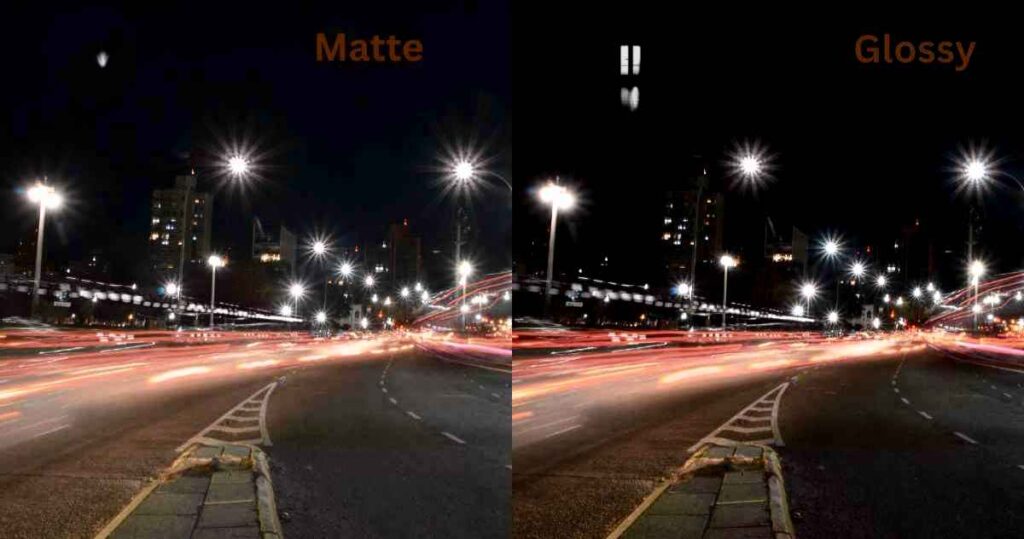
That said, the trade-off becomes more acceptable in bright environments.
In a sunlit room, the improved glare handling of a matte screen often outweighs the slight loss in contrast.
After all, what’s the point of perfect blacks if you just can’t see them due to reflections?
In simple terms, matte coatings sacrifice a small amount of image purity to improve visibility in challenging lighting conditions.
Whether this trade-off is worth it depends on your viewing environment.
Matte vs Glossy: What Works Best for Your Room?
Choosing between matte and glossy OLED screens depends much on where and how you watch TV.
In bright rooms with lots of natural light, matte screens have a clear advantage. They reduce harsh reflections and make it easier to see the image during the day.
If your TV is placed opposite windows or in a well-lit living room, a matte OLED will provide a more comfortable viewing experience.
In moderately lit rooms, however, the difference becomes less pronounced.
Glossy OLEDs with good anti-reflective coatings can perform very well, especially if light sources aren’t directly hitting the screen. In this scenario, you get the best of both worlds: strong contrast and manageable reflections.

That said, it also depends on the actual scenes. If the scene demand diffused lighting with not so deep blacks, and the reflecting sources are absent, both matte and glossy OLEDs perform nearly equally.
While in dark rooms, glossy screens are the clear winner.
With minimal ambient light, reflections are no longer an issue, and the superior contrast and clarity of a glossy finish become fully apparent.
This is why home theater enthusiasts often prefer glossy OLED TVs.
In a nutshell, matte is better for daytime viewing and uncontrolled lighting, while glossy excels in controlled or dark environments.
Top Anti-Glare OLED TVs
Samsung S95F OLED: Glare-Free Innovation in Action
The Samsung S95F OLED TV stands out for its advanced glare-free technology, which uses a matte coating to significantly reduce reflections. It performs exceptionally well in bright rooms, diffusing light sources such as windows and lamps into soft, barely noticeable patches. This makes it ideal for daytime viewing without the need to draw curtains. While there is a slight reduction in perceived contrast compared to glossy screens, the overall viewing experience remains impressive.
The S95F is particularly suited for users who prioritize visibility in well-lit spaces over absolute picture purity. That said, some users may experience reduced eye fatigue while viewing the TV in highly bright rooms with slightly raised black levels.
LG G5 OLED: Glossy Excellence with Smart Coating
The LG G5 OLED TV continues LG’s tradition of using glossy panels enhanced with advanced anti-reflective coatings. Instead of diffusing reflections, it minimizes their brightness and visibility while preserving excellent contrast and color accuracy. In dim and dark environments, the G5 delivers outstanding picture quality with deep blacks and vibrant colors.
In brighter rooms, reflections can still be noticeable, especially from direct light sources, but they are less distracting than on older models. This TV is best suited for users who value top-tier image quality and can control their viewing environment.
Final Thoughts: Should You Worry About Glare on OLED TVs?
OLED TVs do get glare, but how much it affects you depends on the screen finish and your room lighting.
Matte coatings reduce reflections by diffusing light, making them ideal for bright spaces, while glossy finishes deliver superior contrast and clarity in darker environments.
Modern OLEDs have made significant strides in reflection handling, so even glossy models are more usable in bright rooms than before.
In summary, if you watch a lot of TV during the day in a bright room, go for an OLED with strong anti-glare features.
However, if you are a nighttime viewer or have a dedicated home theater setup, a glossy OLED will give you the best picture quality.
Pingback: MLA vs WOLED: What is Micro-Lens Array and how does it work?
Pingback: QLED vs NanoCell: What's the difference and which TV to buy?